
Data Governance Framework: Components + 8 Steps to Implement

Data Governance Framework: Components + 8 Steps to Implement

Feb 4, 2026

Maarten Masschelein

Maarten Masschelein

Maarten Masschelein

CEO and Founder at Soda

CEO and Founder at Soda

CEO and Founder at Soda

Table of Contents

Most data governance programs fail for a simple reason.
They stop at policy.

You get a slide deck that defines principles, a few committees, a shiny catalog, and maybe a new approval workflow. But no one can show that the rules are actually followed in production data. There is no loop that connects policy, enforcement, and learning.

This guide is for teams that want a data governance framework that lives in everyday work. One that makes data more trustworthy, not just more documented.

We will cover:

  • What a data governance framework is and is not

  • The core components every practical framework needs

  • An 8 step implementation plan you can copy

  • How to operationalise governance with real checks and alerts

  • A simple maturity model and KPI starter set

  • How Soda.io puts this into practice

What a data governance framework is (and is not)

A data governance framework is the operating model for how your company manages, secures, and uses data. It defines the roles, decision rights, policies, processes, and data governance tools that keep data accurate, safe, and aligned with business goals.

Simply put:

A data governance framework is how you decide who owns which data, what “good” looks like, how you keep it that way, and how you prove it.

Governance is more than a catalog

A data catalog or data governance solution is important. It helps people find data and understand definitions. But a catalog without clear ownership, decision rights, and checks in production is just a better organized library.

Your framework should answer questions like:

  • Who can approve a change to a key metric or field

  • Which policies apply to customer data in a specific domain

  • How issues are raised, triaged, and fixed

  • How you know if governance is working

Governance is not a one-time project

Many teams treat governance as a program that runs for a year, delivers some artefacts, and dissolves.

Real governance behaves more like product management. You start small, ship something that works, measure usage and impact, and iterate.

This is why you will see a maturity model and KPIs later in this guide. They keep you honest about progress.

Governance and data quality go together

Governance and data quality sit in a loop. Governance defines the rules and ownership. Data quality measures whether those rules hold in real data.

If you are still deciding which to start with, this article on data quality vs data governance explains why you usually need both in parallel.

Core components of a practical governance framework

Before you launch, create a components map of your data governance framework. Think of it as the blueprint that connects people, rules, and technology.

Here are the components to include.

1. Decision rights

Clarify who can approve which decisions about data. For example:

  • Who approves the creation of a new certified dataset

  • Who signs off on a data retention policy

  • Who can deprecate a widely used KPI

Keep it simple. Use a short list of decision types and assign them to roles, not individuals, so you can adapt as people change.

2. Roles: owners, stewards, custodians

Define a small set of roles that appear across domains:

Data owner

  • Accountable for business use of the data

  • Decides what “good enough” looks like

  • Escalation point for risk and exceptions

Data steward

  • Manages definitions, policies, and access within a domain

  • Coordinates with engineers on implementation

Data custodian

  • Usually an engineering or platform role

  • Implements controls, tests, and monitoring in tools and pipelines

These roles will show up again when we build the RACI matrix in the implementation steps.

3. Policies and standards

Policies and standards turn vague principles into rules. Start with three families.

Definitions

  • Business terms, KPIs, and critical fields

  • Rules for how they are calculated

Access and retention

  • Who can see what

  • How long you keep different data classes

Quality thresholds

  • Minimum requirements for completeness, accuracy, timeliness, and other dimensions

  • The conditions under which data is “certified” or blocked

Keep policies short and specific. A good policy is easy to turn into an automated check.

4. Processes

Processes tell people what to do when something changes or breaks. At minimum, define:

Change management

  • How you propose, review, and approve schema or metric changes

  • Impact analysis before a breaking change ships

Issue management

  • How users raise data incidents

  • How you prioritise and assign them

Escalation paths

  • When an issue affects compliance or revenue, who gets the call

  • How you communicate with leadership

These processes can be light at first. The important part is that people know which path to follow.

5. Technology

Most teams already have some data governance tools in place, such as a warehouse, a catalog, a ticketing system, and maybe a lineage tool. The framework connects them.

For a modern stack, you typically need:

  • A data catalog or governance solution to store definitions, ownership, and policies

  • Data lineage to understand how changes and issues flow across systems. If you want a primer, use this guide to data lineage for governance

  • Access controls at the warehouse and analytics layer

  • Quality enforcement tools that can express policies as checks and run them continuously, not only in ad hoc investigations

What’s really good? Governance teams can define policies in catalog tools, then execute them as automated checks in Soda, which turns documentation into actionable validation and alerts.

6. Metrics

Finally, decide how you will measure governance itself. A framework is only working if you can show improvements in:

  • Adoption of governed data

  • Trust in key datasets

  • Speed and safety of changes

We will cover specific KPIs later. For now, just note that metrics belong in the framework from day one, not as an afterthought.

The 8-step implementation plan

You do not need a huge team to get started. You do need a clear sequence.

Here is an 8-step plan you can copy and adapt.

Step 1. Define outcomes

Start with three to five outcomes that matter to leadership. Examples:

  • Reduce regulatory or privacy risk

  • Increase trust in metrics for board-level reporting

  • Shorten the time it takes to onboard new analysts or data products

Write each outcome in a one-line format:

Because we govern data better, we will achieve X for Y audience, measured by Z.

These outcomes will shape your policies, KPIs, and roadmap.

Step 2. Scope domains and Tier 1 data products

Do not try to govern everything. Pick domains and Tier 1 data products.

  • A domain is a business area such as Sales, Finance, Risk, or Product Analytics.

  • A Tier 1 data product is any dataset or report that, if wrong, hurts customers, revenue, or compliance.

Select one or two domains and a short list of Tier 1 products inside them. Everything in this guide can be piloted there first.

Step 3. Establish governance bodies

You now need a lightweight structure of committees or forums. Typical examples:

Enterprise Data Council

  • Meets monthly

  • Sets overall priorities and approves cross domain policies

  • Includes a C level sponsor, domain owners, and platform leadership

Domain governance groups

  • Meet weekly or every two weeks

  • Review issues and proposed changes within a domain

  • Own the backlog of governance work

Keep meetings short and focused on decisions, not status updates. Use written proposals for policy or ownership changes so decisions are traceable.

Step 4. Assign roles and RACI

For each Tier 1 data product, assign clear roles. Then document them in a simple RACI matrix.

Responsible

  • Usually data engineers or analytics engineers

  • Build and maintain the pipelines or models

Accountable

  • Data owner for the domain

  • Final sign off on business meaning and quality thresholds

Consulted

  • Stewards, security, risk, or compliance stakeholders

Informed

  • Downstream data consumers

You can design RACI matrices at the activity level, not only by dataset. For example, “approve new access”, “accept a schema change”, or “define retention period”. That approach keeps responsibilities very concrete.
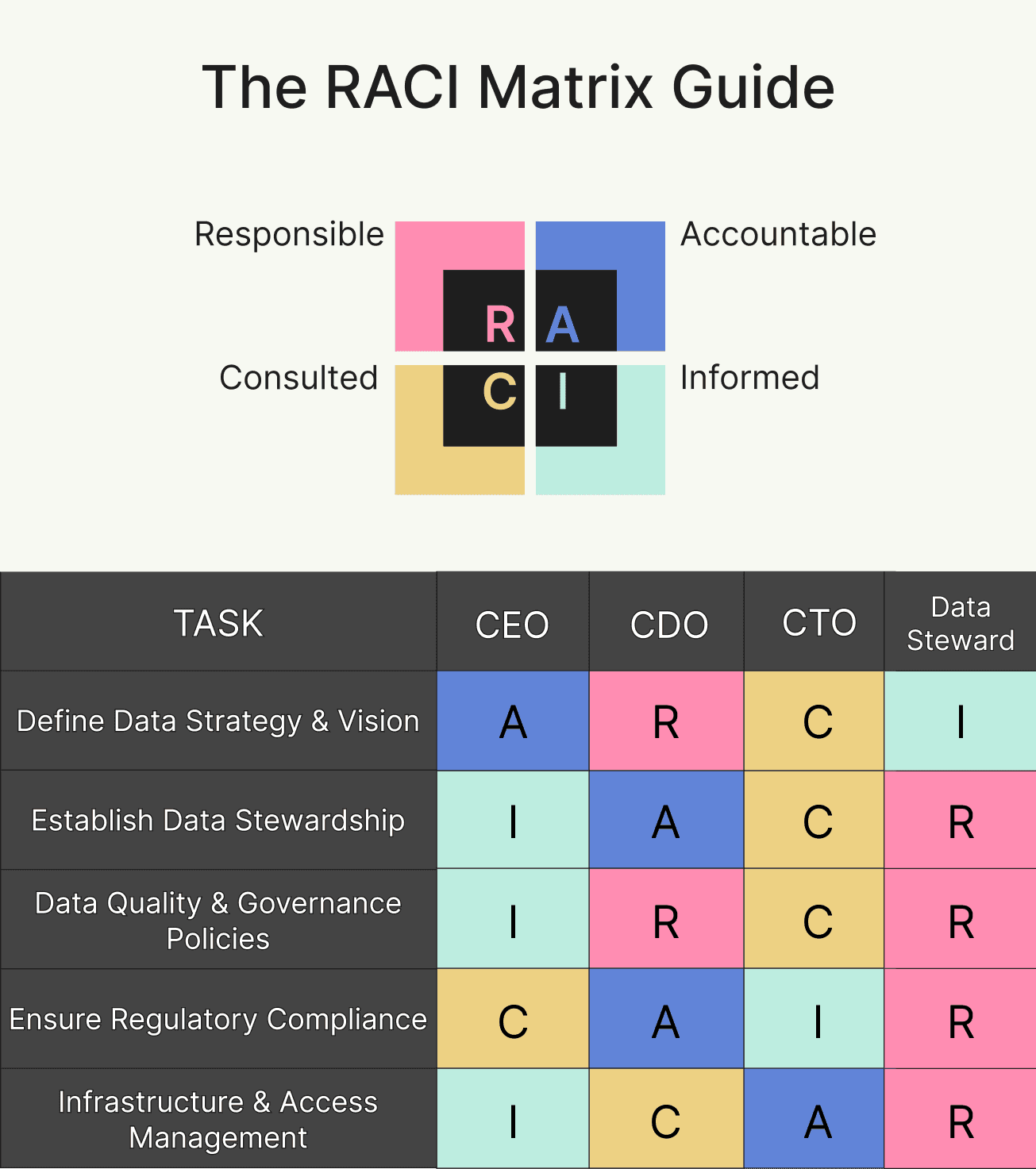
raci-matrix

Step 5. Define policies and standards

Now pick an initial set of policies. Resist the urge to write a full playbook. Start with three policy families and a handful of specific statements in each.

  1. Definitions

    • Example: “There is one certified definition of active customer, owned by the Sales data owner. Any change to this definition requires sign off from Finance and Product owners.”

  2. Access

    • Example: “Only customer success and support roles can see full customer contact details. All others see masked values in analytics datasets.”

  3. Quality

    • Example: “For the Tier 1 Revenue Reporting dataset, daily completeness must be at least 99.5 percent, and any deviation triggers a P1 incident.”

Keep policies in the same place as your metadata, ideally in your catalog or governance solution, not in a separate document repository.

Step 6. Implement metadata and lineage

To govern anything, you need to see it. That visibility starts with metadata and lineage.

Focus on:

Ownership and documentation in the catalog

  • Every Tier 1 dataset should have an owner, steward, purpose, and contact channel.

Technical lineage

  • Connect tables, pipelines, and BI dashboards so you can answer “What breaks if we change this field” in minutes.

Business lineage

  • Link data to processes, regulations, and reports. For example, “This table is the source for our regulatory capital calculation.”

If you are new to lineage, share a simple primer like data lineage for governance with teams so you have a shared language.

Step 7. Operationalize quality enforcement

This is the step many teams skip. They define policies but never translate them into checks that run against real data.

You need a repeatable loop:

  1. Policy

    • Example: “Customer records for EU residents must not include unencrypted national identifiers.”

  2. Contract or rule

    • Express this as a data contract or quality rule in your catalog or governance solution.

  3. Check

    • Implement the rule as an automated test in a tool such as Soda. For instance, “no values in column X may match pattern Y”.

  4. Alert

    • Configure alerts to route incidents to the right channel, mapped to the RACI assignments.

  5. Remediation

    • Define playbooks for common failures. Some can be automated, others may require a human decision.

This is also a good moment to explore dedicated data governance tools and data governance solutions that make policy execution easier. Many teams integrate catalog platforms like Collibra with Soda so governance rules flow directly into executable checks and monitoring. You can see an example of this in how teams operationalize governance with enforcement.

Step 8. Measure and iterate

Finally, build a small governance scorecard. Track it every month and review it with your data council.

You can use the KPI starter set below, grouped into:

  • Adoption

  • Trust

  • Change and risk

Use the scorecard to drive decisions on staffing, new data governance tools, and policy changes. When you add a new domain, use the same scorecard so results stay comparable.

How to operationalise governance in real stacks

Most governance programs stall between steps 5 and 7. Policies exist, but they sit in documents. Engineers and analysts keep working in their own tools, and data issues are still discovered by angry dashboard users.

To avoid that gap, treat enforcement as a shared workflow between governance and engineering.

A simple example loop:

  1. Governance team defines a quality rule in the catalog.

  2. The rule is synced to Soda as a check in a Data Contract for a given table or column.

  3. Soda runs checks as part of pipelines or continuous monitoring.

  4. If a check fails, Soda raises an alert in the team’s incident channel.

  5. The owner and responsible engineer triage, fix, and document the outcome in the catalog.

Over time, this loop gives you something that policy documents never can: evidence. You can show which policies are enforced, where they fail, and how quickly you respond. That is the difference between “we have a policy” and “we run a governed data platform”.

A simple data governance maturity model

Use this lightweight maturity model to explain progress to non technical leaders.

Level

Name

What it looks like

0

Ad hoc

Data issues handled case by case. No shared definitions, ownership, or processes.

1

Policy aware

Some policies and a catalog exist, but enforcement is manual and inconsistent.

2

Connected

Domains, owners, and councils are in place. Key datasets have checks and alerts.

3

Operational and automated

Policies, lineage, quality checks, and access controls are integrated in tools.

Most organisations move from level 0 to level 2 in their first one to two years. Level 3 is an ongoing journey, not a project milestone.

KPIs to prove governance is working

You cannot manage what you never measure. Here is a starter set of governance KPIs you can track from day one.

Adoption KPIs

  • Catalog usage: Number of monthly active users in the catalog or governance portal

  • Certified dataset coverage: Percentage of key reports that are built on certified datasets

  • Owner coverage: Percentage of Tier 1 datasets with an assigned owner and steward

Trust KPIs

  • Data incident rate: Number of high-impact data incidents per month or quarter

  • Mean time to resolve (MTTR): Average time from detection to resolution for data incidents

  • Policy compliance rate: Percentage of automated checks that pass for Tier 1 datasets

Change and risk KPIs

  • Breaking change rate: Percentage of schema or metric changes that cause downstream issues

  • Change lead time: Average time to move a governed change from proposal to production

  • Contract compliance: Percentage of data contracts with all required checks implemented

Start small. Pick two adoption metrics, two trust metrics, and one change metric. Put them on a simple dashboard. Use that dashboard in every governance council meeting.

How Soda does it

Soda sits in the middle of this framework. It connects the world of policies and ownership with the world of pipelines, tables, and dashboards. Here is how Soda supports each part of the model.

Turning policies into executable checks

Governance teams define rules for quality, access, and critical fields. Soda turns those rules into:

  • Human-readable checks that describe what “good” data looks like

  • Automated tests that run inside data pipelines or on a schedule

This means a policy such as “no personal email addresses in this dataset” becomes a concrete rule that runs against every new batch or every new row, not just a note in a wiki.

Continuous monitoring for Tier 1 data products

Soda lets you mark certain datasets as more important and then monitor them more closely. For your Tier 1 data products, you can:

  • Attach stricter checks and thresholds

  • Run validations more frequently

  • Route alerts to dedicated channels or on call rotations

This matches the idea of Tier 1 data products in the framework and keeps the focus on where issues hurt most.

Integration with catalogs and governance tools

Most organisations already invest in a catalog or governance platform. Soda connects to those tools, so you do not create yet another silo. For example:

  • Policies defined in a catalog can be translated into Soda checks

  • Ownership information can drive alert routing, so incidents go straight to the accountable team

  • Lineage information can help you understand the blast radius of a failed check

The post on how teams operationalize governance with enforcement shows this in more detail with Collibra.

Evidence for councils and auditors

Every check Soda runs leaves a trace. Over time you build a rich history of:

  • Passed and failed checks

  • Frequency and severity of incidents

  • Time to detection and resolution

This history turns into concrete evidence for your governance council, for risk and compliance teams, and for auditors. Instead of saying “we believe our data quality is high”, you can show trends and concrete numbers.

Helping teams collaborate on data quality

Soda isn’t only for engineers. Business users, data stewards, and data owners can:

  • See the status of key datasets at a glance

  • Subscribe to alerts for the data they care about

  • Comment on incidents and document decisions

That shared view is what makes governance part of everyday work—not something that shows up once a year in a policy review.

And it’s collaborative: engineers and business users can define and evolve the rules together. Engineers run checks as code, while business teams participate in the UI—so data contracts stay both enforceable and understandable.

FAQs

Do we need a Chief Data Officer before we start governance?

No. You can start with an executive sponsor who feels the pain from bad data, plus a small cross functional group that can give governance some focused time. A future CDO can then build on this foundation.

What is the minimum team size?

For a pilot, you usually need one data or product leader who acts as data owner for a domain, one steward who cares about definitions and policies, and one engineer who can implement checks and lineage. All of them can do this part-time if the scope is narrow.

How long before we see value?

If you focus on one domain and a short list of Tier 1 datasets, you should see value within one quarter in the form of fewer incidents, faster resolution, and more confidence in key reports.

How do ISO or NIST style frameworks relate to this approach?

ISO and NIST provide high-level principles and control families. The eight-step plan in this guide is a practical way to apply them. You can later map each step to specific clauses so your operating model doubles as compliance evidence.


Most data governance programs fail for a simple reason.
They stop at policy.

You get a slide deck that defines principles, a few committees, a shiny catalog, and maybe a new approval workflow. But no one can show that the rules are actually followed in production data. There is no loop that connects policy, enforcement, and learning.

This guide is for teams that want a data governance framework that lives in everyday work. One that makes data more trustworthy, not just more documented.

We will cover:

  • What a data governance framework is and is not

  • The core components every practical framework needs

  • An 8 step implementation plan you can copy

  • How to operationalise governance with real checks and alerts

  • A simple maturity model and KPI starter set

  • How Soda.io puts this into practice

What a data governance framework is (and is not)

A data governance framework is the operating model for how your company manages, secures, and uses data. It defines the roles, decision rights, policies, processes, and data governance tools that keep data accurate, safe, and aligned with business goals.

Simply put:

A data governance framework is how you decide who owns which data, what “good” looks like, how you keep it that way, and how you prove it.

Governance is more than a catalog

A data catalog or data governance solution is important. It helps people find data and understand definitions. But a catalog without clear ownership, decision rights, and checks in production is just a better organized library.

Your framework should answer questions like:

  • Who can approve a change to a key metric or field

  • Which policies apply to customer data in a specific domain

  • How issues are raised, triaged, and fixed

  • How you know if governance is working

Governance is not a one-time project

Many teams treat governance as a program that runs for a year, delivers some artefacts, and dissolves.

Real governance behaves more like product management. You start small, ship something that works, measure usage and impact, and iterate.

This is why you will see a maturity model and KPIs later in this guide. They keep you honest about progress.

Governance and data quality go together

Governance and data quality sit in a loop. Governance defines the rules and ownership. Data quality measures whether those rules hold in real data.

If you are still deciding which to start with, this article on data quality vs data governance explains why you usually need both in parallel.

Core components of a practical governance framework

Before you launch, create a components map of your data governance framework. Think of it as the blueprint that connects people, rules, and technology.

Here are the components to include.

1. Decision rights

Clarify who can approve which decisions about data. For example:

  • Who approves the creation of a new certified dataset

  • Who signs off on a data retention policy

  • Who can deprecate a widely used KPI

Keep it simple. Use a short list of decision types and assign them to roles, not individuals, so you can adapt as people change.

2. Roles: owners, stewards, custodians

Define a small set of roles that appear across domains:

Data owner

  • Accountable for business use of the data

  • Decides what “good enough” looks like

  • Escalation point for risk and exceptions

Data steward

  • Manages definitions, policies, and access within a domain

  • Coordinates with engineers on implementation

Data custodian

  • Usually an engineering or platform role

  • Implements controls, tests, and monitoring in tools and pipelines

These roles will show up again when we build the RACI matrix in the implementation steps.

3. Policies and standards

Policies and standards turn vague principles into rules. Start with three families.

Definitions

  • Business terms, KPIs, and critical fields

  • Rules for how they are calculated

Access and retention

  • Who can see what

  • How long you keep different data classes

Quality thresholds

  • Minimum requirements for completeness, accuracy, timeliness, and other dimensions

  • The conditions under which data is “certified” or blocked

Keep policies short and specific. A good policy is easy to turn into an automated check.

4. Processes

Processes tell people what to do when something changes or breaks. At minimum, define:

Change management

  • How you propose, review, and approve schema or metric changes

  • Impact analysis before a breaking change ships

Issue management

  • How users raise data incidents

  • How you prioritise and assign them

Escalation paths

  • When an issue affects compliance or revenue, who gets the call

  • How you communicate with leadership

These processes can be light at first. The important part is that people know which path to follow.

5. Technology

Most teams already have some data governance tools in place, such as a warehouse, a catalog, a ticketing system, and maybe a lineage tool. The framework connects them.

For a modern stack, you typically need:

  • A data catalog or governance solution to store definitions, ownership, and policies

  • Data lineage to understand how changes and issues flow across systems. If you want a primer, use this guide to data lineage for governance

  • Access controls at the warehouse and analytics layer

  • Quality enforcement tools that can express policies as checks and run them continuously, not only in ad hoc investigations

What’s really good? Governance teams can define policies in catalog tools, then execute them as automated checks in Soda, which turns documentation into actionable validation and alerts.

6. Metrics

Finally, decide how you will measure governance itself. A framework is only working if you can show improvements in:

  • Adoption of governed data

  • Trust in key datasets

  • Speed and safety of changes

We will cover specific KPIs later. For now, just note that metrics belong in the framework from day one, not as an afterthought.

The 8-step implementation plan

You do not need a huge team to get started. You do need a clear sequence.

Here is an 8-step plan you can copy and adapt.

Step 1. Define outcomes

Start with three to five outcomes that matter to leadership. Examples:

  • Reduce regulatory or privacy risk

  • Increase trust in metrics for board-level reporting

  • Shorten the time it takes to onboard new analysts or data products

Write each outcome in a one-line format:

Because we govern data better, we will achieve X for Y audience, measured by Z.

These outcomes will shape your policies, KPIs, and roadmap.

Step 2. Scope domains and Tier 1 data products

Do not try to govern everything. Pick domains and Tier 1 data products.

  • A domain is a business area such as Sales, Finance, Risk, or Product Analytics.

  • A Tier 1 data product is any dataset or report that, if wrong, hurts customers, revenue, or compliance.

Select one or two domains and a short list of Tier 1 products inside them. Everything in this guide can be piloted there first.

Step 3. Establish governance bodies

You now need a lightweight structure of committees or forums. Typical examples:

Enterprise Data Council

  • Meets monthly

  • Sets overall priorities and approves cross domain policies

  • Includes a C level sponsor, domain owners, and platform leadership

Domain governance groups

  • Meet weekly or every two weeks

  • Review issues and proposed changes within a domain

  • Own the backlog of governance work

Keep meetings short and focused on decisions, not status updates. Use written proposals for policy or ownership changes so decisions are traceable.

Step 4. Assign roles and RACI

For each Tier 1 data product, assign clear roles. Then document them in a simple RACI matrix.

Responsible

  • Usually data engineers or analytics engineers

  • Build and maintain the pipelines or models

Accountable

  • Data owner for the domain

  • Final sign off on business meaning and quality thresholds

Consulted

  • Stewards, security, risk, or compliance stakeholders

Informed

  • Downstream data consumers

You can design RACI matrices at the activity level, not only by dataset. For example, “approve new access”, “accept a schema change”, or “define retention period”. That approach keeps responsibilities very concrete.

raci-matrix

Step 5. Define policies and standards

Now pick an initial set of policies. Resist the urge to write a full playbook. Start with three policy families and a handful of specific statements in each.

  1. Definitions

    • Example: “There is one certified definition of active customer, owned by the Sales data owner. Any change to this definition requires sign off from Finance and Product owners.”

  2. Access

    • Example: “Only customer success and support roles can see full customer contact details. All others see masked values in analytics datasets.”

  3. Quality

    • Example: “For the Tier 1 Revenue Reporting dataset, daily completeness must be at least 99.5 percent, and any deviation triggers a P1 incident.”

Keep policies in the same place as your metadata, ideally in your catalog or governance solution, not in a separate document repository.

Step 6. Implement metadata and lineage

To govern anything, you need to see it. That visibility starts with metadata and lineage.

Focus on:

Ownership and documentation in the catalog

  • Every Tier 1 dataset should have an owner, steward, purpose, and contact channel.

Technical lineage

  • Connect tables, pipelines, and BI dashboards so you can answer “What breaks if we change this field” in minutes.

Business lineage

  • Link data to processes, regulations, and reports. For example, “This table is the source for our regulatory capital calculation.”

If you are new to lineage, share a simple primer like data lineage for governance with teams so you have a shared language.

Step 7. Operationalize quality enforcement

This is the step many teams skip. They define policies but never translate them into checks that run against real data.

You need a repeatable loop:

  1. Policy

    • Example: “Customer records for EU residents must not include unencrypted national identifiers.”

  2. Contract or rule

    • Express this as a data contract or quality rule in your catalog or governance solution.

  3. Check

    • Implement the rule as an automated test in a tool such as Soda. For instance, “no values in column X may match pattern Y”.

  4. Alert

    • Configure alerts to route incidents to the right channel, mapped to the RACI assignments.

  5. Remediation

    • Define playbooks for common failures. Some can be automated, others may require a human decision.

This is also a good moment to explore dedicated data governance tools and data governance solutions that make policy execution easier. Many teams integrate catalog platforms like Collibra with Soda so governance rules flow directly into executable checks and monitoring. You can see an example of this in how teams operationalize governance with enforcement.

Step 8. Measure and iterate

Finally, build a small governance scorecard. Track it every month and review it with your data council.

You can use the KPI starter set below, grouped into:

  • Adoption

  • Trust

  • Change and risk

Use the scorecard to drive decisions on staffing, new data governance tools, and policy changes. When you add a new domain, use the same scorecard so results stay comparable.

How to operationalise governance in real stacks

Most governance programs stall between steps 5 and 7. Policies exist, but they sit in documents. Engineers and analysts keep working in their own tools, and data issues are still discovered by angry dashboard users.

To avoid that gap, treat enforcement as a shared workflow between governance and engineering.

A simple example loop:

  1. Governance team defines a quality rule in the catalog.

  2. The rule is synced to Soda as a check in a Data Contract for a given table or column.

  3. Soda runs checks as part of pipelines or continuous monitoring.

  4. If a check fails, Soda raises an alert in the team’s incident channel.

  5. The owner and responsible engineer triage, fix, and document the outcome in the catalog.

Over time, this loop gives you something that policy documents never can: evidence. You can show which policies are enforced, where they fail, and how quickly you respond. That is the difference between “we have a policy” and “we run a governed data platform”.

A simple data governance maturity model

Use this lightweight maturity model to explain progress to non technical leaders.

Level

Name

What it looks like

0

Ad hoc

Data issues handled case by case. No shared definitions, ownership, or processes.

1

Policy aware

Some policies and a catalog exist, but enforcement is manual and inconsistent.

2

Connected

Domains, owners, and councils are in place. Key datasets have checks and alerts.

3

Operational and automated

Policies, lineage, quality checks, and access controls are integrated in tools.

Most organisations move from level 0 to level 2 in their first one to two years. Level 3 is an ongoing journey, not a project milestone.

KPIs to prove governance is working

You cannot manage what you never measure. Here is a starter set of governance KPIs you can track from day one.

Adoption KPIs

  • Catalog usage: Number of monthly active users in the catalog or governance portal

  • Certified dataset coverage: Percentage of key reports that are built on certified datasets

  • Owner coverage: Percentage of Tier 1 datasets with an assigned owner and steward

Trust KPIs

  • Data incident rate: Number of high-impact data incidents per month or quarter

  • Mean time to resolve (MTTR): Average time from detection to resolution for data incidents

  • Policy compliance rate: Percentage of automated checks that pass for Tier 1 datasets

Change and risk KPIs

  • Breaking change rate: Percentage of schema or metric changes that cause downstream issues

  • Change lead time: Average time to move a governed change from proposal to production

  • Contract compliance: Percentage of data contracts with all required checks implemented

Start small. Pick two adoption metrics, two trust metrics, and one change metric. Put them on a simple dashboard. Use that dashboard in every governance council meeting.

How Soda does it

Soda sits in the middle of this framework. It connects the world of policies and ownership with the world of pipelines, tables, and dashboards. Here is how Soda supports each part of the model.

Turning policies into executable checks

Governance teams define rules for quality, access, and critical fields. Soda turns those rules into:

  • Human-readable checks that describe what “good” data looks like

  • Automated tests that run inside data pipelines or on a schedule

This means a policy such as “no personal email addresses in this dataset” becomes a concrete rule that runs against every new batch or every new row, not just a note in a wiki.

Continuous monitoring for Tier 1 data products

Soda lets you mark certain datasets as more important and then monitor them more closely. For your Tier 1 data products, you can:

  • Attach stricter checks and thresholds

  • Run validations more frequently

  • Route alerts to dedicated channels or on call rotations

This matches the idea of Tier 1 data products in the framework and keeps the focus on where issues hurt most.

Integration with catalogs and governance tools

Most organisations already invest in a catalog or governance platform. Soda connects to those tools, so you do not create yet another silo. For example:

  • Policies defined in a catalog can be translated into Soda checks

  • Ownership information can drive alert routing, so incidents go straight to the accountable team

  • Lineage information can help you understand the blast radius of a failed check

The post on how teams operationalize governance with enforcement shows this in more detail with Collibra.

Evidence for councils and auditors

Every check Soda runs leaves a trace. Over time you build a rich history of:

  • Passed and failed checks

  • Frequency and severity of incidents

  • Time to detection and resolution

This history turns into concrete evidence for your governance council, for risk and compliance teams, and for auditors. Instead of saying “we believe our data quality is high”, you can show trends and concrete numbers.

Helping teams collaborate on data quality

Soda isn’t only for engineers. Business users, data stewards, and data owners can:

  • See the status of key datasets at a glance

  • Subscribe to alerts for the data they care about

  • Comment on incidents and document decisions

That shared view is what makes governance part of everyday work—not something that shows up once a year in a policy review.

And it’s collaborative: engineers and business users can define and evolve the rules together. Engineers run checks as code, while business teams participate in the UI—so data contracts stay both enforceable and understandable.

FAQs

Do we need a Chief Data Officer before we start governance?

No. You can start with an executive sponsor who feels the pain from bad data, plus a small cross functional group that can give governance some focused time. A future CDO can then build on this foundation.

What is the minimum team size?

For a pilot, you usually need one data or product leader who acts as data owner for a domain, one steward who cares about definitions and policies, and one engineer who can implement checks and lineage. All of them can do this part-time if the scope is narrow.

How long before we see value?

If you focus on one domain and a short list of Tier 1 datasets, you should see value within one quarter in the form of fewer incidents, faster resolution, and more confidence in key reports.

How do ISO or NIST style frameworks relate to this approach?

ISO and NIST provide high-level principles and control families. The eight-step plan in this guide is a practical way to apply them. You can later map each step to specific clauses so your operating model doubles as compliance evidence.

Most data governance programs fail for a simple reason.
They stop at policy.

You get a slide deck that defines principles, a few committees, a shiny catalog, and maybe a new approval workflow. But no one can show that the rules are actually followed in production data. There is no loop that connects policy, enforcement, and learning.

This guide is for teams that want a data governance framework that lives in everyday work. One that makes data more trustworthy, not just more documented.

We will cover:

  • What a data governance framework is and is not

  • The core components every practical framework needs

  • An 8 step implementation plan you can copy

  • How to operationalise governance with real checks and alerts

  • A simple maturity model and KPI starter set

  • How Soda.io puts this into practice

What a data governance framework is (and is not)

A data governance framework is the operating model for how your company manages, secures, and uses data. It defines the roles, decision rights, policies, processes, and data governance tools that keep data accurate, safe, and aligned with business goals.

Simply put:

A data governance framework is how you decide who owns which data, what “good” looks like, how you keep it that way, and how you prove it.

Governance is more than a catalog

A data catalog or data governance solution is important. It helps people find data and understand definitions. But a catalog without clear ownership, decision rights, and checks in production is just a better organized library.

Your framework should answer questions like:

  • Who can approve a change to a key metric or field

  • Which policies apply to customer data in a specific domain

  • How issues are raised, triaged, and fixed

  • How you know if governance is working

Governance is not a one-time project

Many teams treat governance as a program that runs for a year, delivers some artefacts, and dissolves.

Real governance behaves more like product management. You start small, ship something that works, measure usage and impact, and iterate.

This is why you will see a maturity model and KPIs later in this guide. They keep you honest about progress.

Governance and data quality go together

Governance and data quality sit in a loop. Governance defines the rules and ownership. Data quality measures whether those rules hold in real data.

If you are still deciding which to start with, this article on data quality vs data governance explains why you usually need both in parallel.

Core components of a practical governance framework

Before you launch, create a components map of your data governance framework. Think of it as the blueprint that connects people, rules, and technology.

Here are the components to include.

1. Decision rights

Clarify who can approve which decisions about data. For example:

  • Who approves the creation of a new certified dataset

  • Who signs off on a data retention policy

  • Who can deprecate a widely used KPI

Keep it simple. Use a short list of decision types and assign them to roles, not individuals, so you can adapt as people change.

2. Roles: owners, stewards, custodians

Define a small set of roles that appear across domains:

Data owner

  • Accountable for business use of the data

  • Decides what “good enough” looks like

  • Escalation point for risk and exceptions

Data steward

  • Manages definitions, policies, and access within a domain

  • Coordinates with engineers on implementation

Data custodian

  • Usually an engineering or platform role

  • Implements controls, tests, and monitoring in tools and pipelines

These roles will show up again when we build the RACI matrix in the implementation steps.

3. Policies and standards

Policies and standards turn vague principles into rules. Start with three families.

Definitions

  • Business terms, KPIs, and critical fields

  • Rules for how they are calculated

Access and retention

  • Who can see what

  • How long you keep different data classes

Quality thresholds

  • Minimum requirements for completeness, accuracy, timeliness, and other dimensions

  • The conditions under which data is “certified” or blocked

Keep policies short and specific. A good policy is easy to turn into an automated check.

4. Processes

Processes tell people what to do when something changes or breaks. At minimum, define:

Change management

  • How you propose, review, and approve schema or metric changes

  • Impact analysis before a breaking change ships

Issue management

  • How users raise data incidents

  • How you prioritise and assign them

Escalation paths

  • When an issue affects compliance or revenue, who gets the call

  • How you communicate with leadership

These processes can be light at first. The important part is that people know which path to follow.

5. Technology

Most teams already have some data governance tools in place, such as a warehouse, a catalog, a ticketing system, and maybe a lineage tool. The framework connects them.

For a modern stack, you typically need:

  • A data catalog or governance solution to store definitions, ownership, and policies

  • Data lineage to understand how changes and issues flow across systems. If you want a primer, use this guide to data lineage for governance

  • Access controls at the warehouse and analytics layer

  • Quality enforcement tools that can express policies as checks and run them continuously, not only in ad hoc investigations

What’s really good? Governance teams can define policies in catalog tools, then execute them as automated checks in Soda, which turns documentation into actionable validation and alerts.

6. Metrics

Finally, decide how you will measure governance itself. A framework is only working if you can show improvements in:

  • Adoption of governed data

  • Trust in key datasets

  • Speed and safety of changes

We will cover specific KPIs later. For now, just note that metrics belong in the framework from day one, not as an afterthought.

The 8-step implementation plan

You do not need a huge team to get started. You do need a clear sequence.

Here is an 8-step plan you can copy and adapt.

Step 1. Define outcomes

Start with three to five outcomes that matter to leadership. Examples:

  • Reduce regulatory or privacy risk

  • Increase trust in metrics for board-level reporting

  • Shorten the time it takes to onboard new analysts or data products

Write each outcome in a one-line format:

Because we govern data better, we will achieve X for Y audience, measured by Z.

These outcomes will shape your policies, KPIs, and roadmap.

Step 2. Scope domains and Tier 1 data products

Do not try to govern everything. Pick domains and Tier 1 data products.

  • A domain is a business area such as Sales, Finance, Risk, or Product Analytics.

  • A Tier 1 data product is any dataset or report that, if wrong, hurts customers, revenue, or compliance.

Select one or two domains and a short list of Tier 1 products inside them. Everything in this guide can be piloted there first.

Step 3. Establish governance bodies

You now need a lightweight structure of committees or forums. Typical examples:

Enterprise Data Council

  • Meets monthly

  • Sets overall priorities and approves cross domain policies

  • Includes a C level sponsor, domain owners, and platform leadership

Domain governance groups

  • Meet weekly or every two weeks

  • Review issues and proposed changes within a domain

  • Own the backlog of governance work

Keep meetings short and focused on decisions, not status updates. Use written proposals for policy or ownership changes so decisions are traceable.

Step 4. Assign roles and RACI

For each Tier 1 data product, assign clear roles. Then document them in a simple RACI matrix.

Responsible

  • Usually data engineers or analytics engineers

  • Build and maintain the pipelines or models

Accountable

  • Data owner for the domain

  • Final sign off on business meaning and quality thresholds

Consulted

  • Stewards, security, risk, or compliance stakeholders

Informed

  • Downstream data consumers

You can design RACI matrices at the activity level, not only by dataset. For example, “approve new access”, “accept a schema change”, or “define retention period”. That approach keeps responsibilities very concrete.

raci-matrix

Step 5. Define policies and standards

Now pick an initial set of policies. Resist the urge to write a full playbook. Start with three policy families and a handful of specific statements in each.

  1. Definitions

    • Example: “There is one certified definition of active customer, owned by the Sales data owner. Any change to this definition requires sign off from Finance and Product owners.”

  2. Access

    • Example: “Only customer success and support roles can see full customer contact details. All others see masked values in analytics datasets.”

  3. Quality

    • Example: “For the Tier 1 Revenue Reporting dataset, daily completeness must be at least 99.5 percent, and any deviation triggers a P1 incident.”

Keep policies in the same place as your metadata, ideally in your catalog or governance solution, not in a separate document repository.

Step 6. Implement metadata and lineage

To govern anything, you need to see it. That visibility starts with metadata and lineage.

Focus on:

Ownership and documentation in the catalog

  • Every Tier 1 dataset should have an owner, steward, purpose, and contact channel.

Technical lineage

  • Connect tables, pipelines, and BI dashboards so you can answer “What breaks if we change this field” in minutes.

Business lineage

  • Link data to processes, regulations, and reports. For example, “This table is the source for our regulatory capital calculation.”

If you are new to lineage, share a simple primer like data lineage for governance with teams so you have a shared language.

Step 7. Operationalize quality enforcement

This is the step many teams skip. They define policies but never translate them into checks that run against real data.

You need a repeatable loop:

  1. Policy

    • Example: “Customer records for EU residents must not include unencrypted national identifiers.”

  2. Contract or rule

    • Express this as a data contract or quality rule in your catalog or governance solution.

  3. Check

    • Implement the rule as an automated test in a tool such as Soda. For instance, “no values in column X may match pattern Y”.

  4. Alert

    • Configure alerts to route incidents to the right channel, mapped to the RACI assignments.

  5. Remediation

    • Define playbooks for common failures. Some can be automated, others may require a human decision.

This is also a good moment to explore dedicated data governance tools and data governance solutions that make policy execution easier. Many teams integrate catalog platforms like Collibra with Soda so governance rules flow directly into executable checks and monitoring. You can see an example of this in how teams operationalize governance with enforcement.

Step 8. Measure and iterate

Finally, build a small governance scorecard. Track it every month and review it with your data council.

You can use the KPI starter set below, grouped into:

  • Adoption

  • Trust

  • Change and risk

Use the scorecard to drive decisions on staffing, new data governance tools, and policy changes. When you add a new domain, use the same scorecard so results stay comparable.

How to operationalise governance in real stacks

Most governance programs stall between steps 5 and 7. Policies exist, but they sit in documents. Engineers and analysts keep working in their own tools, and data issues are still discovered by angry dashboard users.

To avoid that gap, treat enforcement as a shared workflow between governance and engineering.

A simple example loop:

  1. Governance team defines a quality rule in the catalog.

  2. The rule is synced to Soda as a check in a Data Contract for a given table or column.

  3. Soda runs checks as part of pipelines or continuous monitoring.

  4. If a check fails, Soda raises an alert in the team’s incident channel.

  5. The owner and responsible engineer triage, fix, and document the outcome in the catalog.

Over time, this loop gives you something that policy documents never can: evidence. You can show which policies are enforced, where they fail, and how quickly you respond. That is the difference between “we have a policy” and “we run a governed data platform”.

A simple data governance maturity model

Use this lightweight maturity model to explain progress to non technical leaders.

Level

Name

What it looks like

0

Ad hoc

Data issues handled case by case. No shared definitions, ownership, or processes.

1

Policy aware

Some policies and a catalog exist, but enforcement is manual and inconsistent.

2

Connected

Domains, owners, and councils are in place. Key datasets have checks and alerts.

3

Operational and automated

Policies, lineage, quality checks, and access controls are integrated in tools.

Most organisations move from level 0 to level 2 in their first one to two years. Level 3 is an ongoing journey, not a project milestone.

KPIs to prove governance is working

You cannot manage what you never measure. Here is a starter set of governance KPIs you can track from day one.

Adoption KPIs

  • Catalog usage: Number of monthly active users in the catalog or governance portal

  • Certified dataset coverage: Percentage of key reports that are built on certified datasets

  • Owner coverage: Percentage of Tier 1 datasets with an assigned owner and steward

Trust KPIs

  • Data incident rate: Number of high-impact data incidents per month or quarter

  • Mean time to resolve (MTTR): Average time from detection to resolution for data incidents

  • Policy compliance rate: Percentage of automated checks that pass for Tier 1 datasets

Change and risk KPIs

  • Breaking change rate: Percentage of schema or metric changes that cause downstream issues

  • Change lead time: Average time to move a governed change from proposal to production

  • Contract compliance: Percentage of data contracts with all required checks implemented

Start small. Pick two adoption metrics, two trust metrics, and one change metric. Put them on a simple dashboard. Use that dashboard in every governance council meeting.

How Soda does it

Soda sits in the middle of this framework. It connects the world of policies and ownership with the world of pipelines, tables, and dashboards. Here is how Soda supports each part of the model.

Turning policies into executable checks

Governance teams define rules for quality, access, and critical fields. Soda turns those rules into:

  • Human-readable checks that describe what “good” data looks like

  • Automated tests that run inside data pipelines or on a schedule

This means a policy such as “no personal email addresses in this dataset” becomes a concrete rule that runs against every new batch or every new row, not just a note in a wiki.

Continuous monitoring for Tier 1 data products

Soda lets you mark certain datasets as more important and then monitor them more closely. For your Tier 1 data products, you can:

  • Attach stricter checks and thresholds

  • Run validations more frequently

  • Route alerts to dedicated channels or on call rotations

This matches the idea of Tier 1 data products in the framework and keeps the focus on where issues hurt most.

Integration with catalogs and governance tools

Most organisations already invest in a catalog or governance platform. Soda connects to those tools, so you do not create yet another silo. For example:

  • Policies defined in a catalog can be translated into Soda checks

  • Ownership information can drive alert routing, so incidents go straight to the accountable team

  • Lineage information can help you understand the blast radius of a failed check

The post on how teams operationalize governance with enforcement shows this in more detail with Collibra.

Evidence for councils and auditors

Every check Soda runs leaves a trace. Over time you build a rich history of:

  • Passed and failed checks

  • Frequency and severity of incidents

  • Time to detection and resolution

This history turns into concrete evidence for your governance council, for risk and compliance teams, and for auditors. Instead of saying “we believe our data quality is high”, you can show trends and concrete numbers.

Helping teams collaborate on data quality

Soda isn’t only for engineers. Business users, data stewards, and data owners can:

  • See the status of key datasets at a glance

  • Subscribe to alerts for the data they care about

  • Comment on incidents and document decisions

That shared view is what makes governance part of everyday work—not something that shows up once a year in a policy review.

And it’s collaborative: engineers and business users can define and evolve the rules together. Engineers run checks as code, while business teams participate in the UI—so data contracts stay both enforceable and understandable.

FAQs

Do we need a Chief Data Officer before we start governance?

No. You can start with an executive sponsor who feels the pain from bad data, plus a small cross functional group that can give governance some focused time. A future CDO can then build on this foundation.

What is the minimum team size?

For a pilot, you usually need one data or product leader who acts as data owner for a domain, one steward who cares about definitions and policies, and one engineer who can implement checks and lineage. All of them can do this part-time if the scope is narrow.

How long before we see value?

If you focus on one domain and a short list of Tier 1 datasets, you should see value within one quarter in the form of fewer incidents, faster resolution, and more confidence in key reports.

How do ISO or NIST style frameworks relate to this approach?

ISO and NIST provide high-level principles and control families. The eight-step plan in this guide is a practical way to apply them. You can later map each step to specific clauses so your operating model doubles as compliance evidence.

Trusted by the world’s leading enterprises

Real stories from companies using Soda to keep their data reliable, accurate, and ready for action.

At the end of the day, we don’t want to be in there managing the checks, updating the checks, adding the checks. We just want to go and observe what’s happening, and that’s what Soda is enabling right now.

Sid Srivastava

Director of Data Governance, Quality and MLOps

Investing in data quality is key for cross-functional teams to make accurate, complete decisions with fewer risks and greater returns, using initiatives such as product thinking, data governance, and self-service platforms.

Mario Konschake

Director of Product-Data Platform

Soda has integrated seamlessly into our technology stack and given us the confidence to find, analyze, implement, and resolve data issues through a simple self-serve capability.

Sutaraj Dutta

Data Engineering Manager

Our goal was to deliver high-quality datasets in near real-time, ensuring dashboards reflect live data as it flows in. But beyond solving technical challenges, we wanted to spark a cultural shift - empowering the entire organization to make decisions grounded in accurate, timely data.

Gu Xie

Head of Data Engineering

4.4 of 5

Start trusting your data. Today.

Find, understand, and fix any data quality issue in seconds.
From table to record-level.

Trusted by

Trusted by the world’s leading enterprises

Real stories from companies using Soda to keep their data reliable, accurate, and ready for action.

At the end of the day, we don’t want to be in there managing the checks, updating the checks, adding the checks. We just want to go and observe what’s happening, and that’s what Soda is enabling right now.

Sid Srivastava

Director of Data Governance, Quality and MLOps

Investing in data quality is key for cross-functional teams to make accurate, complete decisions with fewer risks and greater returns, using initiatives such as product thinking, data governance, and self-service platforms.

Mario Konschake

Director of Product-Data Platform

Soda has integrated seamlessly into our technology stack and given us the confidence to find, analyze, implement, and resolve data issues through a simple self-serve capability.

Sutaraj Dutta

Data Engineering Manager

Our goal was to deliver high-quality datasets in near real-time, ensuring dashboards reflect live data as it flows in. But beyond solving technical challenges, we wanted to spark a cultural shift - empowering the entire organization to make decisions grounded in accurate, timely data.

Gu Xie

Head of Data Engineering

4.4 of 5

Start trusting your data. Today.

Find, understand, and fix any data quality issue in seconds.
From table to record-level.

Trusted by

Trusted by the world’s leading enterprises

Real stories from companies using Soda to keep their data reliable, accurate, and ready for action.

At the end of the day, we don’t want to be in there managing the checks, updating the checks, adding the checks. We just want to go and observe what’s happening, and that’s what Soda is enabling right now.

Sid Srivastava

Director of Data Governance, Quality and MLOps

Investing in data quality is key for cross-functional teams to make accurate, complete decisions with fewer risks and greater returns, using initiatives such as product thinking, data governance, and self-service platforms.

Mario Konschake

Director of Product-Data Platform

Soda has integrated seamlessly into our technology stack and given us the confidence to find, analyze, implement, and resolve data issues through a simple self-serve capability.

Sutaraj Dutta

Data Engineering Manager

Our goal was to deliver high-quality datasets in near real-time, ensuring dashboards reflect live data as it flows in. But beyond solving technical challenges, we wanted to spark a cultural shift - empowering the entire organization to make decisions grounded in accurate, timely data.

Gu Xie

Head of Data Engineering

4.4 of 5

Start trusting your data. Today.

Find, understand, and fix any data quality issue in seconds.
From table to record-level.

Trusted by