
A data governance framework is the operating model that defines who owns which data, what “good” looks like, and how you keep it that way. However, a framework that works for a hospital will not work for a retailer. A financial services firm worries about model risk and regulatory reporting, while a hospital worries about PHI and patient safety. Same discipline, different priorities.
Regulatory load, data types, and risk profiles differ sharply by industry, so a generic framework rarely transfers cleanly from one org to another. That's why the data governance framework examples below are organized by sector rather than offered as a single one-size-fits-all model.
Below, we are giving you five data governance framework examples built for the industries where governance carries the most weight: healthcare, financial services, retail and e-commerce, manufacturing and supply chain, and public sector and government. Each is a starting point, not a finished program, and each follows the same five-part structure so you can compare them side by side.
By the end, you should be able to pick the example closest to your industry and adapt it.
What Every Data Governance Framework Has in Common
Before you get to the industry-specific detail, it helps to know what stays constant. Every data governance framework, no matter the sector, is built from the same handful of components:
Decision rights: who is empowered to decide what “good” data means, approve exceptions, and settle disputes — the accountability layer that has to exist before a single policy is written.
Roles: owners, stewards, engineers: someone owns the domain, someone stewards its definitions, policies, and access, and someone on the engineering side implements the controls in the pipeline.
Policies and standards: the rules that govern how data is created, used, and retired, plus the shared definitions and metadata that keep “active customer” or “verified transaction” meaning the same thing everywhere.
Processes: data quality management, access requests, and lifecycle management.
Technology: the tooling that enforces those rules in production (checks that run, monitoring, and lineage) instead of leaving them as documentation.
Metrics: a way to prove the framework is actually working, not just documented.
This article keeps that context brief on purpose. For the full walkthrough of each component and how to sequence them, see the 8-step implementation plan.
How to Read and Use These Framework Examples
Each data governance framework example below follows the same five-part structure: industry drivers and regulations, critical data types, priority governance focus, key roles, and example policies and metrics.
Keep the structure as-is. It is the part that transfers across industries. What you should customize is the substance inside each section: swap in your actual regulatory obligations, your real data domains, and the roles that already exist in your org chart. If your company operates across more than one of these industries (a retailer with its own payments arm, for instance), borrow from both examples rather than forcing a single one to fit.
1. Healthcare Data Governance Framework Example
Drivers and regulations: HIPAA sets the baseline; its Privacy Rule protects PHI in every form (oral, paper, and electronic), while its Security Rule adds safeguards specifically for electronic PHI (ePHI). The HITECH Act then expanded breach-notification requirements and extended direct liability to business associates. On top of that, the ONC Cures Act Final Rule bans information blocking and requires FHIR-based APIs in certified health IT. The CMS Interoperability and Patient Access Rule requires CMS-regulated payers to expose patient data through the same FHIR-based APIs. Together, that is why HL7 FHIR now functions as a regulatory requirement, not just a voluntary standard, for how clinical data moves between systems.
Critical data types: PHI and ePHI, clinical records, claims data, and device or telemetry data from connected medical equipment.
Priority governance focus: privacy and access control come first, followed by data quality that directly affects patient safety, strong auditability, and defined retention schedules.
Key roles: an executive data owner, often a CMIO or CDO, sets policy at the top. Domain stewards cover clinical and claims data specifically, and a privacy or security officer owns access and compliance.
Example policies and metrics: role-based access with automatic audit logging, a maximum acceptable rate of missing or malformed clinical codes, and a defined retention period by record type. Payers flip the emphasis: claims accuracy and eligibility data quality matter more than clinical data quality.
2. Financial Services Data Governance Framework Example
Drivers and regulations: BCBS 239 drives risk-data aggregation and reporting controls at systemically important banks (G-SIBs and D-SIBs, not every financial firm). SOX adds financial-reporting controls for any public company. GLBA and AML/KYC rules govern customer data handling, and GDPR or CCPA apply wherever the institution serves EU or California residents. Model risk requirements add another layer if the firm runs its own risk or credit models.
Critical data types: Transaction data, customer and KYC data, and risk and regulatory-reporting data.
Priority governance focus: data lineage and traceability sit at the top, since regulators expect institutions to show exactly where a reported number came from. Controls, accuracy in regulatory reporting, and tight access governance follow close behind.
Key roles: business-line data owners (one per product or risk domain), risk and finance stewards who manage the underlying data day to day, and a compliance liaison who bridges governance and regulatory requirements.
Example policies and metrics: a documented lineage trail for every regulatory report, a defined threshold for reconciliation breaks between systems, and sign-off requirements before a KPI or metric definition changes. Asset managers reorder it — portfolio and holdings data quality outranks consumer transaction data.
3. Retail & E-commerce Data Governance Framework Example
Drivers and regulations: PCI DSS (currently v4.0.1) governs payment data, CCPA and GDPR apply to customer data depending on where shoppers are located, and marketing consent rules shape how behavioral data can be used. Most retailers are also chasing a customer-360 view, which raises the stakes on data quality.
Critical data types: Customer and PII data, payment data, product and catalog data, and behavioral or marketing data.
Priority governance focus: consent management comes first, followed by data quality for personalization and inventory accuracy, and payment security throughout the transaction flow.
Key roles: marketing or customer-data owners who are accountable for the customer record, and product-data stewards who maintain catalog accuracy and completeness.
Example policies and metrics: a defined match rate for reconciling customer identity across systems, inventory accuracy thresholds tied to order fulfillment SLAs, and a documented consent trail for every marketing use of customer data. Omnichannel retailers carry an extra burden: reconciling in-store and digital customer records into one view.
4. Manufacturing & Supply Chain Data Governance Framework Example
Drivers and regulations: ISO 9001 (and IATF 16949 in automotive) quality standards, traceability mandates for regulated components, IoT and OT security requirements, and supplier data requirements imposed by customers or regulators.
Critical data types: Sensor and IoT data from the plant floor, product and bill-of-materials (BOM) data, supplier data, and quality and traceability records.
Priority governance focus: master data management (MDM) is the anchor, since a single part number or supplier record often needs to match across ERP, MES, and supplier systems. Data quality for operational decisions and consistent supplier data standards follow.
Key roles: operations or MDM owners who are accountable for master data accuracy, and plant or quality stewards who manage day-to-day data issues on the floor.
Example policies and metrics: a defined match rate for part and supplier records across systems, a freshness threshold for sensor data feeding operational dashboards, and traceability requirements for any component tied to a quality or safety recall. In process manufacturing, batch and lot traceability carry far more weight than in discrete production.
5. Public Sector & Government Data Governance Framework Example
Drivers and regulations: Open-data and FOIA mandates create pressure to publish, while NIST SP 800-53 controls (mandated for federal systems under FISMA) and FedRAMP authorization for cloud services, citizen privacy rules, and records-retention laws pull in the opposite direction.
Critical data types: Citizen records, geospatial data, program and operational data, and public datasets intended for release.
Priority governance focus: classification and security come first, followed by the ongoing balance between transparency obligations and citizen privacy, and formal records management.
Key roles: agency data owners accountable for specific program data, records, and data stewards who manage classification and retention day-to-day, and a security officer who owns access controls.
Example policies and metrics: a documented classification level for every dataset before release, a defined review cycle for records nearing their retention limit, and an access log requirement for any dataset containing citizen-level detail. Federal agencies lean harder on security and classification; municipal governments often prioritize public-records response times instead.
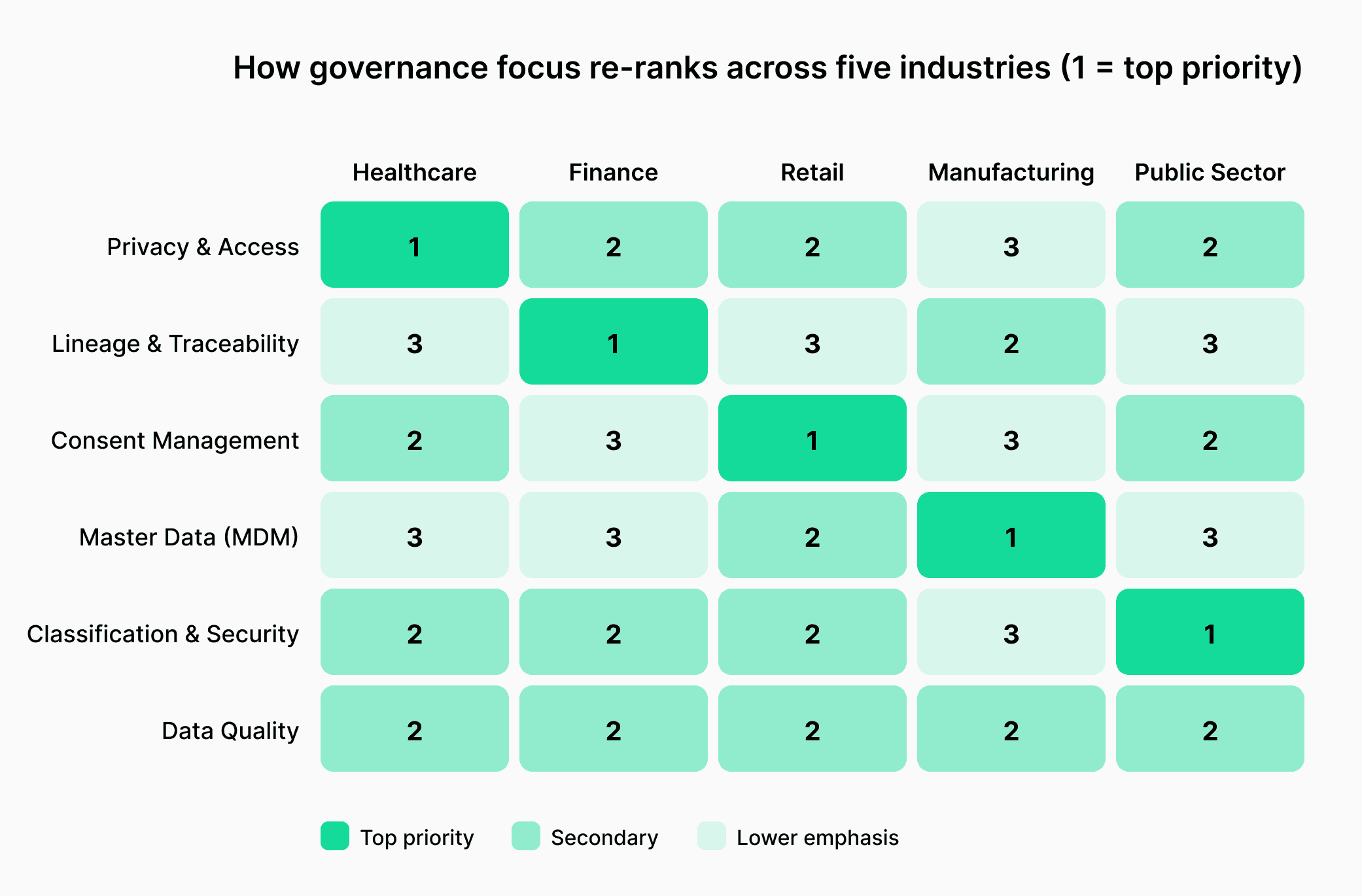
The 5 Frameworks Compared at a Glance
The pattern across all five: the components of governance stay the same, but the priority order shifts based on what breaks first in that industry, whether that's a compliance failure, a patient-safety incident, or a stalled fulfillment order.
How to Customize a Framework for Your Organization
The five examples above are starting points, not drop-in programs. Standing up the framework itself (governance bodies, RACI, policy rollout) follows the same 8-step implementation plan for every industry; what's specific to you is adapting the closest example. Three moves do most of that work:
Swap in your real regulations. Each example lists the usual obligations for its sector; replace them with the exact regulations and jurisdictions you actually answer to. An EU retailer and a US-only one don't carry the same load.
Swap in your real data domains and owners. Keep the five-part structure, but replace the example's critical data types with the datasets where a quality or access failure would genuinely hurt you, and give each one a named owner and steward before you write a single policy.
Reconcile across industries if you span more than one. A retailer with its own payments arm, or a manufacturer that sells direct, should borrow from two examples and merge their priority orders rather than forcing a single one to fit.
Operationalizing Your Framework with Soda
A framework on paper is a plan. A framework enforced in production is governance. The gap between the two is almost always the same: policies get written, but nothing checks whether production data actually follows them.
Soda closes that gap with data contracts: testable artifacts that turn each governance policy into enforceable checks — schema, freshness, validity, and custom rules — that Soda runs automatically against the datasets your framework identifies as critical, plus ownership metadata that ties every dataset to a named owner and steward.
And because Soda integrates with the catalogs governance teams already run (Collibra, Atlan, Alation), those quality results flow back to where your policies live: the catalog shows not just what a dataset is, but whether it currently meets its contract.
Whichever industry example you're working from, the mechanism that keeps it alive is the same: checks that run, alerts that route to the right person, and a record of what passed and what failed. That's what it means to operationalize data governance rather than just document it.
If you're ready to move from a documented framework to one that's enforced automatically, book a demo to see how Soda fits into your existing stack.
Frequently Asked Questions
What is a data governance framework example?
A data governance framework example is a reference model showing how a specific industry or organization structures its governance program: the regulations it answers to, the data types it prioritizes, the roles it assigns, and the policies and metrics it uses to measure success.
How does a data governance framework differ by industry?
The core components (decision rights, roles, policies and standards, processes, technology, metrics) stay the same across every industry. What changes is the priority order and the specifics: a healthcare framework prioritizes PHI privacy and patient safety, while a financial services framework prioritizes lineage and regulatory reporting accuracy.
What should a data governance framework example include?
At a minimum, a useful example defines industry drivers and regulations, critical data types, a priority governance focus, key roles, and example policies and metrics. That five-part structure is what makes it usable rather than just descriptive.
Can I use the same framework across multiple industries?
The underlying components transfer, but the priorities and specifics do not. An organization operating across industries (a retailer with an in-house payments arm, for example) typically needs to blend elements from more than one example rather than applying a single one wholesale.
How long does it take to implement a governance framework?
Timelines vary with scope and starting maturity. Teams that begin with a single high-priority domain (rather than trying to govern everything at once) tend to show results fastest, while reaching broad maturity across a large organization is typically a multi-year program.