
Every organization collects data. Customer records, transaction logs, product metrics, operational reports — the volume grows year over year. Yet for many teams, more data has not meant better decisions. It has meant more confusion. From conflicting numbers in different dashboards to no clear ownership when something looks wrong, and hours lost every week reconciling figures that should agree but don't.
Data governance is the answer to that problem. Not a compliance burden, not an IT project, but a business capability. It’s the system that ensures your data can be found, trusted, and used consistently across every team that depends on it.
This article covers everything you need to understand what data governance is. You will find a plain-language definition of the data governance meaning, the business case for investing in it, the core components that make it work, how it differs from related disciplines like data management and data quality, and a practical path to getting started.
Key Takeaways |
|---|
|
What Is Data Governance?
Data governance is the collection of policies, standards, roles, and processes an organization uses to ensure its data is accurate, consistent, secure, and used responsibly. It defines who is accountable for what data, what the rules are for how that data is handled, and how compliance with those rules is measured and enforced.
A useful analogy: think of data governance as the building code for your organization's data environment. A building code doesn't stop construction; it ensures that what gets built is safe, consistent, and fit for purpose. Governance plays the same role for data. It doesn't restrict access; it creates the conditions under which data can be accessed, shared, and relied upon with confidence.
Governance applies across the full data lifecycle: from how data is collected and what format it must follow, to how it is stored, who can access it, how it is transformed as it moves through systems, and when it is retired. Every stage carries risk if left unmanaged.
The Enforcement Gap
Governance documented in spreadsheets is not governance. Policies only become real when they are enforced as continuous, automated checks, built into pipelines, connected to tooling, and visible to the teams responsible for acting on them. Closing the enforcement gap is what separates a governance program that works from one that exists only on paper.
Why Is Data Governance Important?
Data governance is not an abstract best practice. It addresses concrete business problems, and the cost of ignoring it compounds as organizations grow and data volumes increase.
Regulatory compliance. GDPR, CCPA, HIPAA, and a growing body of AI regulation impose strict requirements on how personal and sensitive data is handled, stored, and shared. Governance is the operational layer that makes compliance possible, defining who has access to what, creating audit trails, and establishing processes for responding to data subject requests or regulatory inquiries.
Data quality and trust. Ungoverned data deteriorates over time. Without clear ownership and enforced standards, definitions drift, pipelines break silently, and teams begin maintaining their own shadow copies of data they don't trust. The result is decisions made on bad data and the cost of a bad decision made confidently is far higher than the cost of building governance up front. See our guide to data quality frameworks for a deeper look at how quality and governance work together.
Operational efficiency. A governed data environment reduces the friction that slows teams down. Analysts spend less time hunting for data or verifying whether a number is reliable. Engineers spend less time fielding questions about schema changes. Leadership gets faster, more trustworthy reporting. Governance eliminates redundant data sources, clarifies ownership, and speeds up time to insight.
AI and analytics readiness. AI readiness has become a board-level question, and governed data is the prerequisite. Machine learning models and self-service analytics tools are only as reliable as the data feeding them; a model trained on inconsistently defined features, or a dashboard built on an ungoverned data source, will produce results no one can defend. For a closer look at the intersection, read our piece on AI Governance & Data Quality.
Organizational accountability. When something goes wrong with data, and eventually, it always does, someone needs to be accountable. Governance creates that clarity: defined data owners, documented policies, and an audit trail that shows what happened and when. Without it, accountability is diffused and problems tend to recur.
Data Governance and Related Disciplines
These terms are frequently used interchangeably, but they describe distinct things. Understanding the difference matters when scoping a governance program or explaining its boundaries to stakeholders.
Term | What It Covers | Relationship to Governance |
|---|---|---|
Data Management | All practices for acquiring, storing, organizing, and using data across its lifecycle | The broad discipline that governance coordinates and sets the rules for |
Data Governance | Policies, roles, standards, and accountability structures for trustworthy, compliant data | The accountability and policy layer within data management |
Data Quality | The measurable fitness of data for its intended use: accuracy, completeness, consistency | An outcome that good governance is designed to protect |
Data Observability | Real-time monitoring of pipeline health: freshness, volume, schema, lineage, distribution | The operational monitoring layer that supports governance strategy |
Data management is the broadest of the four. It encompasses every practice an organization uses to acquire, store, organize, protect, and use data throughout its lifecycle: infrastructure, architecture, integration, warehousing and more.
Data governance is the coordinating component within data management. It is specifically concerned with the policies, roles, and accountability structures that make data trustworthy and compliant, and it sets the rules the other data management disciplines operate under. You can have sophisticated data infrastructure and still have poor governance, the technology isn't the policy.
Data quality refers to the measurable fitness of the data for its intended use: is it accurate, complete, consistent, timely, and valid? Quality is an outcome that good governance is designed to protect, not a synonym for governance itself.
For a direct comparison, take a look at our article on Data Quality vs. Data Governance.
Data observability is a related engineering discipline focused on monitoring the health of data pipelines in real time: tracking freshness, volume, schema changes, and distribution shifts. Think of it as the operational detection layer that sits beneath governance strategy. When an observability alert fires, governance determines who is accountable and what the response process looks like. See our piece on what is data observability for a full explanation.
Key Components of Data Governance
An effective data governance program is built on several interconnected components. Each one addresses a specific failure mode that emerges when data is left unmanaged.
Data Policies. These are the documented rules governing how data is created, stored, used, and disposed of. Policies answer the foundational questions: what data can be collected, how long it must be retained, who is permitted to share it outside the organization, and what happens when a policy is violated.
Data Standards. This refers to the agreed-upon definitions, formats, and naming conventions that ensure consistency across teams and systems. A standard might specify that an 'active customer' is anyone who has made a purchase in the last 90 days, or that all timestamps must be stored in UTC. Without standards, the same concept means different things in different parts of the organization.
Data Ownership and Stewardship. This ensures clearly assigned accountability for each data domain. Data owners, typically business-side leaders, set the rules and quality expectations for their domain. Data stewards implement those policies day to day, manage metadata, and respond to quality issues. This matters because ownership provides strategic accountability and stewardship provides operational execution.
Data Catalog. A data catalog is a centralized inventory of the organization's data assets, including metadata, ownership information, and documentation of what each dataset contains and how it should be used. A well-maintained catalog dramatically reduces the time analysts spend searching for data and second-guessing whether they have found the right thing.
Data Quality Management. These are the processes and tooling used to measure, monitor, and enforce data quality standards across pipelines and systems. This is where governance moves from policy into practice: standards are enforced through automated checks that catch issues before they reach downstream consumers, and metric monitors that surface anomalies over time.
Access Control and Security. These are the role-based permissions, data classification tiers, and audit trails that protect sensitive data without blocking legitimate use. Effective access control is not about restriction for its own sake; it is about ensuring the right people can access the right data, and that every access event is recorded.
Data Lineage. This is a record of where data comes from, how it has been transformed, and where it flows through the organization. Lineage is critical for troubleshooting data quality issues, understanding the impact of upstream changes, and satisfying regulatory audit requirements.
Data Governance Roles and Responsibilities
Governance does not happen automatically. It requires clearly defined human accountability — people who own domains, set policies, implement standards, and respond when things go wrong. Here are the core roles in a mature governance program.
Chief Data Officer (CDO). The executive sponsor and ultimate accountability holder for the organization's data strategy and governance program. The CDO provides the organizational authority that governance requires to be effective across business units.
Data Governance Council. A cross-functional group of senior stakeholders who set policy direction, resolve escalations that cannot be handled within a single domain, and review governance performance against defined metrics. The council provides the collaborative structure that keeps governance aligned with business priorities.
Data Owners. Business-side leaders who are accountable for specific data domains; the Head of Finance for financial data, the VP of Marketing for customer and campaign data. Data owners define access rules, set quality expectations, and are ultimately responsible for the health of their domain.
Data Stewards. The operational layer of governance. Stewards implement the policies established by data owners, manage metadata and business definitions, monitor data quality, and coordinate responses to issues as they arise day-to-day.
Data Engineers and Architects. Responsible for the technical infrastructure that enforces governance policies in practice: pipelines, access controls, catalog integrations, and automated quality checks. Governance strategy only becomes operational when engineers build the systems that make policies enforceable.
A Note on Smaller Organizations
In smaller teams, one person often holds multiple roles. A senior analyst might be both data owner and data steward for a domain. That is fine. What matters is not that every role has a dedicated headcount, but that accountability is explicit: someone can name who is responsible for each data domain, what the expectations are, and what to do when something goes wrong.
Core Principles of Data Governance
Effective governance programs tend to share the same handful of guiding principles. These aren't rules to memorize; they are the mindset that separates governance that sticks from governance that stalls.
Governance enables, it doesn't restrict. The goal isn't to lock data down; it's to make data safe to use. Good governance gives more people confident access to trustworthy data by making clear what is reliable and how to use it.
Accountability has to be explicit. Every data domain needs a named owner. When responsibility is assumed rather than assigned, no one maintains the standards and quality quietly erodes. Deciding who is accountable is the highest-leverage move a governance program makes.
Enforcement beats documentation. A policy that lives in a slide deck or a spreadsheet changes nothing on its own. Governance becomes real only when its rules are enforced as continuous, automated checks that run where the data lives. Closing that enforcement gap is what most stalled programs are missing.
Governance is a business capability, not an IT project. The decisions that matter most, what a metric means, who can see sensitive data, which definition is authoritative, are business decisions. Governance works when business and engineering share ownership, not when one team is left to police the rest.
Start narrow and prove value. Trying to govern everything at once is the most common way governance fails. A focused program on one high-value domain that delivers a visible win earns the credibility to expand. Governance grows by compounding small successes, not by mandate.
Real-World Data Governance Examples
Data governance can sound abstract until you see what it solves in practice. The following examples illustrate how governance addresses the real problems organizations face when data is managed inconsistently.
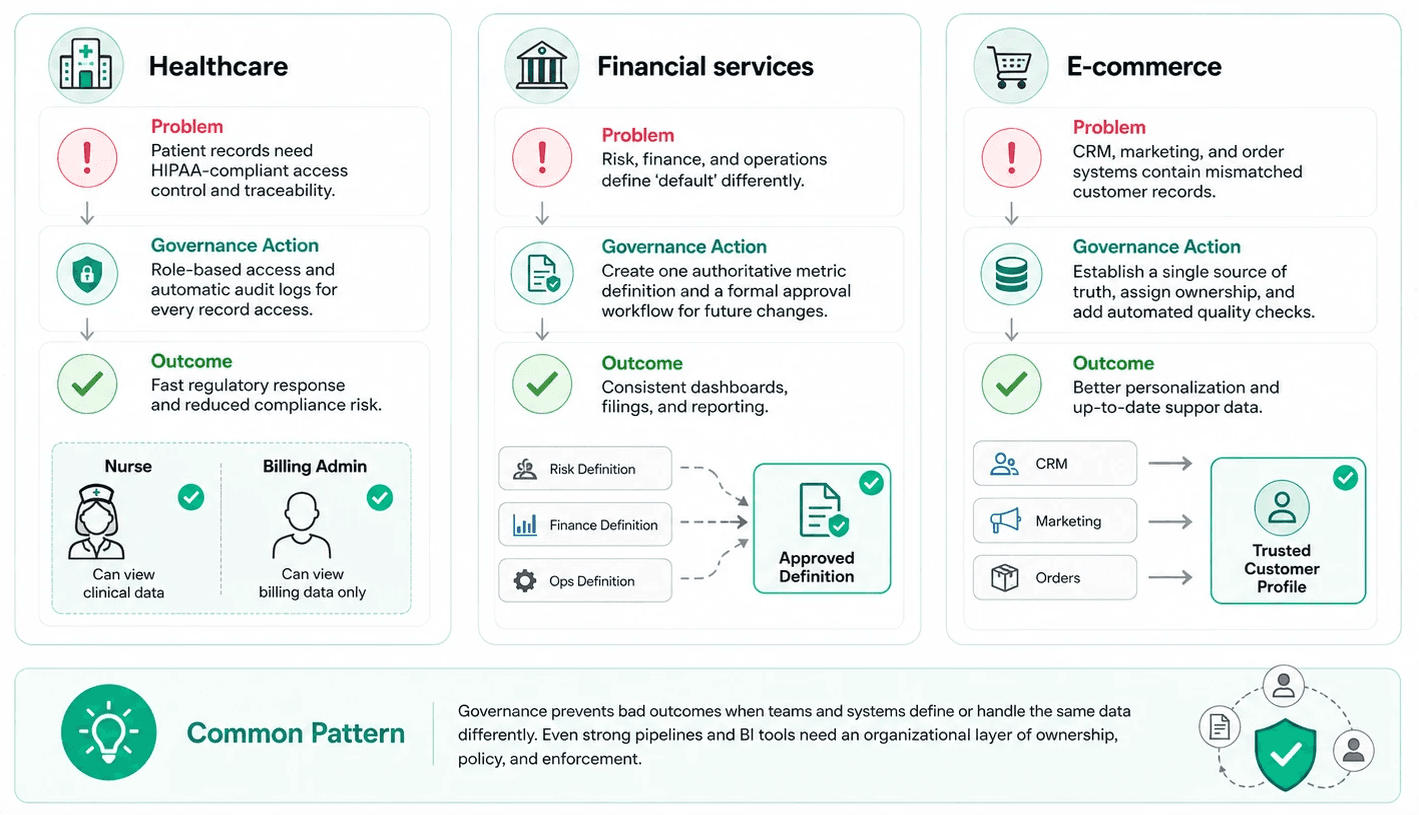
Data governance in healthcare
Problem. A hospital system must keep patient records compliant with HIPAA, but without consistent role-based access and logging it can't prove who viewed which records, a compliance and reputational risk.
Governance Action. Access is controlled by role (a nurse and a billing administrator get different permissions), and every access event is automatically audited.
Outcome. When a regulatory inquiry arrives, the program produces a complete log of who accessed which records, when, and for what purpose.
Data governance in financial services
Problem. A bank's risk, finance, and operations teams each define 'default' slightly differently, so regulatory filings and internal dashboards report different numbers for the same metric — the kind of inconsistency that risk-data rules like BCBS 239 require major banks to eliminate.
Governance Action. The governance program establishes a single, authoritative definition and a review-and-approval process for any future change before it is implemented in any system.
Outcome. Filings and dashboards reconcile because every team works from the same approved definition.
Data governance in e-commerce
Problem. A retailer's CRM, marketing platform, and order management system all hold customer data, but the records don't match, so personalization misfires and support agents work from outdated information.
Governance Action. A governance initiative establishes a single source of truth for customer data, defines an ownership structure, and adds automated quality checks that catch discrepancies before they propagate.
Outcome. Campaigns target accurately and support teams act on current data because every system reconciles to one trusted customer record.
These examples share a common pattern: governance solves problems that arise when different teams, systems, or processes define or handle the same data differently. The technical infrastructure, the pipelines, the warehouse, the BI tools can be first-rate and still produce bad outcomes without the organizational layer that governance provides.
How to Get Started with Data Governance
The most common governance mistake is trying to do everything at once. Comprehensive governance programs are built gradually; start narrow, prove value, and expand. Here is a practical sequence.
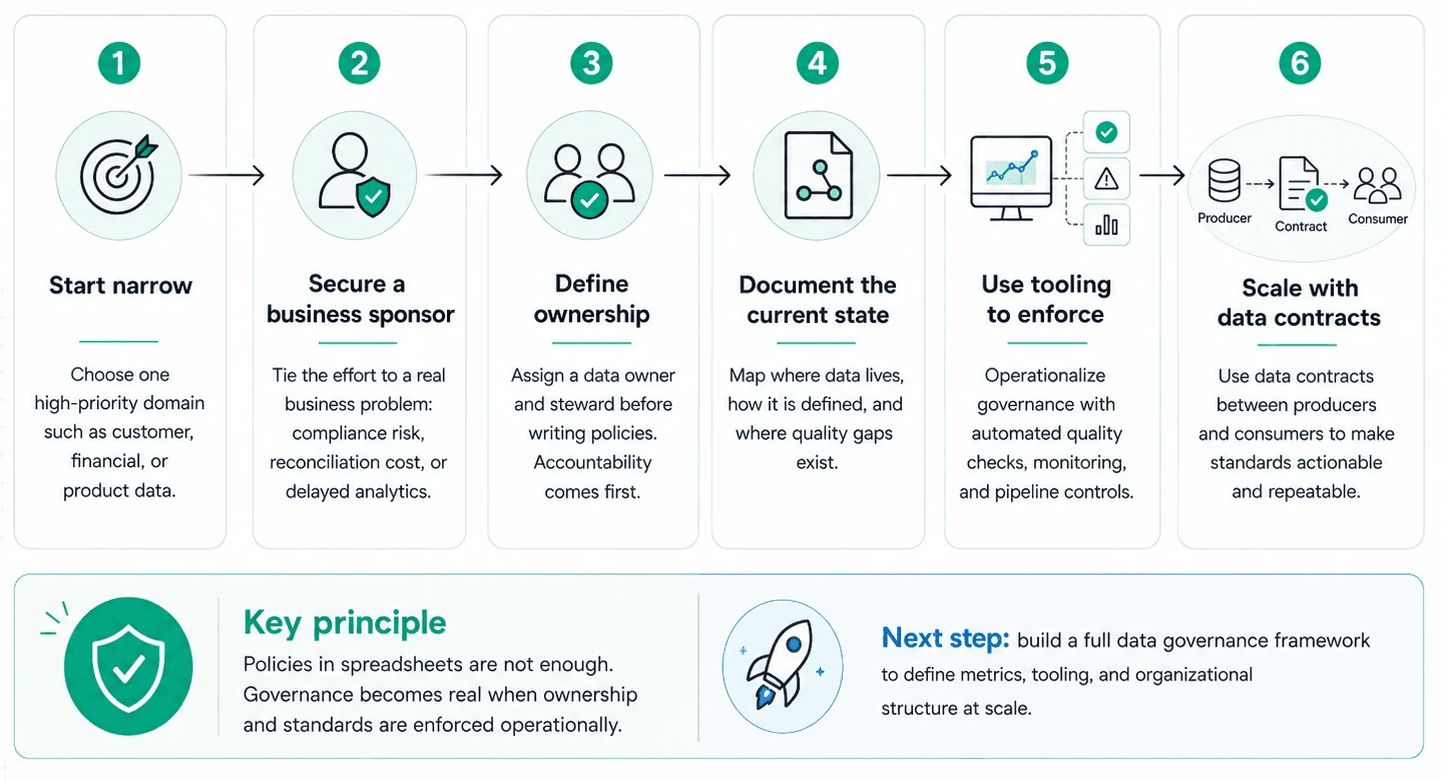
Start narrow, not broad. Pick one high-priority data domain: customer data, financial data, or product data, rather than attempting to govern the entire organization simultaneously. A focused program that delivers results is far more effective than a comprehensive program that stalls under its own weight.
Secure a business sponsor. Governance without executive buy-in stalls at the first cross-functional disagreement. Frame the business case in terms of a specific problem, regulatory risk, a costly data reconciliation process, or an analytics initiative that keeps getting delayed, rather than abstract data principles.
Define ownership first. Before writing a single policy, assign a data owner and a steward to the domain you are starting with. Accountability precedes the process. If no one is responsible, no policy will be maintained.
Document the current state. Understand what data exists, where it lives, how it is currently defined, and where the quality gaps are. You can't design effective governance for a domain you don't fully understand.
Use tooling to enforce, not just document. Policies that live in spreadsheets are not enforced. Connect governance to automated data quality checks and pipeline monitoring to make it operational.
Scale with data contracts. Once enforcement is in place, data contracts between data producers and consumers make your standards actionable and repeatable, catching breaking changes before they propagate and keeping governance enforceable as your data estate grows.
For a comprehensive, step-by-step guide to building out a full program, your next resource to read is the Data Governance Framework implementation guide, which covers how to structure your governance organization, select tooling, define metrics, and scale across the enterprise.
Conclusion
Done well, data governance is the organizational discipline that makes data a reliable, trustworthy asset — one that teams can find, understand, and act on with confidence. Treat it as a one-time project or a compliance checkbox and it will most certainly fail.
The foundation of every effective governance program comes down to a small set of non-negotiable elements: clear definitions that the whole organization shares, explicit ownership for every data domain, documented standards that apply consistently, and enforcement that is built into systems rather than left to good intentions.
Most importantly, governance is not something that can be declared in a policy document and left there. It becomes real only when it is operationalized, connected to automated checks, embedded in the workflows of data owners and stewards, and visible to the teams who depend on it every day.
Data teams at companies like HelloFresh, Nubank, and 2K Games use Soda to turn governance policy into automated data quality monitoring and data contracts. If you're building the business case for governance, see how Soda operationalizes it.
Frequently Asked Questions
What is data governance in simple terms?
Data governance is the system an organization uses to ensure its data is accurate, consistent, and used responsibly. It defines who is accountable for which data, what the rules are for handling it, and how those rules are enforced across teams and systems.
What are the key components of data governance?
The core components are: data policies (the rules for how data is created and used), data standards (shared definitions and formats), data ownership and stewardship (assigned accountability), a data catalog (a centralized inventory of data assets), data quality management (processes and tooling to monitor and enforce quality), access control and security (role-based permissions and audit trails), and data lineage (a record of data's origin and transformations).
What is the difference between data governance and data management?
Data management is the broader discipline. It covers everything an organization does to acquire, store, organize, and use data throughout its lifecycle, including infrastructure, architecture, and integration. Data governance is the coordinating layer within data management, specifically focused on the policies, roles, and accountability structures that ensure data is trustworthy and compliant.
Why is data governance important?
The top business drivers are regulatory compliance (GDPR, CCPA, HIPAA require documented data handling practices), data quality and trust (ungoverned data deteriorates and leads to costly decisions), operational efficiency (governed environments reduce duplicated effort and speed up time to insight), and AI readiness (models and analytics tools are only as reliable as the data feeding them).
What are examples of data governance?
A hospital system implementing HIPAA-compliant access controls with automated audit trails. A bank, standardizing the definition of 'default' across its risk, finance, and operations teams so that internal reports and regulatory filings reflect the same number. A retailer establishing a single source of truth for customer data by reconciling records across its CRM, marketing platform, and order management system. These are just some of the benefits of data governance.
How do I start a data governance program?
Start with a single, high-priority data domain rather than trying to govern everything at once. Secure an executive sponsor before building anything. Assign a data owner and steward to that domain before writing any policies. Document the current state of the data, including where quality gaps exist. Then connect governance to tooling that enforces standards automatically, policies that exist only in documents are not enforced.