
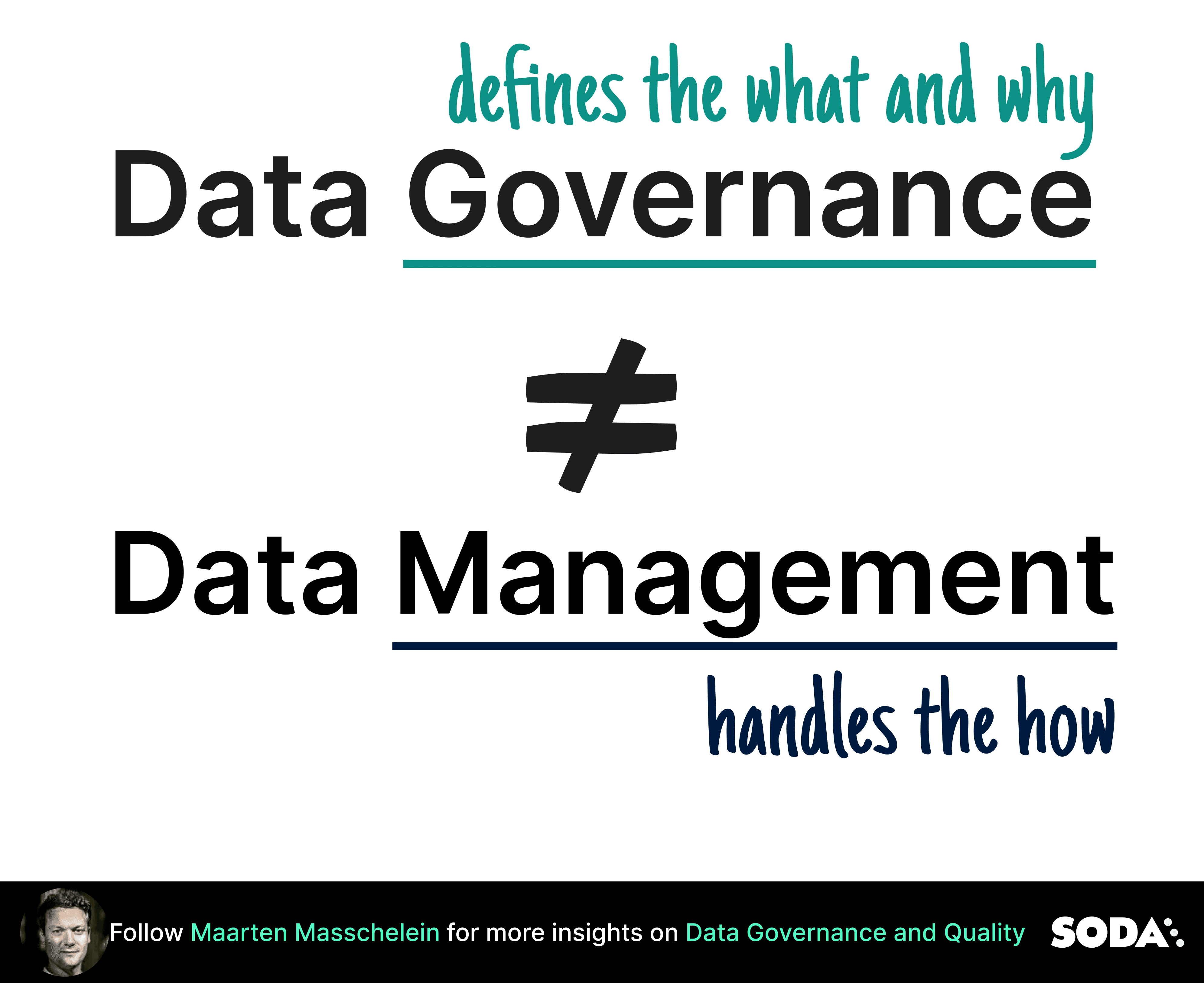
Data governance and data management are distinct disciplines that most organizations treat as one. They're indeed connected. They usually share vocabulary, stakeholders, and tooling. But "connected" and "equal" aren't the same thing, and conflating them leads to governance programs that never get implemented and management practices with no strategic direction.
When the line between strategic oversight and operational execution blurs:
Governance turns into documentation: policies sit in a wiki and never reach a pipeline.
Management runs without direction: quality standards, access controls, and ownership get decided ad hoc, pipeline by pipeline.
Nobody notices until something breaks: a failed audit, a stalled AI initiative, or a dashboard nobody trusts.
This article breaks down the distinction across different dimensions, shows how data contracts create the bridge between them, and offers a practical starting point for governance that produces results, not just documentation. If you need the foundational definition first, our guide to what data governance is covers principles and examples; this article assumes that baseline and focuses on the boundary with management.
Key Takeaways |
|---|
|
The Intersection of Governance and Management
DAMA's DMBOK draws the relationship in its knowledge-area wheels. The classic wheel places data governance at the center, coordinating every other management discipline. The Evolved Wheel in the 2024 revised edition turns governance into the outer ring, with the lifecycle and foundational work of data management inside it. Either way, the message is the same: governance frames the work; management is the work.
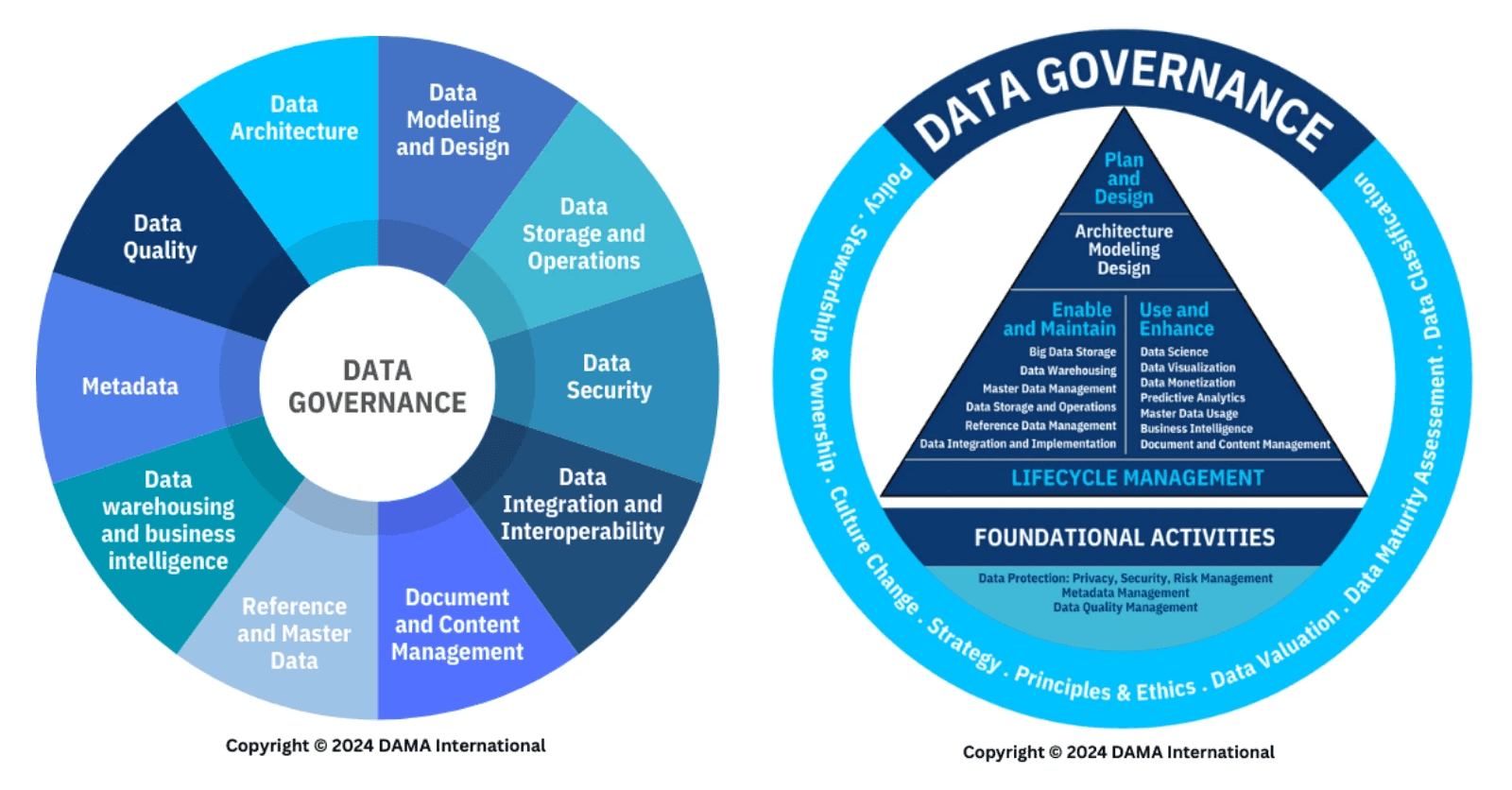
Image: the DAMA Wheel and the Evolved Wheel. Source: DAMA International, The DAMA Guide to the Data Management Body of Knowledge (DAMA-DMBOK2R), 2nd ed. revised, Technics Publications, 2024.
According to the DAMA definition, data governance is “the exercise of authority, control, and shared decision-making (planning, monitoring, and enforcement) over the management of data assets” (DAMA-DMBOK2R, 2024). Data management is the lifecycle work that the authority directs. The two are defined in terms of each other, which is why they're always discussed together, and why they're so often mistaken for one discipline. The same boundary confusion shows up one layer down, between data quality and data governance, a related pairing where the "which comes first" question has its own answer.
At a glance, the difference comes down to who sets the rules and who runs the work:
Data governance | Data management | |
|---|---|---|
What it is | The framework of policies, roles, and decision rights for data | The operational work of ingesting, storing, transforming, and maintaining data |
Core question | What does "good data" mean, and who decides? | Does the data meet the standard as it moves through systems? |
Nature | Strategy: sets the rules | Execution: runs the operations |
Owned by | CDO, governance council, data owners, data stewards | Data engineers, platform teams, DBAs, analytics engineers |
Typical outputs | Policies, standards, ownership assignments, freshness SLAs | Pipelines, warehouses, catalog entries, quality checks |
Measured by | Policy coverage, enforcement rate, audit readiness | Pipeline uptime, freshness, check pass rate, time-to-detection |
To put it simply, data governance defines the rules, and data management makes sure they are implemented. Or as some practitioners frame this difference: governance is about doing the right things; management is about doing things right.
Three Forces Making the Distinction Urgent
Three forces are making the governance-management distinction more consequential than ever: AI readiness, regulatory expansion, and the failure of checklist-based governance.
AI Readiness
AI models amplify data quality issues. A dashboard built on flawed data produces a misleading chart; an AI model trained on flawed data produces confident, scalable wrong answers. Governance defines what "AI-ready data" means: quality thresholds, bias checks, provenance requirements. Management ensures the data meets that bar in production.
Regulatory Expansion
GDPR, DORA, BCBS 239, the EU AI Act. The regulatory environment demands governance frameworks, but compliance audits evaluate operational enforcement. A governance policy might state that personal data subject to a Right to Erasure request must be deleted without undue delay, with the data subject informed of the action taken within GDPR's one-month response window. On its own, that policy is incomplete. It needs the management processes, tooling, and automation that execute the deletion reliably. Organizations need both layers clearly separated, with contracts and automation connecting them.
The End of "Set-and-Forget" Governance
Governance that isn't embedded in continuous operational routines creates bureaucracy instead of business value. The fix is operationalized governance: policies converted into automated, executable quality checks that run in production and feed results back to governance for continuous improvement.
Governance Defined: Strategy, Policies, and Decision Rights
Data governance is the framework of policies, roles, and decision rights that defines what data standards apply, who owns which data, and why those standards exist. It's strategy, not execution.
A governance program establishes:
Policies and standards: What quality rules apply to which datasets; what access controls are required; what compliance obligations must be met
Roles and ownership: Who owns each data domain; who serves as steward; who sits on the governance council and holds decision-making authority
Decision rights: Who can approve schema changes; who defines what "fit for purpose" means for a given dataset; who arbitrates when producers and consumers disagree
Governance also extends beyond the "what" and "why." Effective governance programs define:
When: Freshness SLAs, retention periods, and review cadences
Who: Clear assignment of ownership at the domain level, not just the team level
How much: Resource allocation for quality enforcement; prioritization of which datasets receive active monitoring versus best-effort coverage
Governance sets the boundaries that management operates within. It's the strategy layer: the decisions about how data should be treated before anyone builds a pipeline.
Management Defined: Operations, Tools, and Execution
Data management is the day-to-day operational work of ingesting, storing, transforming, cataloging, securing, and maintaining data. It's execution: the work of putting governance policies into practice.
A management program handles:
The data lifecycle: Ingestion from source systems, transformation for analytics, storage in warehouses and lakes, cataloging for discoverability, quality monitoring for reliability, and archival or deletion per retention policy
Tools and infrastructure: ETL/ELT platforms, data warehouses, orchestrators, quality monitoring tools, catalogs, and lineage systems
People: Data engineers, platform teams, database administrators, and analytics engineers who build and maintain the operational data stack
Management is about implementation: making governance real in production systems.
The Cost of Management Without Governance
When management operates without governance, the result is familiar to most data teams:
Spaghetti pipelines with no naming conventions or documentation standards
Duplicated datasets across teams, each with slightly different definitions
No clear ownership. When data breaks, nobody knows whose responsibility it is to fix it
Quality checks that exist but are not tied to any business requirement or service-level agreement
This is the "move fast and break things" failure mode applied to data engineering. It works until it doesn't: a compliance audit reveals gaps, an AI initiative stalls because the training data misses quality standards nobody formally defined, or a dashboard contradicts the source of truth and three teams point fingers because ownership was never assigned.
How Do Governance and Management Differ in Practice?
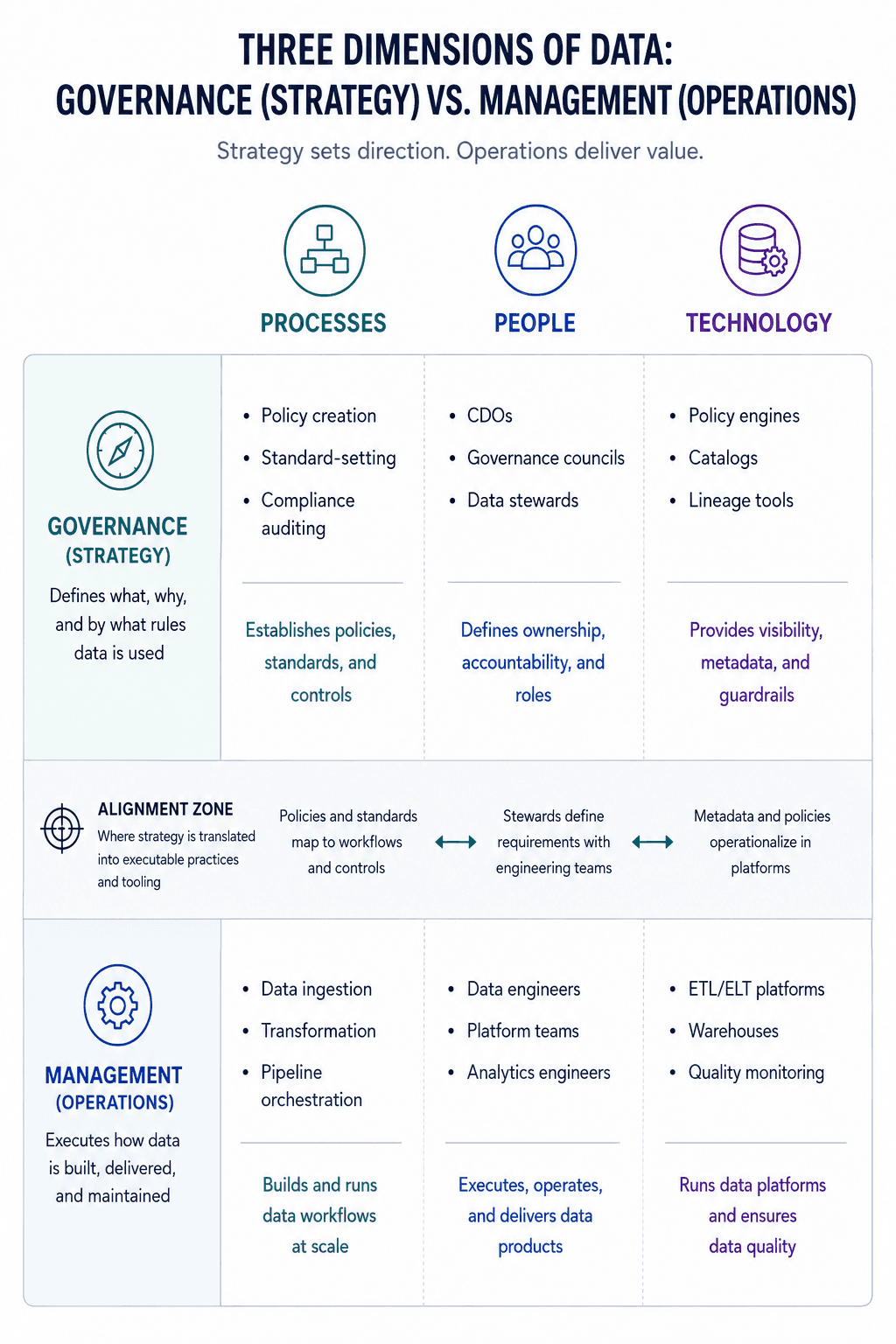
The clearest way to distinguish governance from management is across three dimensions: processes, people, and technology. Each dimension has a governance side (strategic) and a management side (operational), with a zone of overlap where the two must coordinate.
Processes
Governance processes: Policy creation, standard-setting, compliance auditing, data classification, decision-rights assignment, and review cadences
Management processes: Data ingestion, transformation, storage, quality monitoring, pipeline orchestration, incident response, and archival
The boundary: governance determines what the rules are; management determines how the rules are executed in production.
People
Governance roles: Chief Data Officers, governance councils, data owners, data stewards, compliance officers
Management roles: Data engineers, platform engineers, database administrators, analytics engineers, site reliability engineers
The overlap: some roles, particularly data stewards, span both. A steward may define data quality standards (governance) and also monitor adherence to those standards (management). The key is recognizing which hat is being worn at any given moment; the strategic decision differs from the operational execution.
Technology
Governance technology: Policy engines, access control systems, metadata catalogs, lineage tools, business glossaries
Management technology: ETL/ELT platforms, data warehouses, pipeline orchestrators, quality monitoring tools, alerting systems
The overlap: catalogs and quality platforms serve both governance and management. A catalog (Collibra, Atlan, Alation) provides the governance metadata layer: ownership, classification, business context. A quality platform provides the management execution layer: checks, monitoring, anomaly detection. When the two integrate bidirectionally, governance metadata flows to quality checks and quality results flow back to the catalog.
Learn more about the pattern behind operationalizing data governance with Collibra and Soda.→
How Do Governance and Management Connect?
The connection is a feedback loop, not a handoff: governance sets standards, management enforces them and reports back what holds up in production, and governance adjusts.
Governance without management is a policy document nobody reads; management without governance is a pipeline nobody trusts.
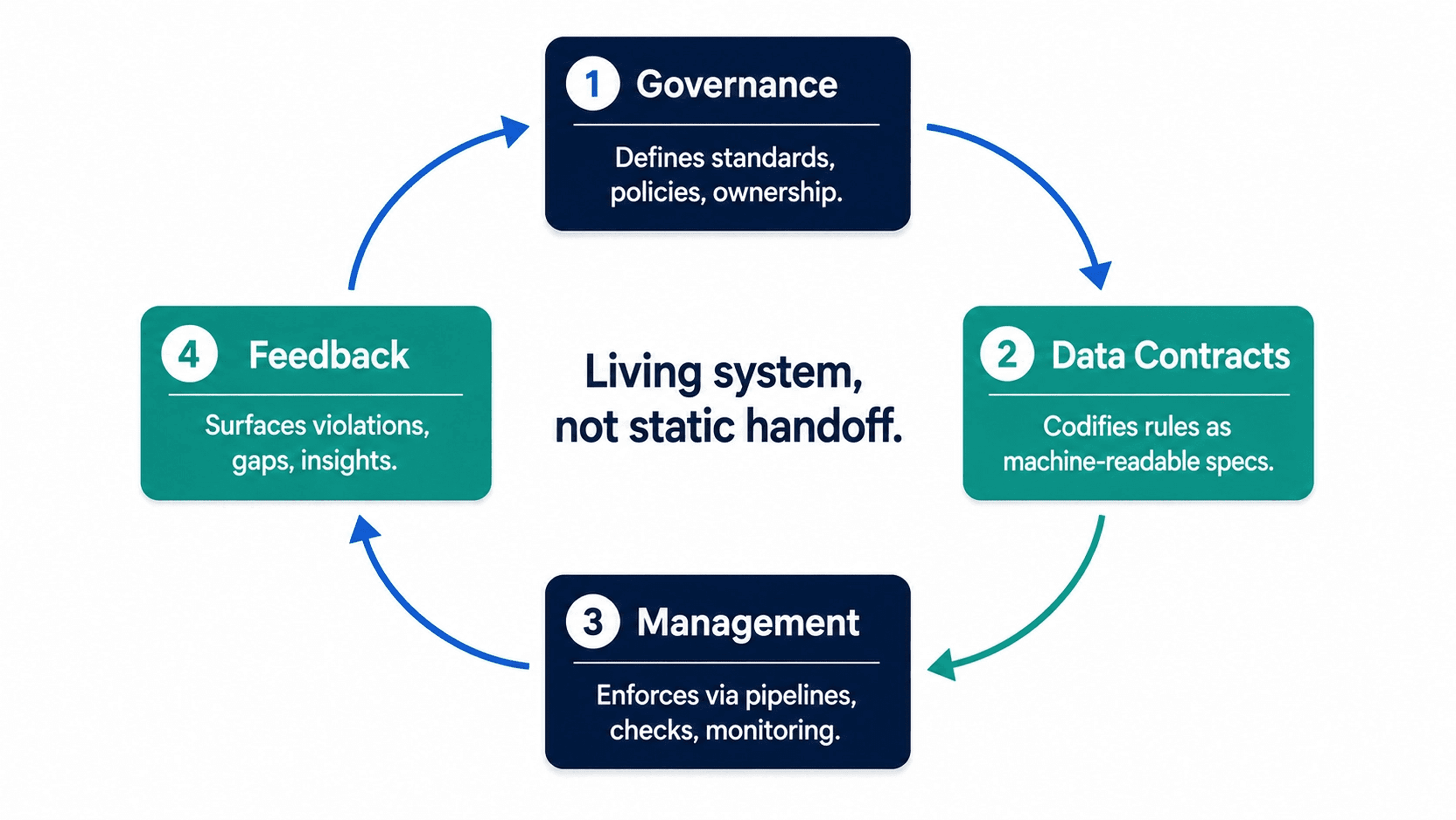
The loop works as follows:
Governance defines standards. The governance council establishes quality rules, freshness SLAs, schema requirements, and ownership assignments for a given data domain.
Contracts codify those standards. The governance decisions are translated into data contracts: machine-readable specifications that define what "good data" looks like for a specific dataset or interface. The contract is readable by the governance lead who ratified the SLA and parseable by the CI/CD system that enforces it.
Management enforces the contracts. Engineering teams integrate the contracts into their pipelines. Quality checks run automatically on every pipeline execution; failures trigger alerts and, where configured, block bad data from moving downstream.
Feedback informs governance. Management surfaces operational reality: which SLAs are too aggressive, which quality rules generate false positives, which datasets need new standards. Governance uses this feedback to update policies, creating a living system rather than a static document.
This is the cycle most organizations are missing. They have governance as policies in a wiki, and management through pipelines in production, but no mechanism connecting the two. The contract is the bridge. It turns governance decisions into management instructions — and management results into governance intelligence.
Data Contracts: Where Governance Meets Management
Data contracts are formalized agreements between data producers and consumers that specify schema, quality rules, SLAs, and ownership. They serve as the operational interface between governance strategy and management execution — and for architects specifically, a system-boundary pattern that keeps schema and quality expectations explicit across data products.
Contracts make the governance-management connection concrete:
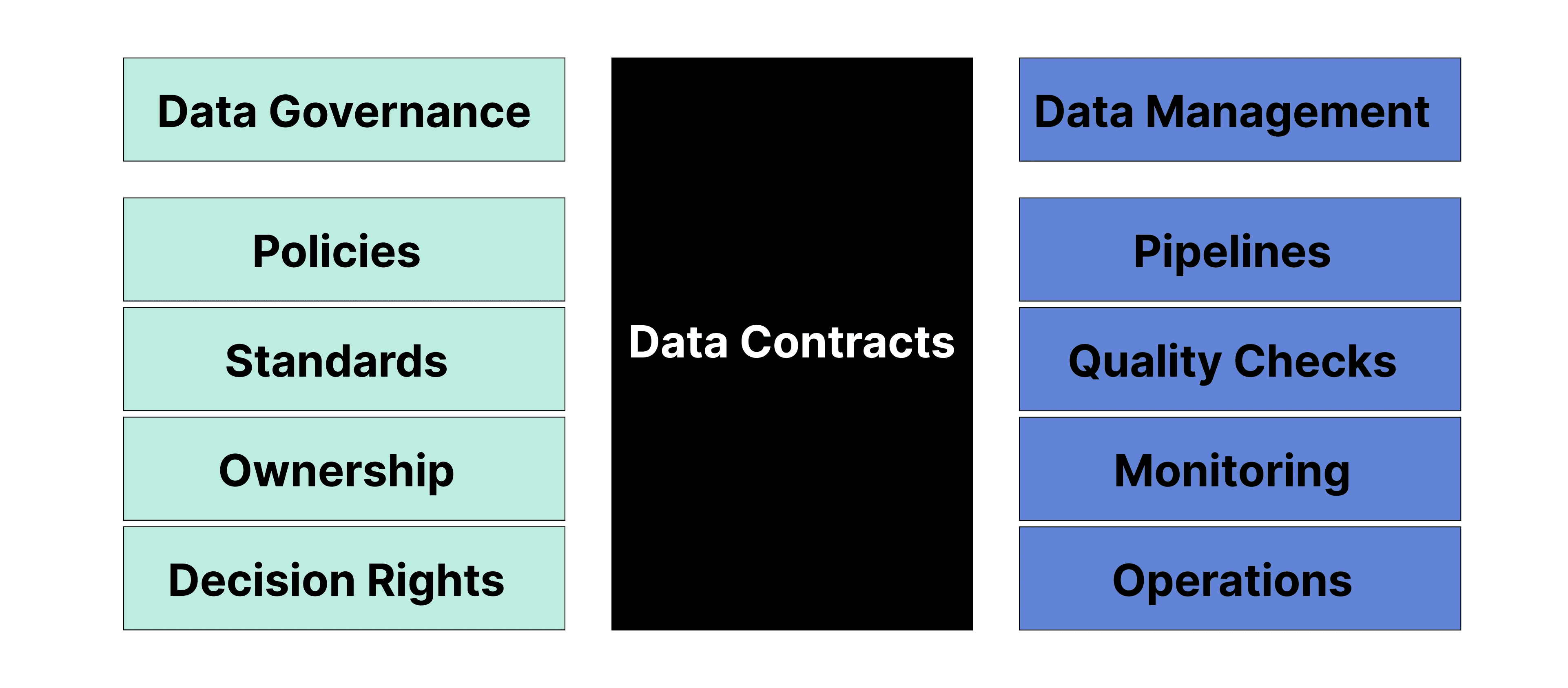
Governance guides the contract: What quality standards apply, what freshness guarantees exist, who owns the data, and what happens when standards are violated
Management enforces the contract: Pipeline checks, automated monitoring, and CI/CD quality gates ensure the data meets the specified standards in production
The contract evolves: As management surfaces operational feedback (violations, edge cases, unrealistic thresholds), the contract gets updated.
Without contracts, governance produces policies and management produces pipelines, and the two may never intersect. With contracts, every governance decision has a traceable path to enforcement, and every operational insight has a path back to policy.
For regulated and multi-cloud teams, this matters operationally as much as conceptually. Contracts run where the data already lives, in your warehouse, your CI/CD, your own environment. The governance-to-management bridge never requires moving data out to a vendor cloud to enforce it.
Ready to bridge governance and management? Explore how data contracts in Soda turn governance policies into automated, enforceable quality checks.
Four Implementation Steps
Most organizations have governance and management activities scattered across teams, tools, and documentation. The task is to figure out which activities are governance (setting rules) and which are management (running operations), then put them both into practice.
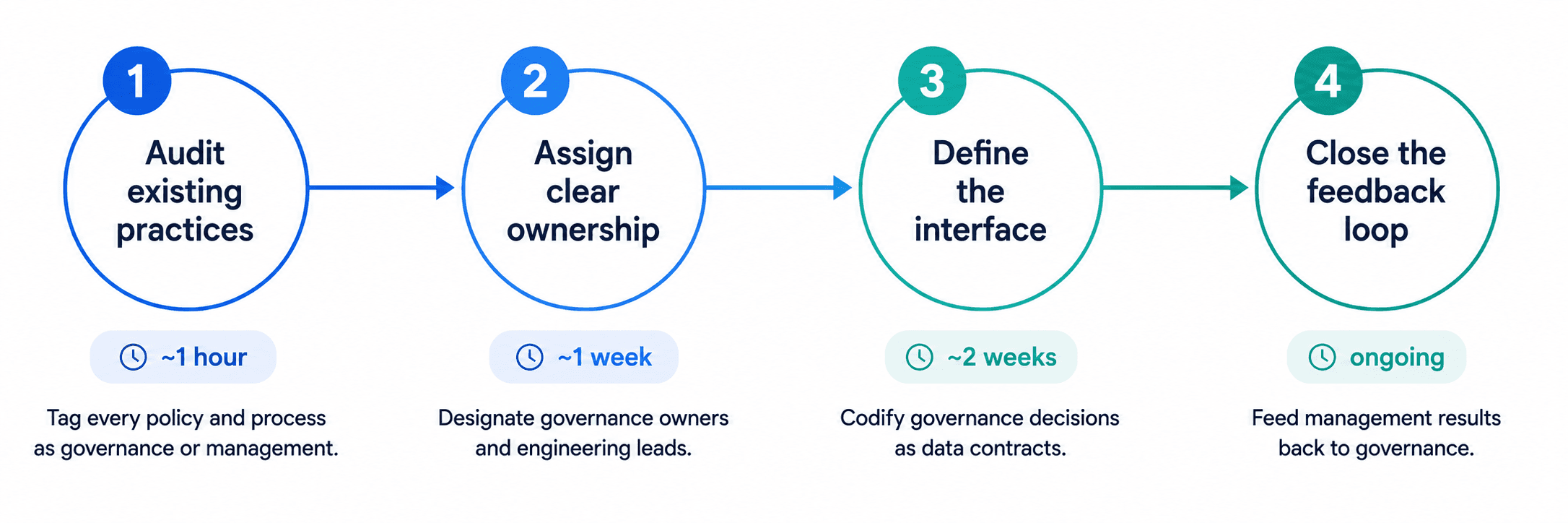
Step 1: Audit existing practices
The first step is straightforward: map what already exists. List every data-related policy, process, and tool. Tag each as governance (strategic) or management (operational). Most teams are surprised by how much implicit governance exists in Slack messages, email threads, and undocumented pipeline logic, and how much of it has never been formalized.
Step 2: Assign clear ownership
Governance needs a council or designated owner with the authority to set standards. Management needs engineering leads with the responsibility to implement and enforce those standards. Roles that span both, particularly data stewards, should have explicit dual accountability, with clarity about which responsibilities are governance and which are management.
Step 3: Define the interface
How do governance decisions become management actions? Data contracts are the most direct mechanism: governance policies are codified as machine-readable specifications that management systems can parse and enforce automatically.
Step 4: Close the feedback loop
Ensure management results feed back to governance. Track:
Number of governance policies with active enforcement in production
Time-to-detection for quality issues (how quickly do problems surface?)
Percentage of critical datasets covered by data contracts
Rate of governance policy revisions driven by operational feedback
These four metrics double as board-level evidence: enforcement and contract coverage quantify regulatory exposure reduction, and time-to-detection trends translate into avoided incident cost. Leadership buy-in matters here. Governance programs that start small, proving the model on one critical dataset before expanding, build credibility faster than those that attempt an organization-wide rollout on day one.
The Bottom Line: Start With the Boundary, Not the Tools
Governance and management are both essential, but they are not the same discipline, and treating them as one is where many governance programs go wrong. The fix isn't more documentation or another catalog rollout. It's a clear boundary between strategy and execution, connected by data contracts that translate governance decisions into automated enforcement and feed operational results back into policy.
There is also a valid argument that the line between governance and management is shifting. As automation, AI-generated quality checks, and self-service tooling mature, some governance activities that were once purely strategic are becoming operational. The framework described here will evolve alongside the tooling.
The bottom line is this: govern in policy, manage in pipelines, and let data contracts carry the rules between them. Start with one critical dataset and let the results argue for the rest.
See the business case for contract-led governance and how policy becomes enforceable across your pipelines, lowering regulatory exposure without adding headcount.
Frequently Asked Questions
Does DAMA's DMBOK not position governance as part of data management?
Formally, yes: data management is the umbrella discipline, and governance is its coordinating layer. The classic wheel places data governance at the center of the knowledge areas, and the Evolved Wheel in the 2024 revised edition goes further: governance becomes the outer ring that encircles all lifecycle and foundational activities. In both views, governance frames the other disciplines rather than sitting inside them as one more task. In practice, governance works best as the discipline that sets the boundaries management operates within, rather than one that competes with management for engineering attention and resources.
What if the same team handles both governance and management?
That's common and workable. The distinction doesn't require separate teams; it requires separate modes of thinking. The same team can define standards (governance) and build pipelines (management), provided team members are clear about which function they are performing. The mechanism that connects the two (data contracts, automated enforcement, feedback loops) matters more than the org chart.
How do data contracts fit if governance and management are already well-separated?
Contracts are the interface that makes the separation functional. Without them, governance produces policies and management produces pipelines, but the two may never connect. Contracts codify governance decisions into a format that management systems parse and enforce automatically. The organizations that build this interface, rather than leaving governance as policy and management as pipelines, are the ones whose governance actually reaches production and earns the business's trust.