
For years, data governance moved at the speed of tickets: write a policy, wait on engineering to enforce it, chase owners, assemble evidence by hand. The work was real, but it never quite kept up with the business.
Now your data has a new reader. Your own AI agents and models act on it directly, at machine speed and without the context a person brings. So leadership is asking whether your data is "AI-ready": data an agent can act on correctly, on its own. That turns governance into the gate on whether AI ships — and getting the estate AI-ready into the governance team's new job.
That is what AI data governance comes down to now — making your data trustworthy enough for AI to act on, before it does.
This piece is about using AI to do governance work faster and at a scale you couldn't reach by hand. You'll see how governance teams use Soda to read data quality across the whole estate, draft contracts to close coverage gaps, and assign the right owners, all in plain language.
AI-ready data is your new bar
Ask a data governance manager what changed this year, and the answer is one word: AI. Every team wants to put AI on top of its data. Almost none can say whether that data is actually ready for it.
A person with domain knowledge sees a $0 order and knows whether it's a canceled sale, a test record, or a bug. An AI agent sees the value and none of that context, so it doesn't pause. It acts.
“AI-ready data” then, is data AI can consume and act on without a person interpreting it first. And to achieve that, your data needs to carry quality checks in a form software can enforce, an established owner, and a clear view of the quality coverage and your data health.
AI-readiness gap is wide and most teams know it. HBR Analytic Services surveyed members in their audience and found that only 7% of enterprises say their data is completely ready for AI.
How do you make sure your data is AI-ready?
AI-readiness isn't a project you finish; it's a state you hold. What counts as "ready" always depends on what your models and agents do with the data. But for any use case, you have to be able to answer three questions about the datasets an agent will touch:
1. Coverage — which datasets have quality checks running? You can't call data AI-ready if you don't know which datasets an agent can even reach.
2. Ownership — who is the named owner of this dataset? Someone has to be accountable for what "ready" means on that data and to decide what happens when an issue is found.
3. Enforcement — is the definition of "good" written where software can check it? Not tribal knowledge in someone's head, not a policy doc in a wiki, but a machine-readable definition, re-checked on every run.
Answer yes to all three, and your data doesn't just look clean — it can prove it's ready on demand, and keep proving it as the data changes.
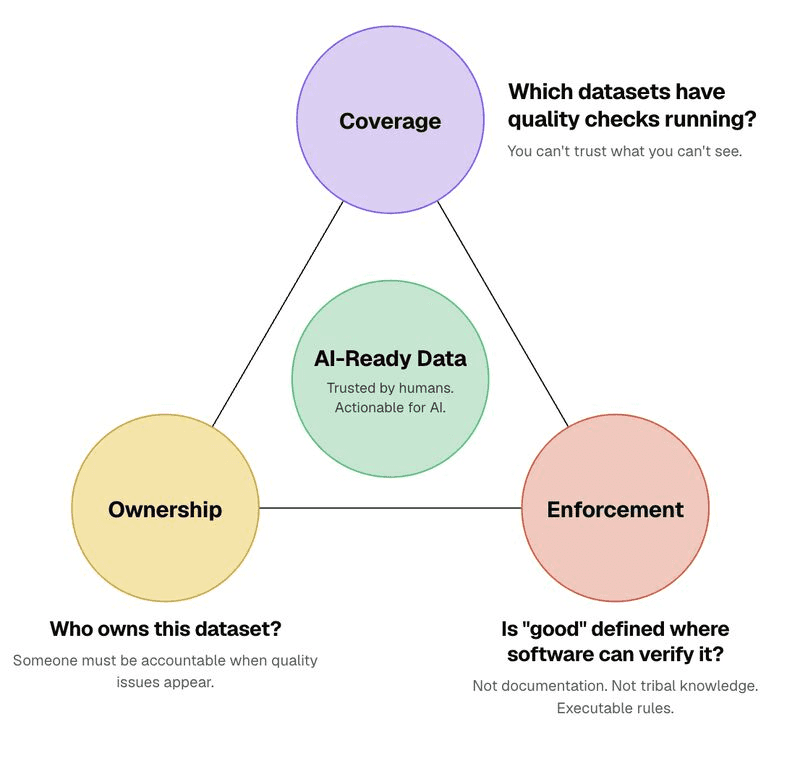
These three are the operational core; the wider organizational readiness — a documented governance framework, a catalog in use, observability, data literacy across the team — is its own checklist, which we lay out in our guide to AI governance and data quality.
Soda AI gets your data AI-ready
Doing all that by hand — reconciling which datasets have checks, who owns them, and where "good" is actually written, across an estate that only grows — is the slow part.
Soda AI does it for you, far faster and across your whole estate at once, so you can get trusted data that's ready for any AI-driven workflow.
You can see how AI-ready your data is, close the gaps with contracts, put the right owners in place, and keep every change under your approval. No SQL, no code, and it works on metadata, never your raw rows.
Let’s see how.
Check the state of your data
Soda AI changes the interface you work on. Instead of hunting across tools, you ask in one place, and Soda retrieves the answer and can act on it. Here are four important aspects to track in terms of coverage:
Which datasets have checks at all?
Which are breaking right now?
Which have no accountable owner?
Which have gone stale?
The answers come back as one estate snapshot. Nothing to set up, nothing to connect.
Getting this same picture by hand, reconciling checks, owners, and failures across sources, used to take weeks. Now, it can take a few minutes of your day.
In Soda AI Chat Interface
Go to Soda Cloud, open the in-product chat interface, and ask a plain question to Soda AI: What is the data quality coverage across all data sources?
In the example below, the answer comes back with 96 datasets, but only about a third have quality checks running against them. The rest have nothing verifying they're fit to use.
↗ Soda AI chat returning a data-quality coverage snapshot across all data sources: datasets, coverage %, checks configured, and failing datasets.
From here, you can go deeper. Ask Soda AI to show coverage by data source, and it breaks the number down with a short read on which domains have the least coverage. You can act on what you find in the same conversation: assign an owner to a neglected source, or flag the datasets that need a contract first.
Watch a full demo of Soda AI for Data Governance Leaders & CDOs.
From your own agent, over MCP
Connect an agent you already use, like Claude or Cursor, to Soda through the Model Context Protocol. It reads your contracts and quality status directly and can act on them, so you ask the same questions from the tools you already work with.
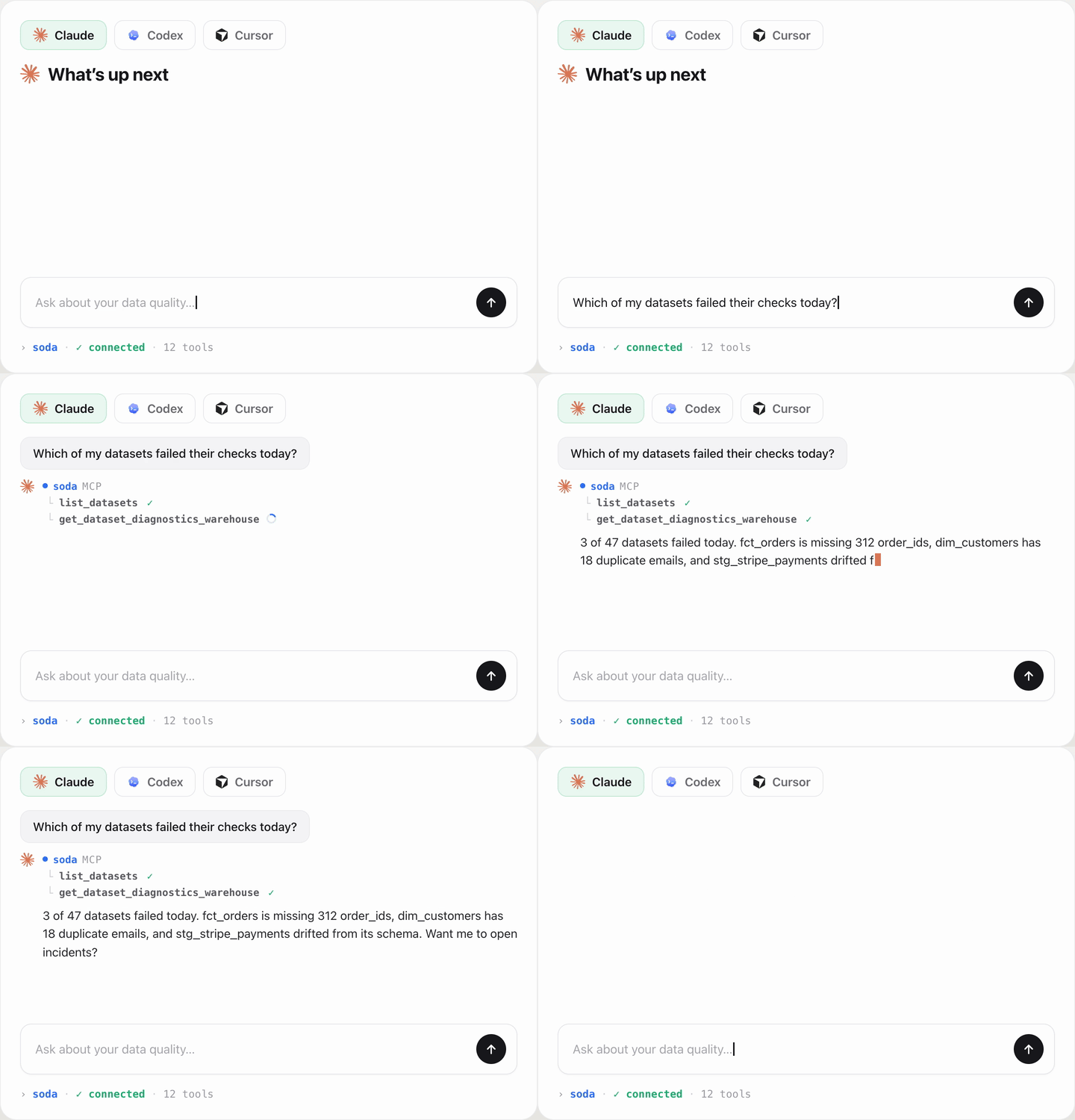
Important: A coding agent like Claude or Cursor gets no special access; it inherits your permissions and still proposes every change for approval.
Here's how to pick between the CLI, API, and MCP for a given job.
The question now is: would you let AI act on an estate where two-thirds of the data has no quality insurance at all? Neither would a regulator. Seeing the gap is the first step to closing it.
Close data quality gaps without waiting on a ticket
Seeing the coverage gap is one thing; closing it used to mean a ticket to engineering and a long wait. Now the governance manager can close it themselves if they want to.
In order to get data both your people and your AI models/agents can trust to use safely, data needs to meet a standard of quality that is enforced automatically, instead of sitting in a policy doc.
Enforcement is the missing piece, and a data contract provides it: a machine-readable definition of what good data looks like, with the rules and their enforcement in the same file, re-checked on every scan — so the data keeps proving it's ready instead of being certified once and quietly drifting.
Soda contracts have a user interface so any user can work on it, technical or not.
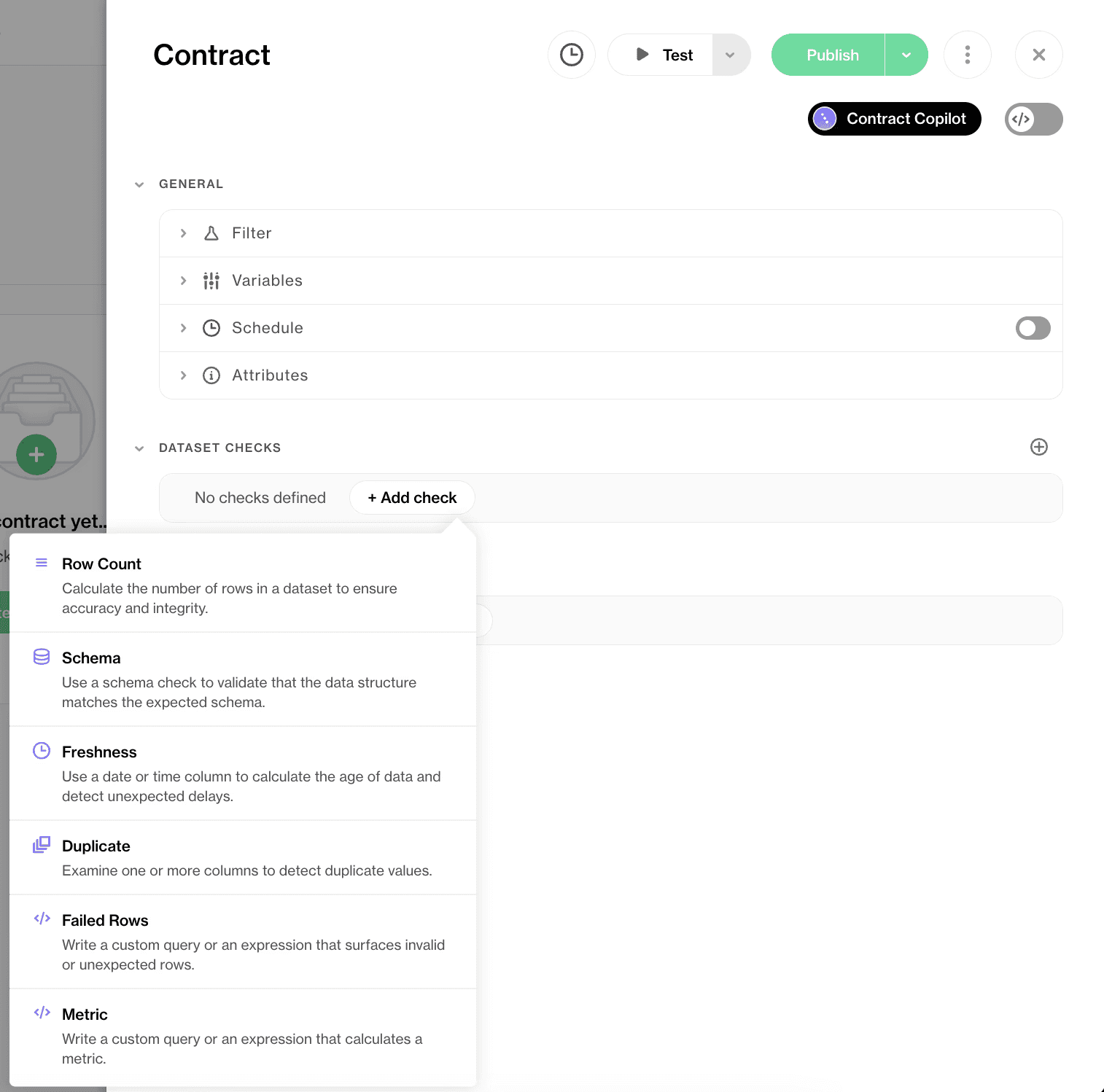
For how contracts move from draft to enforcement, our guide to data contracts walks through the mechanics.
There are two ways to fill the data quality coverage gap we found before:
Get quick coverage across your sources
To get coverage, point Contract Autopilot at your uncovered datasets and it writes a populated contract for each, with recommended checks drawn from the data itself. Three things make this faster than writing contracts by hand:
No blank page — you refine a working draft instead of authoring rules from scratch.
Every source at once — it covers datasets in bulk across all your sources.
Checks that fit the data — each one is recommended from that dataset's own profile, not generic rules.
See it in action below:
Add what only your team knows
For the rules that need domain knowledge, Contract Copilot lets the steward in your team or the business owner add a rule in plain English — say, a customer can't be marked "active" with no signed contract on file.
Copilot writes the checks to the data contract so you don’t need to handle SQL or any code syntax. It proposes the change and shows exactly what it wrote, so the person who knows the data stays in charge.
Watch Copilot iterate on a contract, and the role of the human in the loop:
This is the shift that makes AI-ready data reachable. Instead of hand-authoring hundreds of contracts, the governance manager reviews drafts and approves what gets enforced. Coverage stops being a project you wait on and becomes a queue you work through.
Want to see what these contracts look like before you draft your own? Explore the data contract templates.
Stay in control of every change
Everything so far — reading coverage, drafting contracts, reassigning owners — runs through one gate: the owner reviews and approves what gets enforced.
Soda AI shows you exactly what it's about to do and waits. It can only ever propose what you already have the rights to do; its actions are scoped to your data source permissions, so it can't reach anything you couldn't reach yourself.
Here's what that looks like in practice. Say you notice a whole data source is owned by the wrong person, so you ask Soda AI to fix it: "add this teammate and assign them every dataset in that source." Instead of just doing it, Soda AI checks the current state first and reports back — this person isn't in your Soda workspace yet, and the source has eleven datasets currently assigned to someone else. It lays out the change it would make (add the user, reassign all eleven) and waits for your yes.
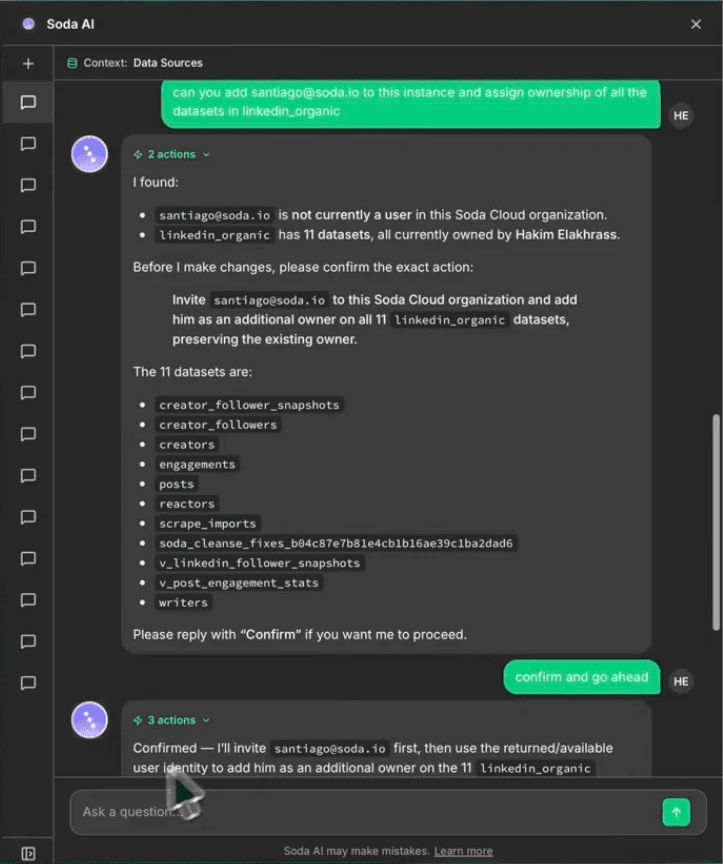
You approve once. Soda does the rest.
What changes for the governance team
The change isn't a new tool to learn. It's a shorter path between a governance question and an answer you can act on.
Without Soda | With Soda |
|---|---|
No single read on how much of the estate has data quality checks | Ask Soda for data quality coverage and get an estate snapshot back in seconds |
Ownership tracked in spreadsheets, wrong people on the wrong data | Assign owners in plain language, staged for your approval |
Policy in a catalog, enforcement left to chance | Executable contracts drafted by Autopilot, evolved in plain English |
AI-readiness as a multi-quarter program | Coverage that starts as a working draft you refine |
Audit evidence assembled by hand | A current record where every change has an owner and a timestamp |
The through-line is control. The manager still decides what "good" means and what gets enforced. Soda AI does the drafting, the reading, and the routing, then hands each decision back for a yes or no. The anomaly detection behind these checks is tuned to surface real problems over noise, which means fewer false alerts to triage and more trust in the ones that land.
Audit-ready and private by design
The supporting pieces stay where governance already lives. Failed-record evidence stays in your own environment through the Diagnostics Warehouse. Quality results flow back to your catalog through Soda integrations, so the people who read the catalog see the same truth.
For teams under frameworks like BCBS 239 or the EU AI Act, that record is the auditable evidence an examiner asks for. It doesn't make you compliant on its own, but it removes the scramble to assemble proof after the fact.
Soda works from metadata, not your raw rows: schema, profiling stats, and your contracts, never the underlying data itself. (If you ever want it to check actual sample rows, that's an explicit opt-in.)
For a governance lead who has to defend every automated decision in an audit, that combination — propose-then-approve, scoped permissions, and no raw data leaving your environment — is what makes Soda AI safe to adopt where the data actually matters.
By integrating governance definitions with systems that can execute and evaluate those expectations, teams close the gap between policy and practice. Read our article about how to Operationalize Data Governance with Collibra and Soda.
Where this applies beyond your team
This loop isn't tied to one industry or one level of data maturity. Any organization moving AI from pilot to production hits the same wall: the model is ready, the data isn't, and someone in governance has to close that distance.
Regulated sectors feel it first. In financial services, healthcare, insurance, and the public sector, "the AI acted on bad data" is a compliance event. A contract-first approach gives those teams the speed of AI-driven data quality without giving up the inspectability they're required to keep.
The same pattern runs one level down, at the record a steward reviews, which we walk through in a day in the life of a data steward.
Wrap up
Getting data AI-ready is the governance team's new job — and, for the first time, one you can keep pace with. You still hold the same control you always had: you decide what "good" means and approve every change. What's new is the reach to prove it across the whole estate, in plain language, instead of one ticket at a time.
The fastest way to see it is against your own estate. Book a demo and we'll run the coverage question live, on a workspace that looks like yours.
Frequently Asked Questions
What is AI-ready data?
AI-ready data is data an AI agent or a person can trust because it has quality checks enforcing it and an accountable owner. It goes beyond clean data: the checks and the ownership are what let you prove the data is fit for a model to act on.
Will AI replace data governance?
No. AI automates the manual parts of governance, drafting contracts, reading coverage, and routing issues, but it keeps a person accountable for what gets enforced. Soda AI proposes actions and waits for approval, so the governance manager stays the decision-maker, not the middleman.
What's the difference between AI governance and data governance?
Data governance makes your data trustworthy through standards, ownership, and enforced quality. AI governance builds on that foundation to manage how models use the data. You can't do the second well without the first, which is why data quality and governance come first.
How fast can we get coverage across sources with Soda AI?
Contract Autopilot drafts contracts from your own data, so coverage starts as a working draft rather than a multi-quarter project. Autopilot is currently available on request for Soda Cloud, so the practical first step is switching it on for the sources with the widest gaps.
Does Soda AI read our raw data or PII?
It works from schema, metadata, and your contracts. Your raw data isn't sent to the model by default, and any row sampling is opt-in. For teams that need it, bring-your-own-key (available on Soda v4) keeps model requests inside your own account.