A Day in the Life of a Data Steward

A Day in the Life of a Data Steward

A Day in the Life of a Data Steward

Kavita Rana

Kavita Rana

Kavita Rana

Rédacteur technique chez Soda

Rédacteur technique chez Soda

Table des matières

Every company wants clean and trustworthy data, and most assume that will just… happen. It doesn't. Without someone accountable for definitions, lineage, and quality, analysts end up debugging dashboards they shouldn't have to, engineers inherit governance work outside their mandate, and the same metric means three different things in three different reports.

That's the gap a data steward fills, a role most people have heard of and few understand. This article walks through a steward's day inside Soda: triaging anomalies, defining contracts, investigating incidents, and approving agent-assisted remediation in a single workflow.

Key Takeaways

  • A data steward's core responsibility is maintaining context: documenting definitions, tracing lineage, flagging issues, and bridging technical and business teams.

  • Stewardship is foundational infrastructure, not administrative overhead. It's the connective tissue between strategy and execution that keeps definitions stable, lineage intact, and trust earned.

  • Four steward archetypes exist (business, technical, domain, and operational), and most teams need a combination, not one hire covering everything.

  • Governance fails when stewards are accountable for quality but have no tooling to see how data actually behaves over time.

  • Inside Soda, stewards triage anomalies, define contracts, investigate incidents, and approve agent-assisted remediation in one workflow, turning governance from documentation into operational practice.

What is a Data Steward?

A data steward ensures data is usable, trusted, and understood by everyone who relies on it. The role centers on maintaining context: the definitions, lineage, ownership, and decision history that separate numbers in a database from decision-grade information. In organizations with unclear governance and ownership, stewards are the difference between data as a liability and data as an asset.

Stewardship is not administrative overhead. It is foundational infrastructure. Without stewards, definitions drift, metrics diverge across dashboards, lineage breaks, and trust erodes. Data stewardship is the connective tissue between strategy and execution. That's the layer that makes governance policy actually execute in the real world.

Key components of the role include:

  • Definition management: owning the glossary of critical business terms and keeping meanings stable as systems evolve.

  • Data quality oversight: monitoring datasets and dashboards for missing context, semantic drift, and regressions.

  • Lineage and ownership documentation: preserving how data moves and who is accountable for each step.

  • Issue investigation: tracing anomalies to root cause rather than patching symptoms.

  • Access and retention: deciding who should see what data and how long records are kept, especially in regulated industries.

  • Stakeholder facilitation: translating between engineering language and business language so both sides work from the same understanding.

A common misconception: stewards are not janitors who clean up bad data after the fact, and they are not policy police who block teams from moving. They are enablers.

Stewards should facilitate and escalate, not execute. That means they make sure issues reach the right owner rather than trying to fix everything themselves.

Data Stewardship is applied, investigative, and interpretive endeavor. This role is the connective tissue between how data is produced, how it behaves, and how people rely on it.

Data Steward vs. Data Owner: What's the Difference?

Data owners are accountable for a data domain at the strategic level.

Data stewards execute governance at the operational level.

The distinction matters because collapsing them into one role is how governance programs burn out their best people.

  • Owners set policy, approve standards, and hold accountability for business outcomes tied to the data.

  • Stewards implement that policy, maintain quality, manage metadata, and run the day-to-day cadence of checks and reviews.

Both roles are necessary, and neither replaces the other. The common failure mode is combining both into one overloaded role. That usually happens because the organization didn't fund the steward position, which guarantees the strategic work gets deferred while the operational fires consume the week. This pattern is especially visible in mid-market companies that assume governance is something their data platform will handle automatically.

For a deeper look at how ownership and stewardship fit inside a full governance operating model, see our data governance framework guide.

Types of Data Stewards

Data stewardship is not a one-size-fits-all role. Four types serve different organizational needs, and most mature data programs use a combination rather than a single hire covering everything. You don't need all four roles staffed separately (many teams start with one person wearing multiple hats), but recognizing the categories helps clarify where ownership sits.

  • Business stewards focus on semantics, definitions, policies, and outcomes. They answer "what does this term mean in our business?" and maintain the glossary of critical terms. Business stewards typically sit close to leadership and own shared vocabulary across the organization.

  • Technical stewards handle metadata, quality monitoring, and integration concerns. They work upstream of the reports, making sure the pipes are clean. Technical stewards partner closely with data engineering and are often the first reviewers on new data contracts.

  • Domain stewards support specific functions (finance, sales, operations, HR) and maintain the contextual knowledge of how data is used in those domains. They know which fields are load-bearing for quarterly close, which are cosmetic, and which have historical quirks nobody has documented.

  • Operational stewards embed inside execution teams and reinforce data practices in daily workflows. They are the closest to the people producing the data, and they catch issues before the issues become incidents.

Business stewards ensure consistent definitions, shared vocabulary, and alignment on outcomes. Technical stewards: manage metadata, monitor data quality, and oversee integration concerns. Domain stewards : support a specific function (finance, sales, operations) and maintain contextual knowledge. Operational steward: works close to execution teams and reinforce data practices in daily workflows.

Whether these responsibilities sit with one person or several, what matters is recognizing them and assigning clear ownership. Organizations that leave stewardship undefined end up with engineers doing business-steward work and analysts doing technical-steward work, and neither group is set up to succeed at it.

Why are Data Stewards needed?

Analysts turn data into answers. Engineers move data and keep it flowing. Their jobs are demanding already and it can be unfair to expect them to fill in the shoes of a steward as well. Stewardship is simply different work.

Without someone maintaining the context, three things fail in sequence.

  • First, definitions drift: the same term means different things to different teams.

  • Second, trust erodes: stakeholders stop believing the numbers and start maintaining shadow spreadsheets.

  • Third, governance collapses into documentation nobody reads.

A data steward is responsible for ensuring that data is usable, trusted, and understood not just by analysts or engineers, but by everyone who needs it.

Which Tools Do Data Stewards Use?

Modern stewards need tooling that makes quality visible, metadata accessible, and contracts enforceable without routing every change through engineering. The category has matured quickly in the past years, and the practical stack now looks something like this:

Data catalogs. Tools like Collibra and Atlan handle metadata, glossary, and lineage visualization. They are the system of record for "what exists and what does it mean." Catalogs are where business stewards spend most of their time.

Data quality platforms. Tools like Soda handle monitoring, contracts, and anomaly detection. They are the execution layer: detection, enforcement, and audit trail. Technical stewards spend most of their time here.

The end-to-end governance layer only works when governance and quality systems are bi-directional: metadata flows into the quality layer, quality results flow back to the catalog.

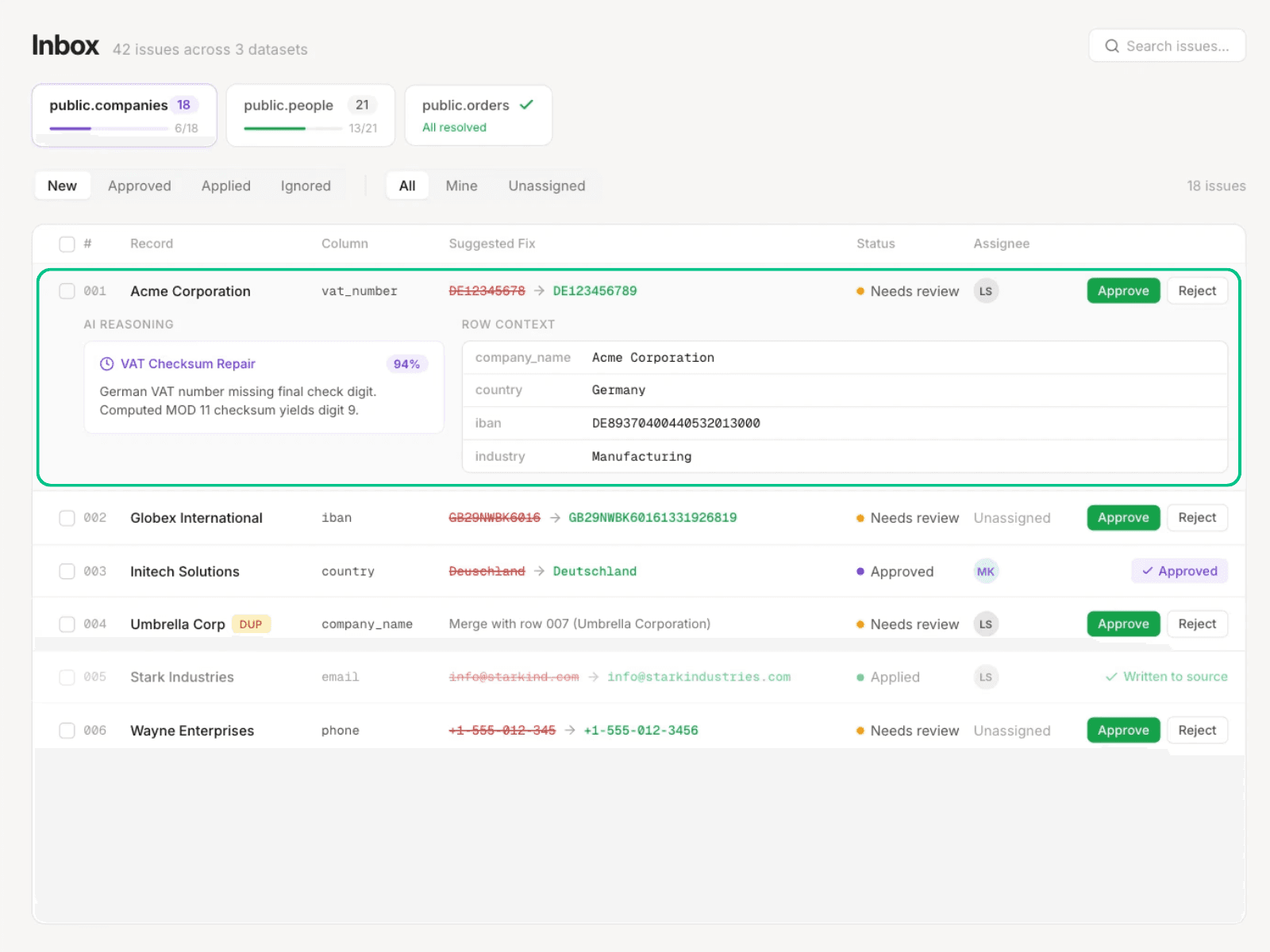
Automated remediation. Newer to the stack, agentic cleansing tools like Soda Cleanse go one step further. They propose fixes for failed records, route them to the responsible steward for approval, and keep a full audit trail of every decision. The human still governs; the agent does the janitorial work.

A Day in the Life: What the Work Actually Looks Like

Data stewards are answerable for keeping data healthy and usable. In day-to-day terms, a data steward is:

  • Defining terms clearly, so analysts, engineers, and executives stop arguing about what exactly counts as a "user," "revenue," or "active customer."

  • Tracking lineage and changes over time: how did this value get here? what upstream change produced the drop in this week's number?

  • Flagging silent failures: missing, duplicate, or incorrect records that produce a confident number which happens to be wrong.

  • Monitoring SLAs and quality rules (freshness, completeness, schema stability, accuracy) and deciding what "acceptable" means for each dataset.

  • Making access and retention decisions: who should see this, and how long should we keep it? These are governance calls stewards make every week in regulated industries.

  • Acting as go-between for technical and business teams, translating "the schema changed" into "your Q3 forecast will be off by 3%" and vice versa.

The real work has a rhythm, and the best way to understand that rhythm is to walk through what a steward actually does inside a modern data quality platform. Here's how a typical day unfolds for a steward working in Soda.

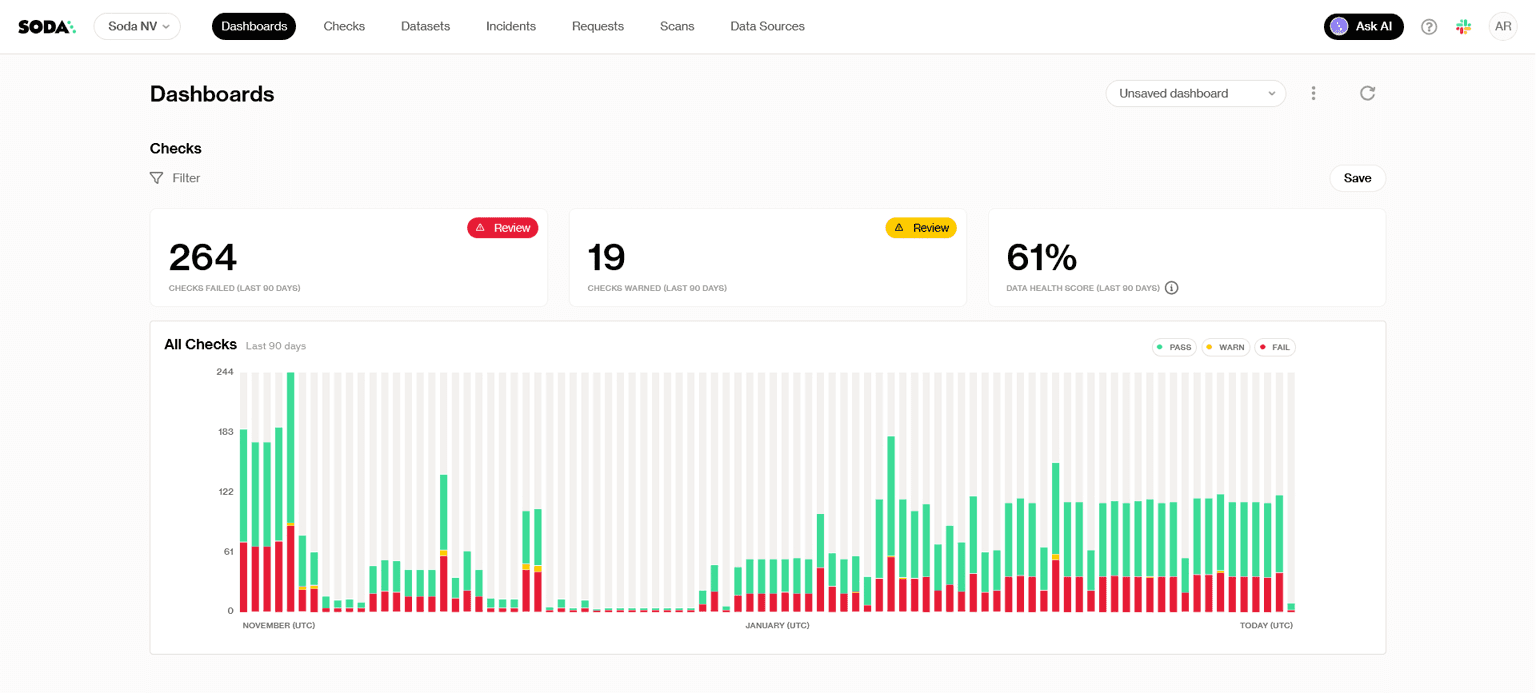
Triaging the Work Queue: Organization Dashboard

The day starts in Soda's organization dashboard. Overnight scans, incidents, and requests from data consumers all surface in a single view, filtered to the domains the steward owns.

Three things sit on a typical morning triage list:

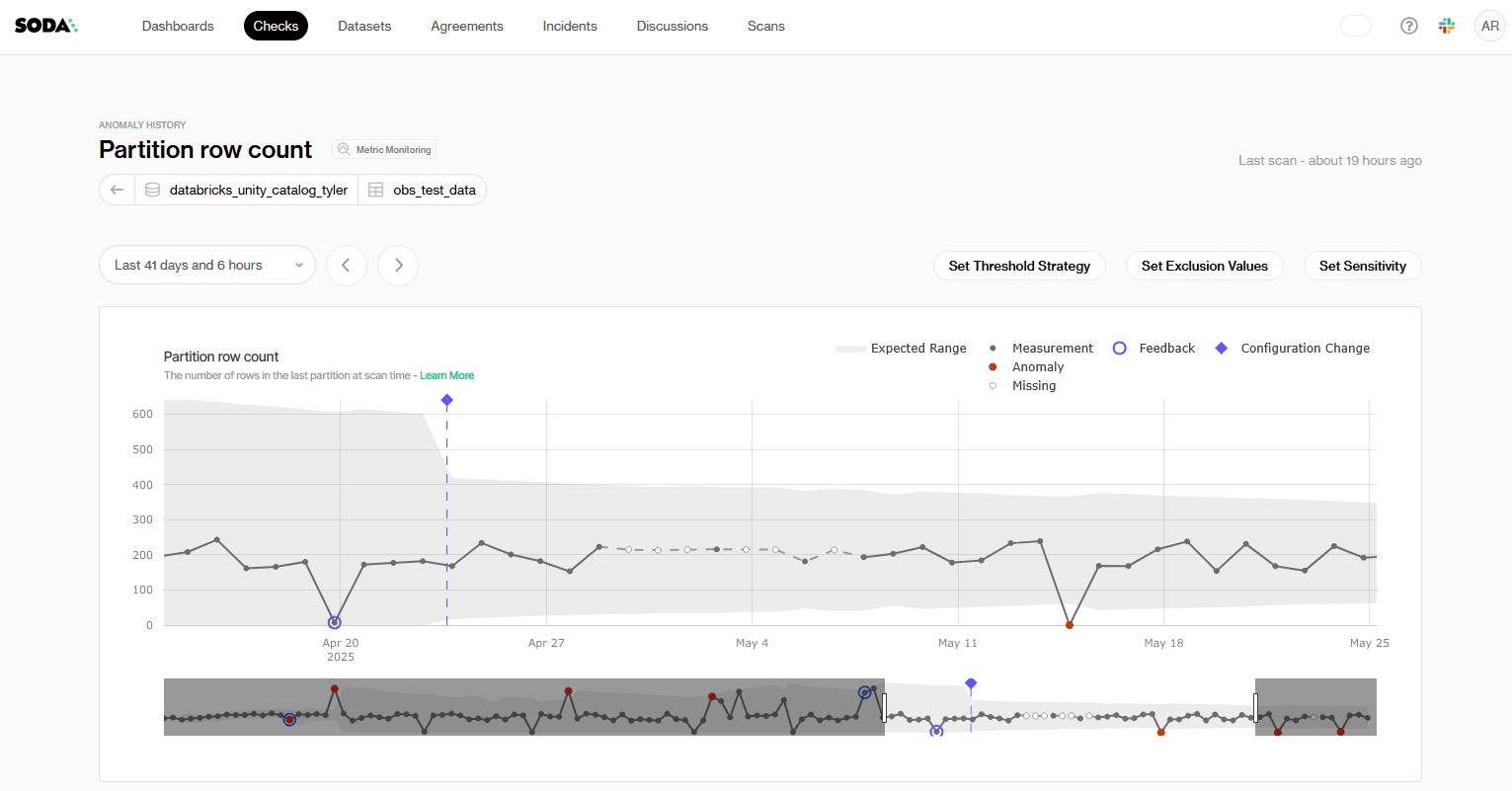
  • Anomalies flagged by Soda AI. Red markers on the metric time series show deviations the automated detection caught overnight. One click opens the detail panel with the historical trend, so the steward can mark the point as expected (feeding the model's learning loop) or escalate it to an incident.

  • Incidents in the steward's domain. Automatic ownership routing means only the incidents tied to the steward's datasets land here, each with the triggering check, who reported it, and the current status.

  • Requests from data consumers. Analysts and business users can propose standards or flag questions via the Request panel, and those queue up alongside the quality signals.

From here, the steward approves, defers, or pins the items that will shape the day. Smart Alerting keeps the queue focused instead of drowned in noise.

Monitoring Data Behavior: Automated Anomaly Detection

Once the steward onboards a new dataset, Soda immediately reconstructs the dataset’s history and displays a full year of patterns. Baselines, trends, and stability ranges are visible even before the first new scan runs.

Each scan afterwards will add onto that context. The metric monitoring dashboard will instantly surface deviations or anomalous behavior in the datasets. It can track checks through two levels.

Dataset-level checks:

  • Row volume changes

  • Data freshness delays

  • Schema evolution (added, missing, or changed columns)

Column-level checks:

  • Spikes in missing values

  • Increases in duplicates

  • Shifts in numeric averages

Here, the main job of the data steward is to configure the dashboard according to the specific demands of each dataset.

The three configurations you can use to fine-tune results are:

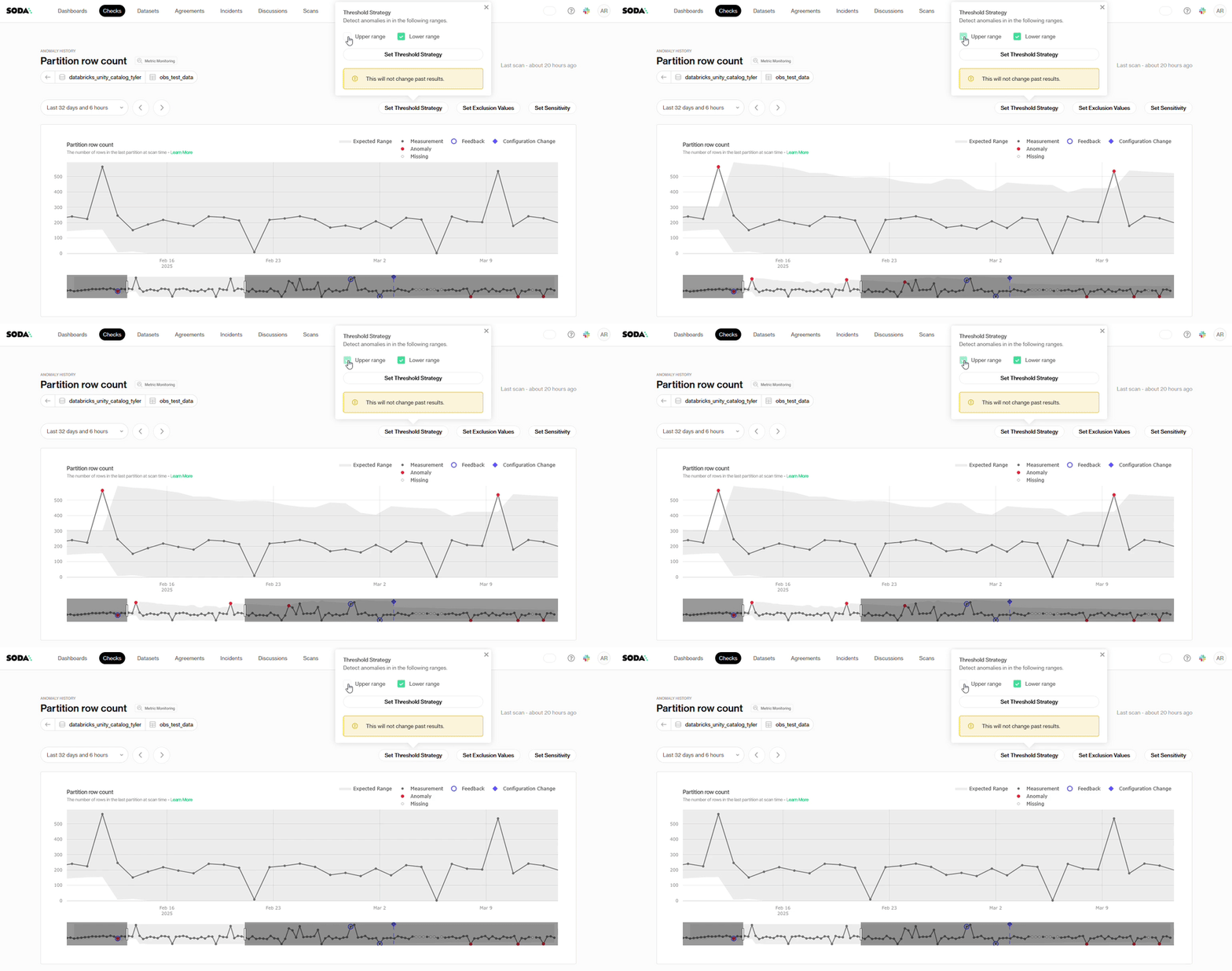
  1. Threshold Strategy: Some datasets require strict oversight of drops, while surges create no real risk. If your metric behaves this way, you enable the lower range and focus only on downward movement.

Configuration of Threshold Strategy
  1. Exclusion Values: Test rows, placeholder timestamps, and known maintenance gaps are examples of repeating values in some datasets that have no analytical significance. You can add an exclusion value when that pattern appears in your data so Soda ignores those points and excludes them from anomaly assessments.

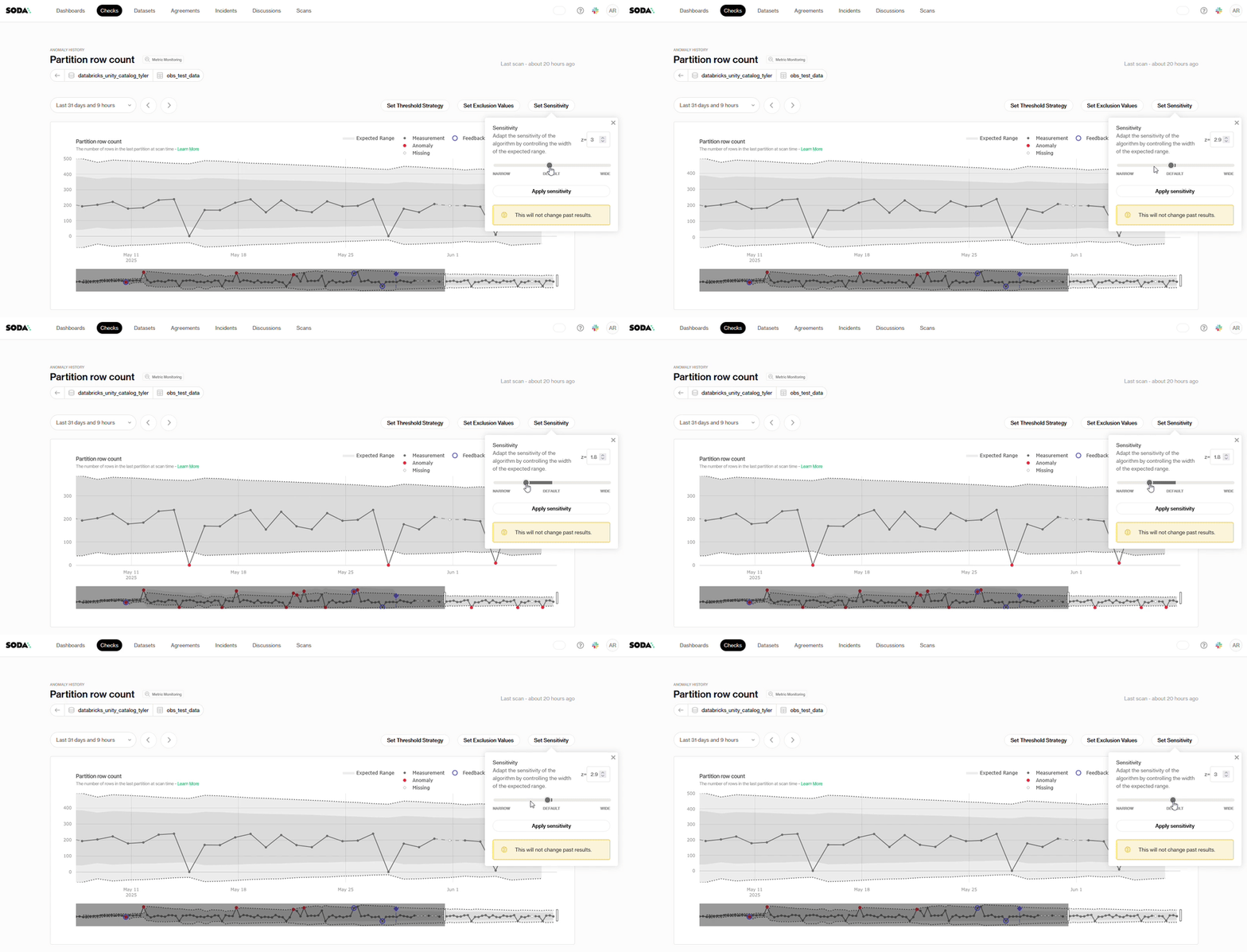
  2. Sensitivity: Some datasets behave predictably, and you may want alerts for even the slightest discrepancy. For those, set a lower z-score. Other datasets shift naturally, so a higher z-score broadens the band and highlights only the biggest movements.

Configuring Sensitivity

Soda handles the pattern recognition while you shape what “important” means for your team.

Investigating an Anomaly: Incident Management

Data quality issues can be from haphazard sources—dashboards, Slack threads, ad hoc reports, and pipeline failures. Each one arrives with limited context and threatens to spread to other systems.

“Did this start today?” or “Who touched this table?” This way stewards spend more time reconstructing the timeline than resolving the issue. That effort scales poorly as companies grow.

Soda has a single-window workflow for this entire process. When the anomaly detection model highlights an unusual metric value, you see the signal immediately in red on the time series.

Check out this video tutorial on Incident Management

One click opens a detail panel with the metric, the values involved, and the historical trend out of which the anomaly has sprung up. If the behavior aligns with known patterns or business activity, you mark the point as expected. The model learns from that feedback and adjusts its understanding of your data rhythms.

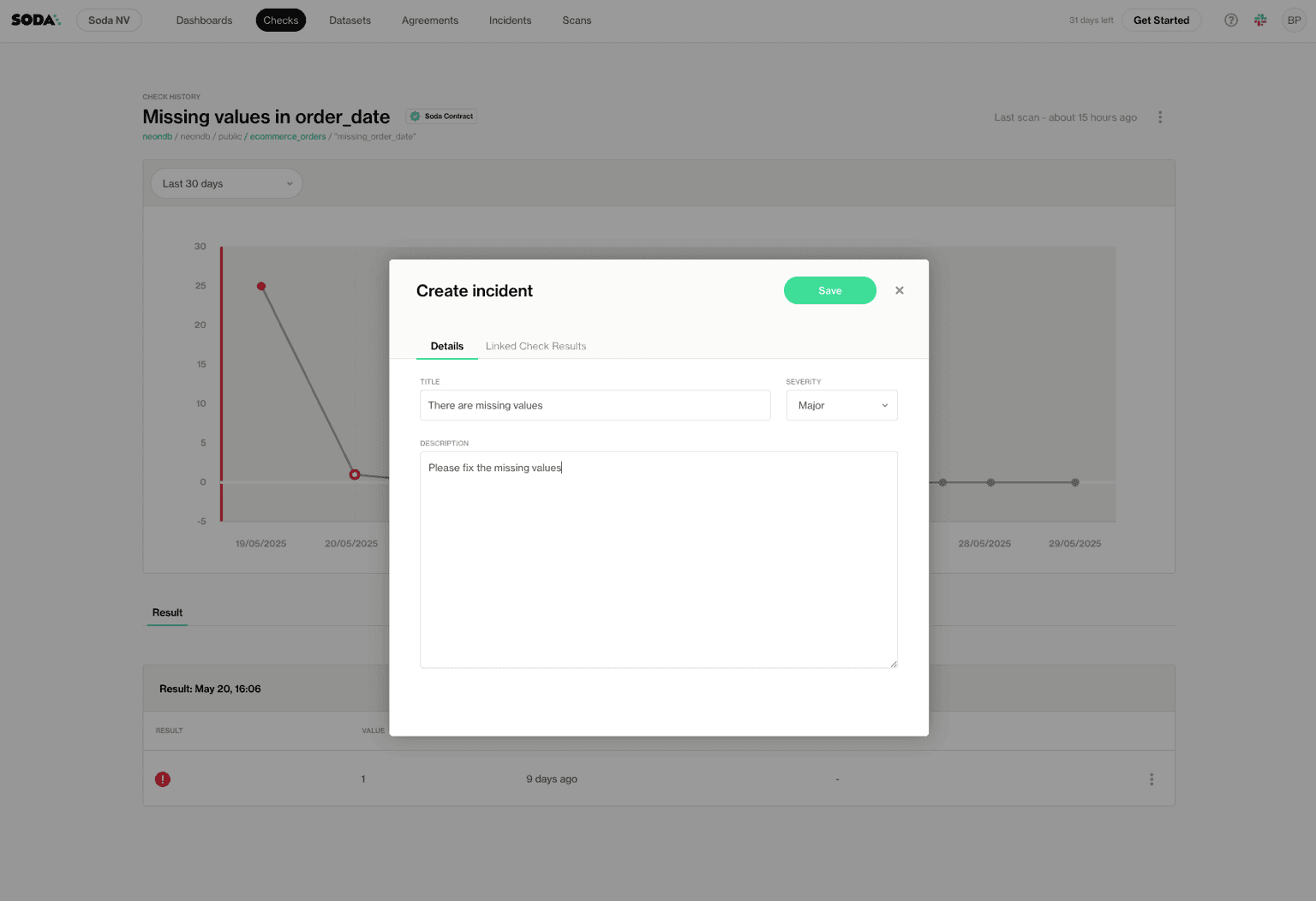
If the point requires deeper investigation, you create an incident directly from the same panel. The incident form opens with the essential fields: title, description, and linked dataset context. Soda records who reported it, when it occurred, and which check or metric triggered it.

The entire chain stays intact, and this structure replaces the ad hoc investigations that usually hide in chats.

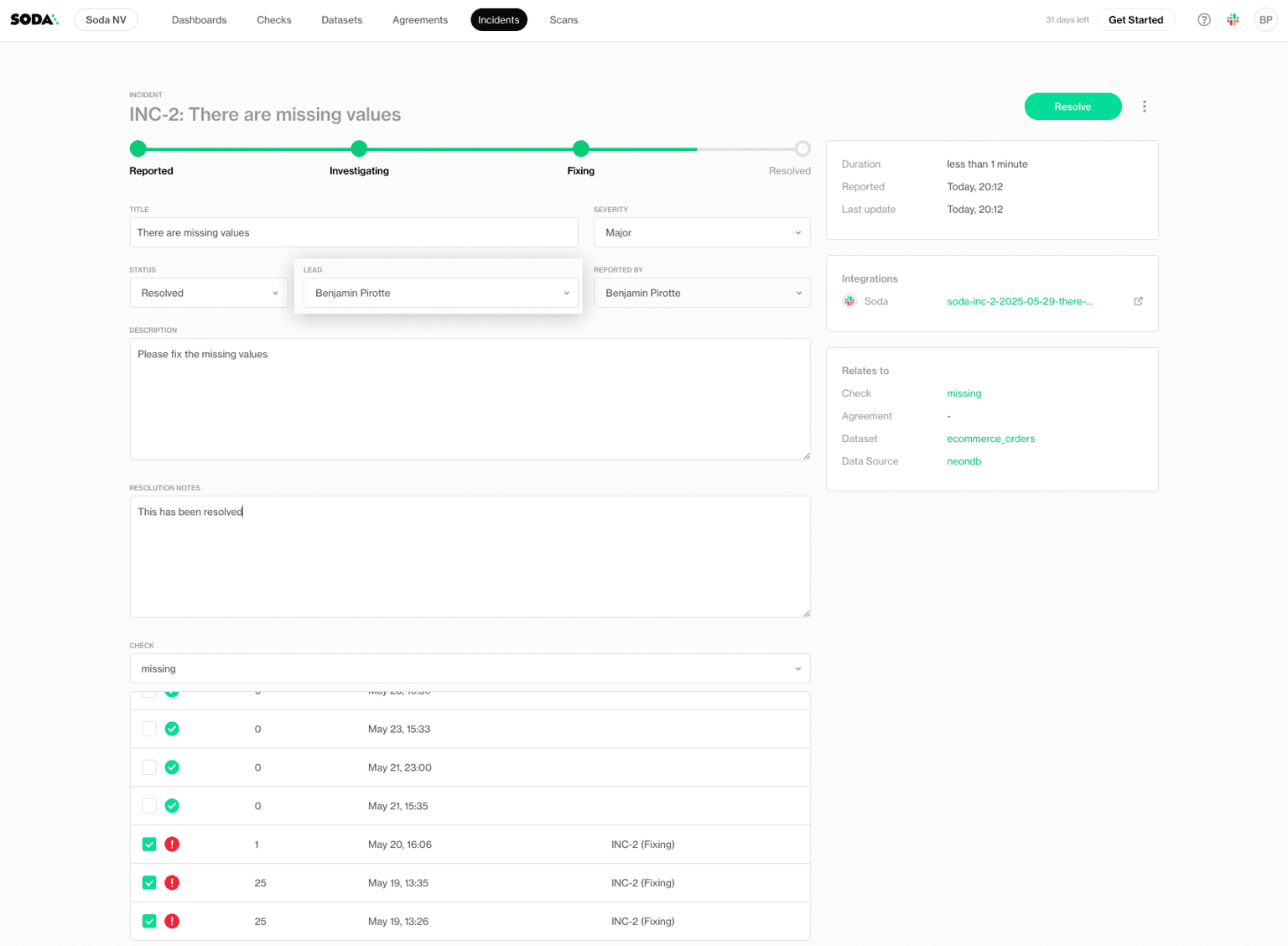
You can also continue the workflow in the Incidents tab, where you can assign a lead, define severity, and set the status. Slack, Jira, and Teams integrations extend the workflow further.

Defining Expectations: Data Contracts

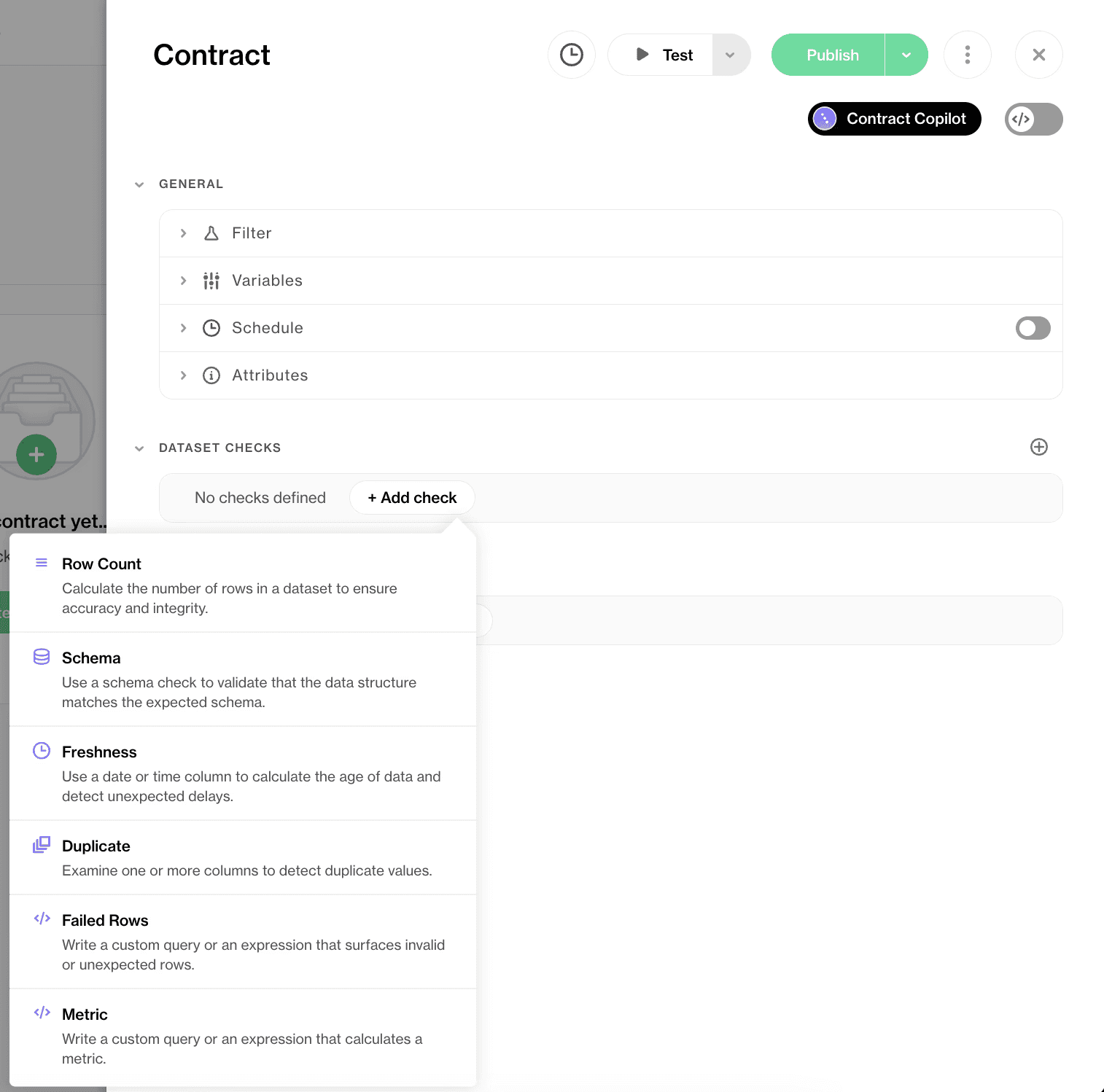
Data contracts are tools to formalize expectations around quality standards for a given piece of data. They aim to give teams a shared agreement about what “good data” means. Soda's no-code data contracts empower data stewards to translate written policies into executable checks and apply rigorous rules over data quality.

Schema, rules, freshness, threshold levels—everything about your dataset can be monitored and verified using the contracts. When the data changes, the contract verifies it automatically, and both sides, technical and business, see the result.

example soda data contract UI


If necessary, Contract Copilot converts plain-English rules into executable checks, so the steward doesn't need to write SQL to codify a policy.

soda contract copilot in action

Collaborating Across Teams: Requests

Every UI change has a synced YAML counterpart, which the responsible data engineer reviews and approves before deployment. Stewards define, engineers approve, both from the same artifact.

Users can clarify needs, align on requirements, and discuss next steps via the Request feature. All conversations will be stored in one place.

data contract requests panel

Prioritizing and Remediating Issues: Soda Cleanse

For chronic, high-materiality issues like this, Soda Cleanse proposes fixes via specialized agents (entity normalization, imputation, deduplication, reconciliation), routes them to the steward's inbox for approval, and keeps an immutable audit trail of every failure in the Diagnostics Warehouse. The steward governs; the agent does the janitorial work.

What Changes for the Steward

The steward workflow shown above isn't tied to one industry or data maturity level. Any organization with twenty or more critical data elements and a named steward function will recognize the same pressure points: definitions drifting, incidents piling up in Slack, engineers inheriting governance work they didn't sign up for, audit evidence assembled by hand.

Soda is an AI-native data quality platform designed to make data governance operational. It gives data stewards direct visibility into how data behaves, detects quality issues automatically, and provides a structured path from detection to resolution.
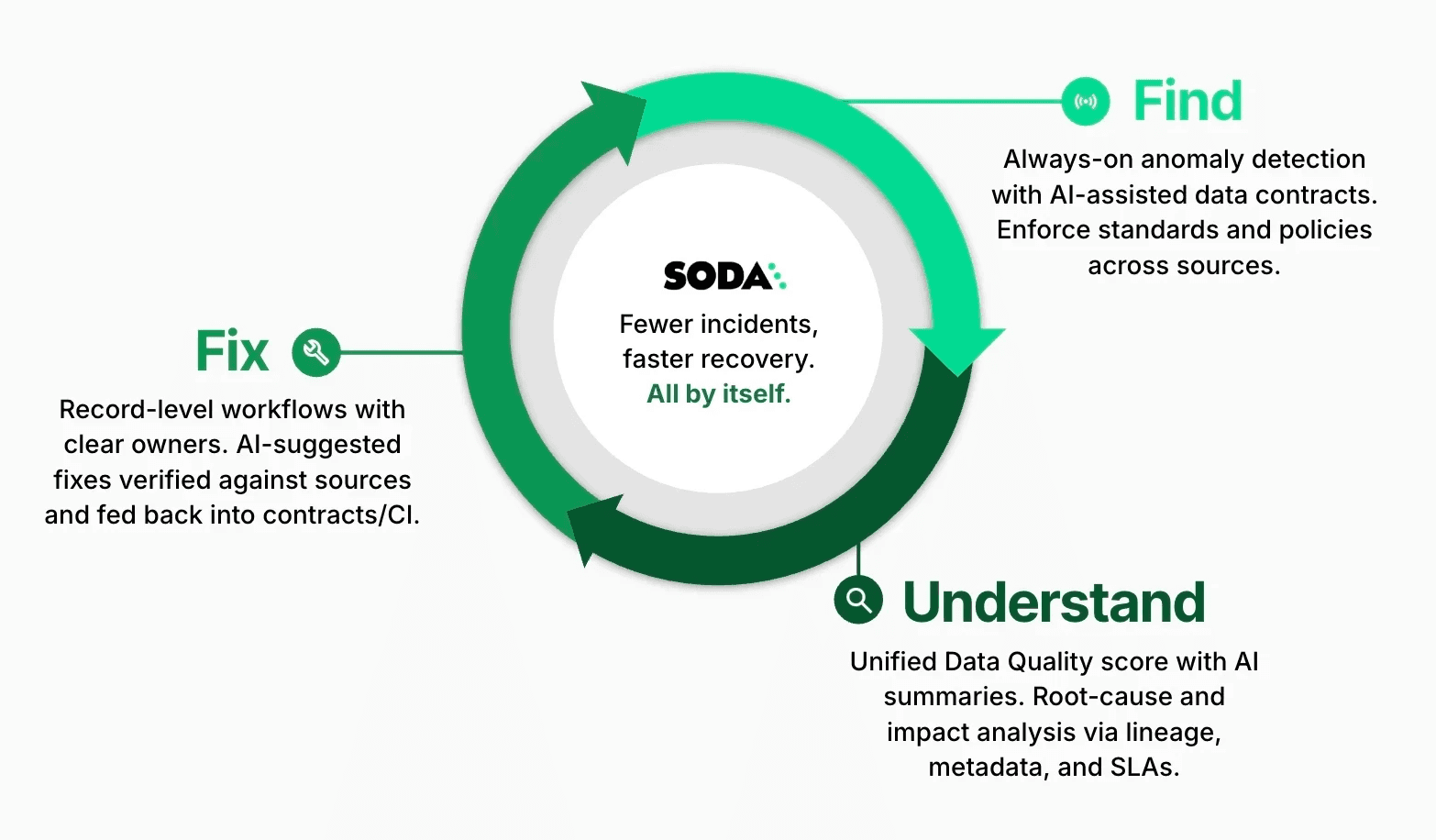
Working inside Soda compresses the steward's day at every step.

Without Soda

With Soda

Manual middleman: chasing teams through Slack, spreadsheets, and tickets

Single-pane triage with automatic ownership routing

Assembling audit evidence by hand from logs and dashboards

Every failed record and validation preserved in the Diagnostics Warehouse

Policy in Confluence, enforcement by hope

Executable checks synced between UI and YAML

Investigation scattered across Slack, Jira, and BI tools

Anomaly → incident → assignee in one workflow

Remediation waits on engineering tickets

Specialized agents propose fixes the steward approves

Get started by requesting a free account.

Why Governance Fails Without Stewards

Data stewards are accountable for data quality, but governance breaks down because that accountability is not paired with operational authority.

Held responsible for quality without visibility into how data behaves, stewards can't point to objective evidence when raising concerns. Producing that evidence typically requires manual reconstruction: querying logs, comparing dashboards, reviewing historical outputs. By the time it's gathered, urgency is lost and decisions are deferred.

Over time, operational responsibility drifts toward data engineers. Pipeline owners become the default problem-solvers even though the root issues sit upstream in definitions and agreements. Data engineers inherit quality ownership without a mandate; stewards retain accountability without authority. Both groups are strained, and the data ecosystem loses its dedicated mechanism to enforce quality.

Governance works when the people who define expectations can also shape how those expectations are enforced. That shift, from "stewards write rules, engineers enforce them" to "stewards define and enforce directly," is what makes the role load-bearing in modern data stacks.

Organizations that invest in stewardship paired with data contracts see measurable improvements in trust and adoption.

Want to see the steward workflow running against your own data? Book a demo and we'll walk through detection, incidents, contracts, and remediation with your team, mapped to the datasets and stack you work with today.

Frequently Asked Questions

What does a data steward do?

A data steward ensures data is usable, trusted, and understood. The role covers six core responsibilities: defining business terms, tracking lineage, flagging quality issues, monitoring SLAs and rules, managing access and retention decisions, and bridging technical and business teams. The work is applied, investigative, and interpretive rather than administrative.

What is the difference between a data steward and a data owner?

Data owners hold strategic accountability for a data domain: they set policy, approve standards, and answer for outcomes. Data stewards execute governance operationally: they implement policy, maintain quality, and manage metadata. Combining both into one role typically overloads the steward and starves the strategic work.

What types of data stewards exist?

Four types: business stewards (semantics, definitions, policy), technical stewards (metadata, quality, integration), domain stewards (finance, sales, HR context), and operational stewards (embedded in execution teams). Most organizations need a combination, not one hire covering everything. Teams often start with a single person across two or three types and specialize as the program matures.

Do data stewards need to write code?

No. Stewards need technical literacy: enough SQL to query, enough comfort with catalog and quality tools to navigate them, enough familiarity with data contracts to review and approve them. Writing production pipelines is the data engineer's job. The emerging pattern is stewards defining rules in plain English and no-code UIs, with engineers reviewing and approving before deployment.

Does Soda work with my existing stack?

Soda integrates with the major warehouses (Snowflake, Databricks, BigQuery, Redshift), orchestrators (Airflow, Dagster, Prefect), transformation tools (dbt), and catalogs (Collibra, Atlan, Alation). Data stays in your environment — Soda runs queries and stores results under your existing access controls, with self-hosted Kubernetes available if data residency is a constraint.

Can Soda handle regulated-industry audit requirements?

Yes. The Diagnostics Warehouse preserves every failed record and validation inside your environment, producing an audit-ready trail without moving data. Soda supports SOC 2 Type II compliance and self-hosted Kubernetes deployment for finance, healthcare, and government contexts where data residency and immutable evidence are non-negotiable.


Trusted by the world’s leading enterprises

Real stories from companies using Soda to keep their data reliable, accurate, and ready for action.

At the end of the day, we don’t want to be in there managing the checks, updating the checks, adding the checks. We just want to go and observe what’s happening, and that’s what Soda is enabling right now.

Sid Srivastava

Director of Data Governance, Quality and MLOps

Investing in data quality is key for cross-functional teams to make accurate, complete decisions with fewer risks and greater returns, using initiatives such as product thinking, data governance, and self-service platforms.

Mario Konschake

Director of Product-Data Platform

Soda has integrated seamlessly into our technology stack and given us the confidence to find, analyze, implement, and resolve data issues through a simple self-serve capability.

Sutaraj Dutta

Data Engineering Manager

Our goal was to deliver high-quality datasets in near real-time, ensuring dashboards reflect live data as it flows in. But beyond solving technical challenges, we wanted to spark a cultural shift - empowering the entire organization to make decisions grounded in accurate, timely data.

Gu Xie

Head of Data Engineering

4,4 sur 5

Commencez à faire confiance à vos données. Aujourd'hui.

Trouvez, comprenez et corrigez tout problème de qualité des données en quelques secondes.
Du niveau de la table au niveau des enregistrements.

Adopté par

Trusted by the world’s leading enterprises

Real stories from companies using Soda to keep their data reliable, accurate, and ready for action.

At the end of the day, we don’t want to be in there managing the checks, updating the checks, adding the checks. We just want to go and observe what’s happening, and that’s what Soda is enabling right now.

Sid Srivastava

Director of Data Governance, Quality and MLOps

Investing in data quality is key for cross-functional teams to make accurate, complete decisions with fewer risks and greater returns, using initiatives such as product thinking, data governance, and self-service platforms.

Mario Konschake

Director of Product-Data Platform

Soda has integrated seamlessly into our technology stack and given us the confidence to find, analyze, implement, and resolve data issues through a simple self-serve capability.

Sutaraj Dutta

Data Engineering Manager

Our goal was to deliver high-quality datasets in near real-time, ensuring dashboards reflect live data as it flows in. But beyond solving technical challenges, we wanted to spark a cultural shift - empowering the entire organization to make decisions grounded in accurate, timely data.

Gu Xie

Head of Data Engineering

4,4 sur 5

Commencez à faire confiance à vos données. Aujourd'hui.

Trouvez, comprenez et corrigez tout problème de qualité des données en quelques secondes.
Du niveau de la table au niveau des enregistrements.

Adopté par

Trusted by the world’s leading enterprises

Real stories from companies using Soda to keep their data reliable, accurate, and ready for action.

At the end of the day, we don’t want to be in there managing the checks, updating the checks, adding the checks. We just want to go and observe what’s happening, and that’s what Soda is enabling right now.

Sid Srivastava

Director of Data Governance, Quality and MLOps

Investing in data quality is key for cross-functional teams to make accurate, complete decisions with fewer risks and greater returns, using initiatives such as product thinking, data governance, and self-service platforms.

Mario Konschake

Director of Product-Data Platform

Soda has integrated seamlessly into our technology stack and given us the confidence to find, analyze, implement, and resolve data issues through a simple self-serve capability.

Sutaraj Dutta

Data Engineering Manager

Our goal was to deliver high-quality datasets in near real-time, ensuring dashboards reflect live data as it flows in. But beyond solving technical challenges, we wanted to spark a cultural shift - empowering the entire organization to make decisions grounded in accurate, timely data.

Gu Xie

Head of Data Engineering

4,4 sur 5

Commencez à faire confiance à vos données. Aujourd'hui.

Trouvez, comprenez et corrigez tout problème de qualité des données en quelques secondes.
Du niveau de la table au niveau des enregistrements.

Adopté par