
Gartner predicts that 80% of data and analytics governance initiatives will fail by 2027. Plenty of them stall for the same repetitive reason: nobody can say, in one sentence, who actually decides things versus who actually does things. "Data owner" and "data steward" get used interchangeably in meetings, in job postings, even in governance policy docs, and the moment a data quality incident hits, that ambiguity turns into a Slack thread full of people asking who's supposed to be handling this.
Being accountable and being responsible are not the same thing and conflating them is one of the most common reasons governance programs stay stuck at the policy-document stage.
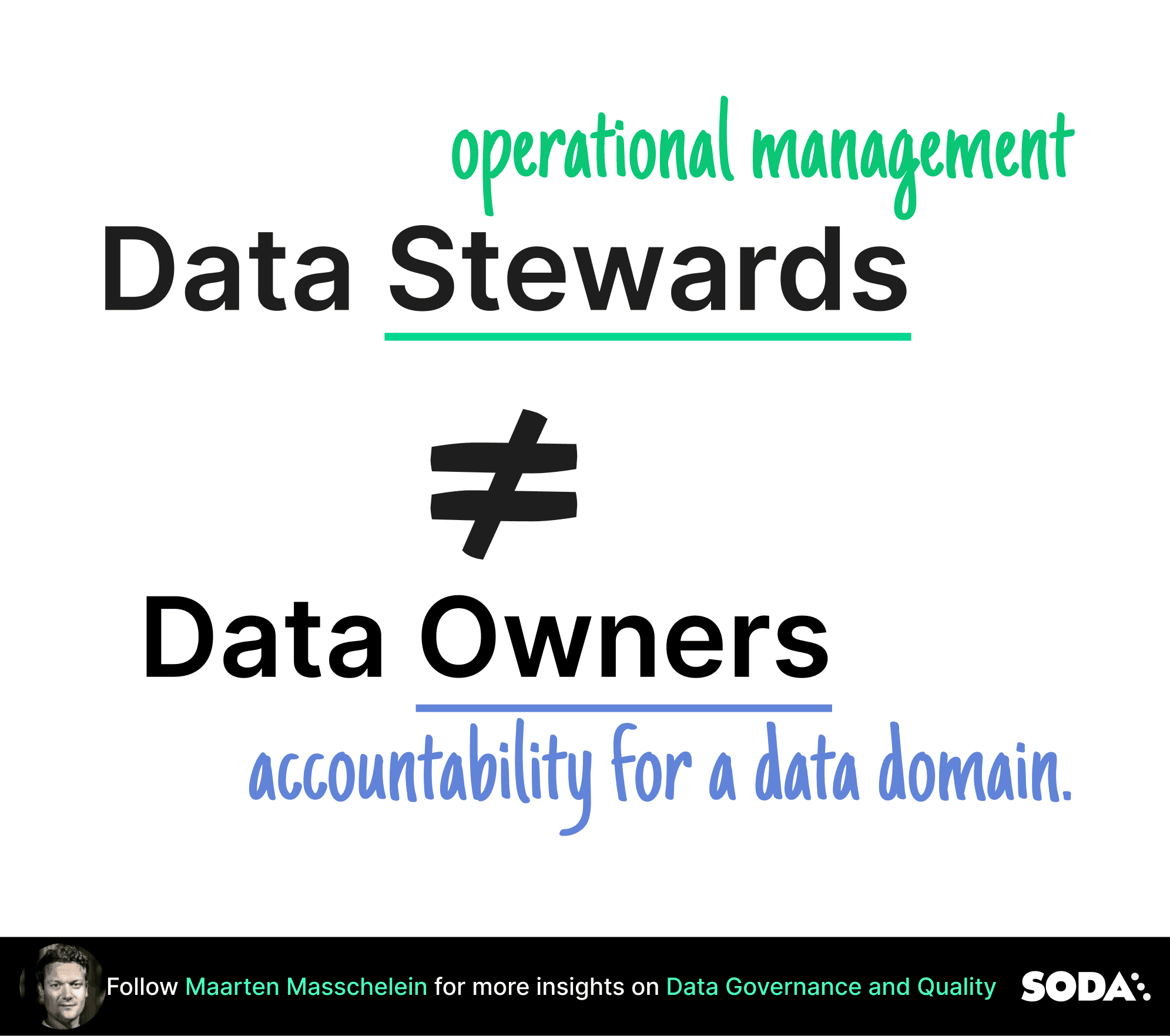
Data owner vs data steward is really a question of who decides versus who does. Here's the one-line version:
→ The data owner is accountable for a data domain and makes the decisions
→ The data steward is responsible for carrying those decisions out day to day.
Both roles sit inside a broader governance operating model, alongside the CDO, the governance council, and data custodians. For the full picture of how all of these fit together, see our guide on what data governance actually is.
This article focuses on: what a data owner does, what a data steward does, how they divide labor using RACI, where they sit relative to custodians and consumers, and the mistakes that show up when organizations get the split wrong.
Key Takeaways |
|---|
|
What Is a Data Owner?
A data owner is a senior, usually business-side leader who is accountable for a specific data domain such as customer, finance, or product data. They're the person whose name is on the line when that domain's data is wrong, misused, or mismanaged. DAMA's Data Management Body of Knowledge (DMBOK) frames the owner as exactly this: a business leader with approval authority over a data domain.
It helps to get specific about what "accountable for a domain" actually means in practice, because the title alone doesn't tell you much.
A data owner:
Sets policy and acceptable use. They decide who can access the domain's data and under what conditions, and what counts as appropriate use versus a violation.
Approves access requests. Not necessarily executes them, approves them. Someone else provisions the access; the owner signs off on whether it should happen.
Defines quality expectations and standards. What does "good" customer data look like? What's an acceptable error rate? The owner sets the bar.
Accepts risk. When a tradeoff has to be made (shipping a report with a known gap, or delaying it to fix the data), the owner is the one who makes that call and lives with the consequences.
Owns the business value of the data. They're answering whether the domain's data is actually useful to the business, not just technically present.
A Realistic Data Owner Job Spec
One detail that tends to get lost in the abstract version of this role: being a data owner is not a full-time job, and it's not a technical one. A reasonable estimate for the time commitment is a couple of hours a week, plus availability when an incident demands a decision.
The role explicitly does not include building dashboards, writing pipelines, maintaining the data catalog, or running the governance program day to day. Those are steward and engineering responsibilities. If your data owners are spending ten hours a week in SQL, the role has drifted into someone else's job.
Who typically holds this title: department heads, domain VPs, and business-line leaders, such as the Head of Finance for financial data or the VP of Marketing for customer and campaign data. In RACI terms, the data owner is Accountable, the "A." For more on why this accountability has to sit with the business rather than with IT or engineering, see our take on data ownership.
What Is a Data Steward?
A data steward is the hands-on custodian who executes governance for a domain on a daily basis. Where the owner decides, the steward does. In DMBOK terms, the steward is the role designated to operationally execute data management, keeping a domain's content and metadata consistent with the policies, standards, and business rules the owner sets.
Core responsibilities of a data steward include:
Enforcing the owner's policies: Translating "customer data should only be accessible to these three teams" into the actual access rules, monitoring, and exceptions process.
Monitoring and improving data quality: Tracking accuracy, completeness, and consistency for the domain, and chasing down the root cause when something looks off.
Maintaining metadata, definitions, and lineage: Keeping the catalog entries, business glossary terms, and lineage documentation for the domain current and trustworthy.
Triaging and resolving data issues: When a quality check fails or a consumer flags a problem, the steward is usually the first responder.
Bridging business and technical teams: Stewards sit between the people who understand what the data should mean and the engineers who build the systems that move it, translating in both directions.
Who typically holds this title: senior analysts, data managers, and domain experts who know the data intimately. Often, they're the people who were already the unofficial go-to for "wait, what does this field actually mean?" questions before the role had a name. In RACI terms, the data steward is Responsible, the "R."
For the longer version of this role, including the different types of stewards and how they specialize, see what is data stewardship. For a closer look at what the work looks like day to day, see a day in the life of a data steward.
Data Steward vs Data Owner: Key Differences
Dimension | Data Owner | Data Steward |
|---|---|---|
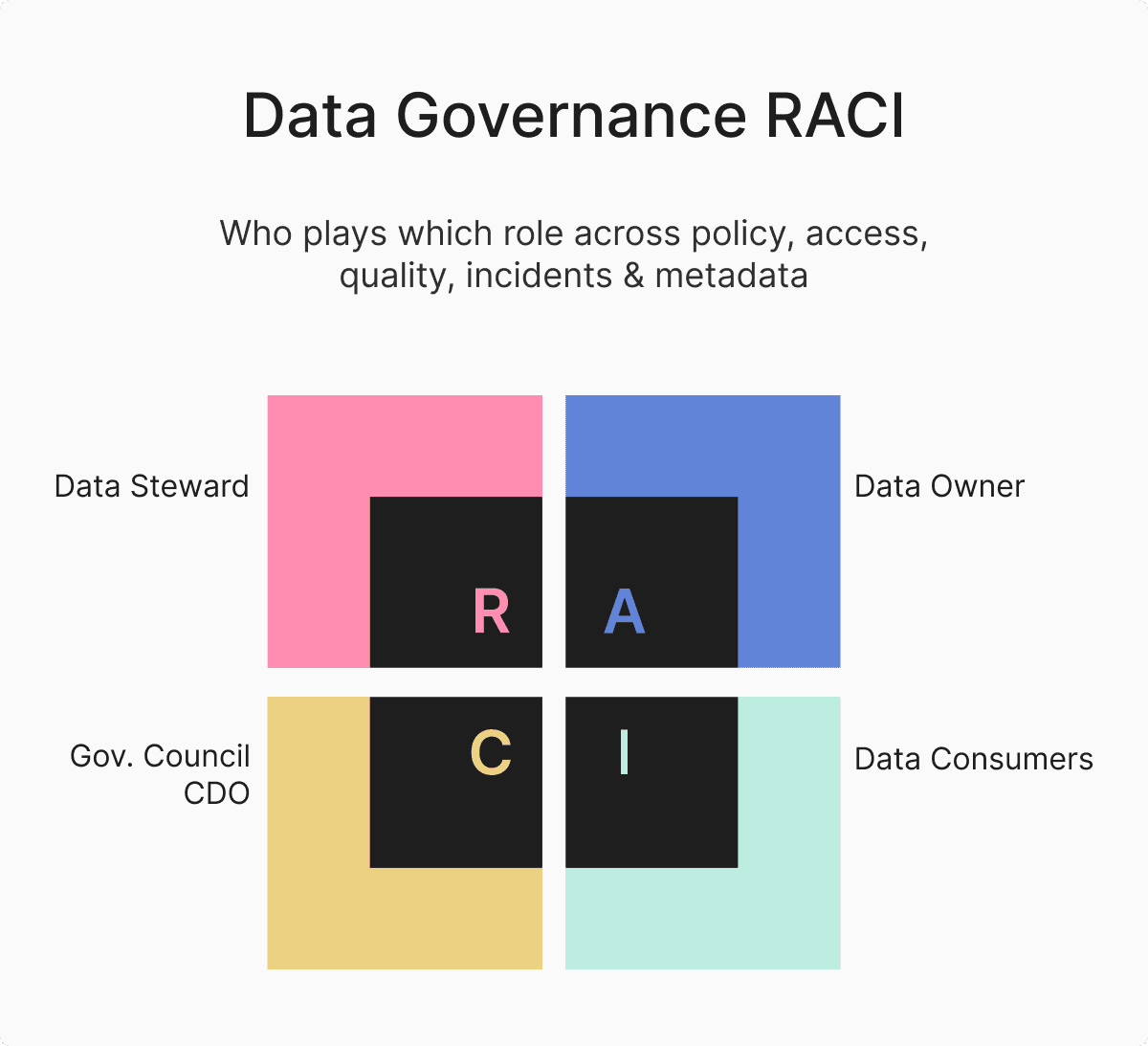
RACI letter | A (Accountable) | R (Responsible) |
Accountability | Answers when the domain's data is wrong | Executes governance day to day |
Focus | Strategic: policy, standards, risk, business value | Operational: monitoring, metadata, issue resolution |
Typical seniority | Senior business leader (department head, domain VP) | Senior analyst, data manager, or domain expert |
Scope of decisions | Sets policy, approves access, accepts risk | Enforces policy, triages and resolves issues |
Example tasks | Define the quality bar; sign off on access; own outcomes | Monitor quality; maintain definitions and lineage; resolve incidents |
Time commitment | ~A couple of hours a week, plus incident decisions | Ongoing, often a core part of the role |
The core distinction comes down to this:
the owner answers for whether the domain's data is trustworthy and used well, sets direction and owns the outcome.
the steward is the one making sure data actually is trustworthy and used well, every day, in the systems where the work happens; they do the work and report back.
Neither role works without the other; an owner with no steward has a policy nobody enforces, and a steward with no owner has no mandate to act on.
How Data Owners and Data Stewards Work Together (RACI)
The RACI Matrix is the clearest way to see the division of labor: the owner is Accountable, the steward is Responsible, the governance council or CDO is Consulted on decisions that cross domains or carry real risk, and data consumers are Informed once a decision is made or an issue is resolved.
Here's how that plays out in a concrete example — a data quality incident:
A nightly pipeline run for the customer domain fails a freshness check. The monitoring system flags it, and a steward picks it up. The steward investigates and traces the issue to an upstream schema change that broke a transformation step. They can fix the immediate pipeline issue themselves (it's within their remit), so they patch it and re-run the load.
But the steward also notices something bigger: the upstream team has been making schema changes without warning the data team, and this isn't the first time. That's a policy question, not a quality fix, so the steward escalates it to the data owner. The owner decides the response: requiring schema-change notifications going forward, or formalizing a data contract with the upstream producer. If the decision affects other domains or needs cross-functional buy-in, the owner consults the governance council before finalizing it. Once a decision is made, the steward implements it, and the consumers who depend on that customer data — the dashboards, the reports, the downstream models — are informed that the issue is resolved and what's changing.
That's the pattern: stewards act and escalate, owners decide, the council weighs in when the stakes are high enough, and consumers find out once it's settled.
The same flow applies to a new access request: a consumer asks for access to a sensitive field, the steward checks it against existing policy, and if it's a clean fit, they provision it. If it's not covered by the existing policy, it goes to the owner to decide.
Where These Roles Fit in the Governance Operating Model
Owners and stewards don't operate in isolation. They sit inside a structure with people above them and people beside them.
Above them, the CDO and the governance council set overall strategy, resolve escalations that cross multiple domains, and hold owners accountable for their domains. For the full operating model, including the council and CDO roles, see what data governance covers, and for a step-by-step build-out, our data governance framework guide.
Beside them, two other groups matter:
Data custodians, often in IT, platform, or engineering, provide the technical care of the systems and storage that hold the data. This is the distinction people get wrong most often: a steward holds business accountability for what the data means and whether it's good; a custodian is responsible for the technical infrastructure that stores and moves it. A steward might define what "valid email format" means for the customer domain; a custodian builds and maintains the system that enforces it at the database level.
Data consumers are everyone downstream who relies on the domain's data: analysts, other teams, leadership dashboards. They're Informed in the RACI model, not Consulted or Responsible, though in practice a good steward treats consumer feedback as an early warning system for quality problems.
How this scales depends on the governance model an organization runs:
Centralized: a small core team owns governance decisions across the whole organization. Works well for smaller companies, but creates a bottleneck as data volume and domain count grow.
Federated (also called data mesh): each domain has its own owner and steward, with a central council setting shared standards. Scales better but requires more coordination discipline.
Hybrid: central policy and tooling standards, with domain-level owners and stewards executing within that framework. This is where most mature programs land.
In smaller organizations, one person often holds both roles for a domain — a senior analyst who is both the de facto owner and steward. That's fine. What matters isn't a dedicated headcount for each title; it's that someone can say clearly who decides and who executes, even if it's the same person wearing two hats.
Common Pitfalls When Assigning Data Owners and Stewards
A handful of mistakes show up again and again when organizations assign these roles:
Treating the two as the same role. This is the root cause of most of the confusion this article is trying to clear up. When one person is asked to "own" data without distinguishing between deciding and doing, the strategic side usually gets dropped first, because the operational fires are louder.
Naming an owner with no real authority. An owner who can't actually approve access, accept risk, or enforce a policy against pushback isn't an owner. They're a title. If the role doesn't come with the authority to make the calls listed earlier, it won't function under pressure.
Assigning a steward with no time or tooling. Stewardship that's bolted onto someone's existing full-time job, with no dedicated hours and no monitoring tooling to do the work, tends to become reactive firefighting instead of proactive quality management.
Skipping the RACI exercise. Without an explicit RACI, "who decides this" gets answered differently every time an issue comes up, usually by whoever's loudest or most available that day.
Appointing too many owners for one domain. Shared accountability is, in practice, no accountability. If three people can each say "that's not really my call," the domain has no real owner.
Leaving the roles disconnected from the actual data systems. An owner's policy that lives in a slide deck and a steward's quality checks that live in someone's personal spreadsheet don't connect to anything. The roles only become real when they're wired into where the data actually lives.
How Soda Helps Owners and Stewards Collaborate
That last pitfall, roles disconnected from systems, is where tooling earns its keep. The owner/steward split only works as well as the infrastructure that supports it:
Ownership metadata that travels with the data. Every dataset in Soda can carry clear owner and steward assignments, so when something breaks, the question of who to notify isn't a guessing game.
Automated data quality monitoring stewards can actually act on. Instead of stewards manually spot-checking tables, Soda runs continuous checks and surfaces anomalies, so stewards spend their time resolving issues instead of hunting for them.
Alert routing to the right person. When a check fails, the alert goes to the steward responsible for that domain, not to a shared channel everyone learns to ignore.
Shared definitions and contracts that encode the owner's decisions. Once an owner sets a quality standard or access policy, it can be captured as a data contract that's enforced automatically, rather than relying on everyone remembering and following a document.
If you're trying to make the owner and steward split real in your own data estate rather than just on an org chart, see how Soda operationalizes data governance, or visit our dedicated page for data stewards.
Frequently Asked Questions
What is the difference between a data steward and a data owner?
A data owner is accountable for a data domain: they set policy, define quality expectations, and accept risk. A data steward is responsible for executing that policy day to day: enforcing access rules, monitoring quality, and resolving issues. In RACI terms, the owner is Accountable and the steward is Responsible.
Is a data steward the same as a data owner?
No. They're related but distinct roles. The owner is typically a senior business leader who makes strategic decisions about a data domain; the steward is a hands-on practitioner who carries out those decisions operationally. Treating them as interchangeable is one of the most common reasons governance programs stall.
Can one person be both a data owner and a data steward?
Yes, especially in smaller organizations or for lower-priority domains. What matters more than a dedicated headcount for each title is that the accountability is explicit: someone can clearly say who decides and who executes for a given domain, even if it's the same person.
What is the difference between a data owner, data steward, and data custodian?
The owner is accountable for the domain and makes policy decisions. The steward is responsible for day-to-day execution: quality, metadata, and issue resolution. The custodian, typically in IT or platform engineering, provides the technical infrastructure (storage, security, systems) that the owner's policies and the steward's standards run on.
Who should be a data owner?
Generally, a senior business-side leader with real authority over the domain, such as a department head, domain VP, or business-line leader, rather than someone in IT or a purely technical role. The owner needs the authority to approve access, accept risk, and enforce policy, which usually means business accountability rather than technical proximity to the data.
Does every dataset need both roles?
In a mature governance program, yes, every dataset should have a clear line back to an owner and a steward, even if that line runs through a domain-level assignment rather than a per-table one. Datasets without an assigned owner or steward are the ones most likely to drift into inconsistent definitions and unmonitored quality issues.