ETL vs ELT: Which Data Pipeline Approach Is Right for You?
ETL vs ELT: Which Data Pipeline Approach Is Right for You?
ETL vs ELT: Which Data Pipeline Approach Is Right for You?

Kavita Rana
Kavita Rana
Technical Writer at Soda
Technical Writer at Soda
Table of Contents
Almost every data team building a pipeline hits the same fork: ETL or ELT. The right answer has nothing to do with which one is newer; it comes down to your stack, your data, and your constraints.
The mechanics themselves are simple: ETL transforms your data before loading it into its destination, while ELT loads raw data first and transforms it inside the destination itself.
Cheap, elastic cloud compute from platforms like Snowflake, BigQuery, and Databricks has made ELT the modern default for a lot of teams, but ETL still wins in specific, well-defined situations.
Getting this wrong is expensive in a specific way: you rarely find out at deploy time. You find out months later, when the only fix is migrating where your transformations live.
In this guide, we’ll define both approaches, compare them side by side, weigh the tradeoffs, walk through a practical decision framework, and cover what it takes to keep either pipeline reliable once it’s live.
What Is ETL? (Extract, Transform, Load)
ETL is the original pipeline pattern: extract from source systems, transform in a separate staging layer, then load the cleaned result into its destination. The order matters. Nothing reaches the destination until it has been shaped, validated, and standardized.
It emerged when storage and compute were expensive and mostly on-premises. Teams couldn't afford to dump raw data into a warehouse and sort it out later, so they did the heavy lifting upfront, in dedicated tools like Talend or SSIS.
That history is still ETL's core strength. Because transformation happens before load, an ETL pipeline gives you a natural checkpoint to clean, mask, and structure data before it ever lands somewhere sensitive.
That is also the structural reason ETL persists in healthcare, banking, and insurance. Wherever a compliance sign-off gates what may reach a system, and in what form, the checkpoint has to sit before the load rather than after it.
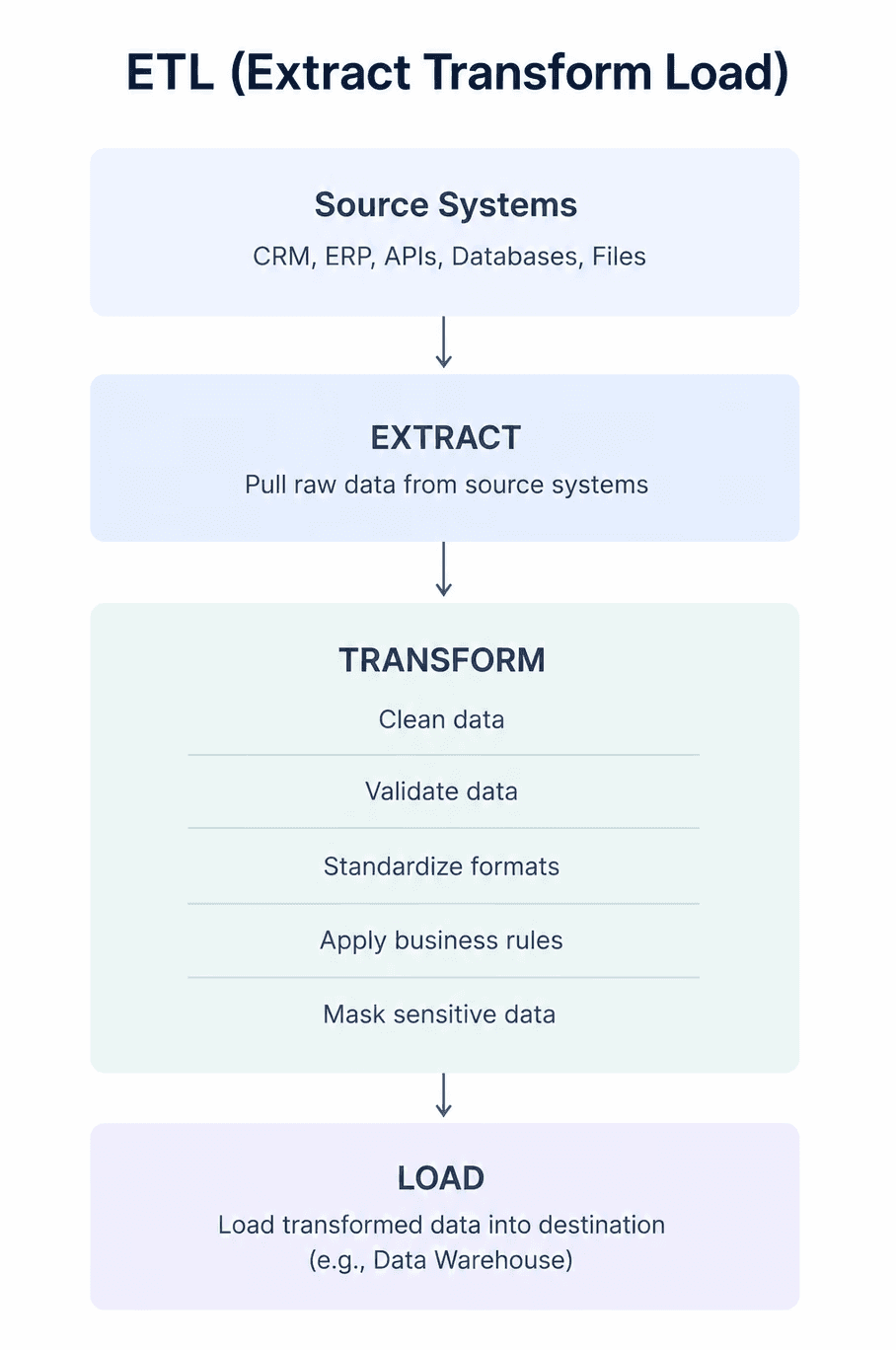
Pros and Cons of ETL
Pros:
Data is transformed before it lands, which makes it easier to mask sensitive fields and meet compliance requirements pre-load
Mature, well-established tooling with decades of enterprise use behind it
Handles complex, multi-step transformation logic well
Predictable, controlled load on the destination system
Cons:
Less flexible, since transformation logic has to be defined upfront
Requires a separate transformation engine to build, run, and maintain
Slower to adapt when business questions or reporting needs change
Can become a bottleneck as data volume and complexity grow
What Is ELT? (Extract, Load, Transform)
ELT flips the last two steps. You still extract from source systems, but you load the raw data straight into a cloud warehouse or lakehouse and transform it afterward, in place, using the destination's own compute, usually with SQL or dbt.
It rose alongside two shifts: cloud compute got cheap and elastic, and storage decoupled from compute. Once a warehouse could scale processing on demand, there was no longer a strong reason to transform data somewhere else first.
That is the core strength of an ELT pipeline: speed and flexibility. Raw data lands fast and can be retained in place, so analysts reshape it as business questions change without re-running the extraction. It also pairs naturally with modern analytics engineering, where tools like dbt turn transformation into version-controlled SQL that lives alongside the data, so changes to business logic become a pull request rather than a re-engineered pipeline.
That speed has a cost worth naming, though. Cheap compute made ELT the default, and compute has since stopped feeling cheap: in dbt Labs' 2026 State of Analytics Engineering report, 57% of teams reported rising warehouse and compute spend against 36% reporting budget increases (dbt Labs, 2026). ELT's advantage is real at load time; over a model's lifetime it depends on how often you reprocess, which is why teams lean on incremental models rather than re-running full history.

Pros and Cons of ELT
Pros:
Fast to load, since there’s no upfront transformation step blocking the pipeline
Raw data is preserved, so you can re-transform it anytime without re-extracting
Runs on elastic warehouse compute instead of a separate engine
Fits naturally with large or semi-structured datasets
Analyst-friendly, since most transformation happens in SQL or dbt
Cons:
Raw, potentially sensitive data arrives in the warehouse first, which raises governance and privacy questions
Transformation cost shifts into the warehouse and can grow as usage scales
Depends on strong in-warehouse testing and observability to catch issues
Can get messy fast without shared modeling standards across the team
ETL vs ELT: The Key Differences
ETL and ELT differ on one axis above all — whether data is transformed before it lands or after — and the dimensions below all follow from it.
The core distinction comes down to this:
ETL trades flexibility for an upfront safety net, doing the cleanup before data ever reaches its destination.
ELT gives that up for speed and scale, loading everything first and pushing the cleanup downstream.
For a modern cloud warehouse or lakehouse, ELT wins on speed, flexibility, and fit with SQL and dbt. ETL wins wherever a compliance gate has to sit before the load, and wherever reprocessing full history would make warehouse compute the dominant cost.
However, few teams sit cleanly at either pole; most land somewhere in between. Hybrid patterns, sometimes called ETLT, apply light transformations like masking before load and leave the heavier modeling for the warehouse. In practice, that is where most teams land: raw by default, pre-masking only the fields that legally cannot land.
Where the Failure Mode Moves
Here is the part most comparisons skip: choosing one pattern or the other doesn't remove your data quality problem. Both patterns move data; what changes is where a failure surfaces, and who finds it.
Say an upstream service renames customer_id to cust_id.
In an ETL pipeline, the transform expects that column. The job fails, the load is blocked, and the bad data goes nowhere. Someone gets called that night.
In an ELT pipeline, the load succeeds. Managed connectors typically add
cust_idand stop populatingcustomer_id, which still exists and goes null for new rows. Nothing errors, nobody is called, and aselect *model carries the null column into the revenue mart. Finance finds it three days later.
Same defect, two different failure modes. The question is not whether the data broke, but who finds out and when: ETL surfaces it at the pipeline, ELT at the consumer.
A not_null test on the modeled layer would have caught the ELT case. That is the distinction worth carrying into the decision: ETL's check is structural, enforced by the order of operations, while ELT's is discretionary, enforced only if someone wrote it. Neither pattern is unsafe. They differ in whether safety is automatic or deliberate.
ETL vs ELT: How to Choose
There’s no universal right answer here, each pattern optimizes for a different constraint. But there is a practical way to work through the decision. Run your situation through this checklist:
Destination architecture. Cloud warehouse or lakehouse, go ELT. On-premises or legacy source systems, go ETL.
Reprocessing volume. If the same transformation reprocesses full history on every run, or warehouse compute is a visible line item on your bill, the ELT cost argument inverts and the work belongs in a cheaper engine.
When two criteria conflict. Cloud warehouse plus data that cannot land raw is the common collision. Compliance wins.
Data types involved. Structured, well-defined data works with either approach. Large volumes of semi-structured or unstructured data go ELT.
Team skills. A team strong in SQL and dbt will get more value out of ELT. A team with deep experience in dedicated ETL tooling may be more productive sticking with ETL.
Latency, cost, and existing tooling. Factor in what you already have running, and what a switch would actually cost to build and maintain.
To make this concrete:
A fintech company ingests transaction data from three payment processors into Snowflake, with a strong dbt practice and a team of analytics engineers. Cardholder fields are already tokenized at the source, so sensitive data is handled before it ever loads, and that team should almost always go ELT. The warehouse can handle the compute, the raw data is valuable to preserve for audits, and dbt already owns the transformation layer.
Contrast that with a healthcare provider syncing patient records into an on-premises warehouse, where the team's chosen HIPAA control is to de-identify PHI before it reaches the analytics environment rather than secure it in place afterward. Given that control, that team needs ETL, regardless of what's trendier.
But wherever you land, the pattern is only half the decision. The other half is keeping the pipeline reliable once it's live.
Keeping ETL and ELT Pipelines Reliable
Whichever approach you choose, the pattern itself doesn’t guarantee reliable data. That comes from testing and observability layered on top.
Testing verifies the rules you already know to check — row counts, valid values, referential integrity.
Observability catches the problems you didn't think to look for — a volume drop, a freshness lag, a distribution that shifts after an upstream change.
Where those checks go differs by pattern according to where problems hide.
With ETL, a bad transformation usually blocks the load, which surfaces the issue at the pipeline level. The main checkpoint should then sit after transformation and before load, so a single gate catches most of it.
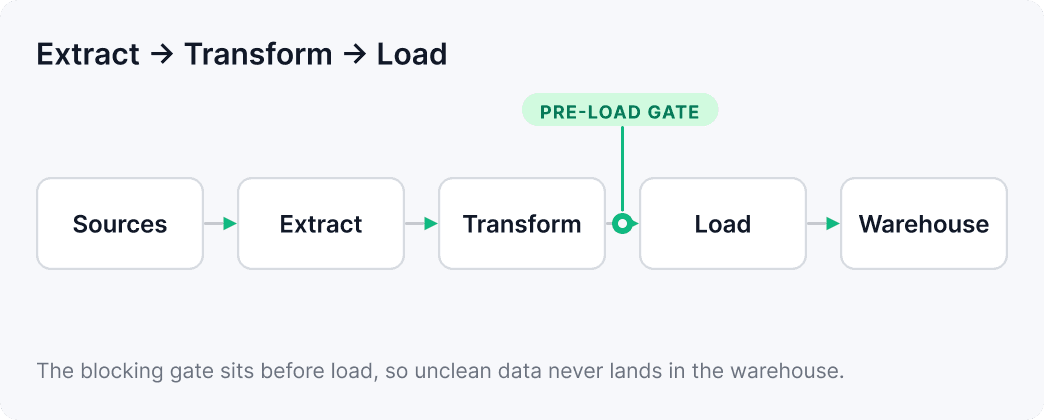
In ELT, bad data often loads successfully and only becomes visible when a downstream model produces wrong numbers. That’s a harder failure mode to catch without explicit checks. So you need at least two: one right after raw data lands, and one after transformation runs in the warehouse.
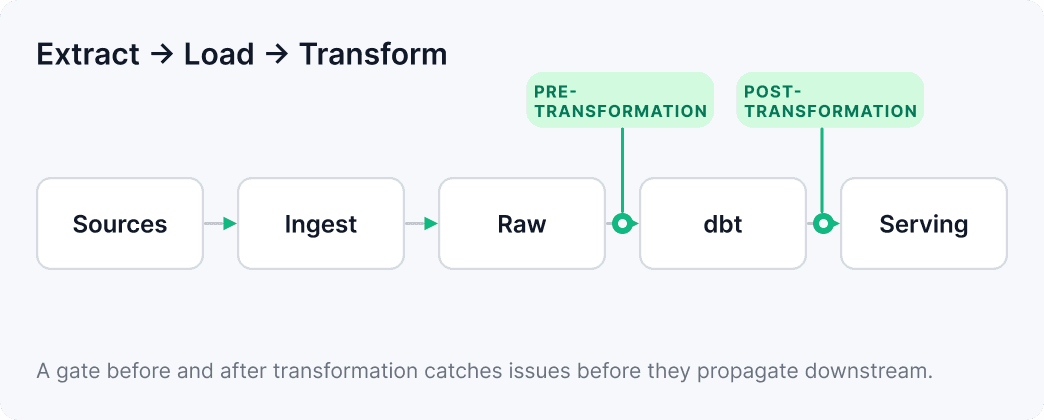
In any case, shifting quality checks left, closer to the source and to the point where data first lands, is what separates teams that trust their pipelines from those that find out about data problems from a business stakeholder.
How Soda Helps You Trust Your Pipelines
Soda runs data quality checks and observability across either pattern — validating data right after it lands in an ELT pipeline, or at the pre-load checkpoint that defines an ETL pipeline.
Data observability features monitor freshness, volume, and schema automatically. And data contracts enforce rules directly in your orchestration and CI/CD workflows, so issues get caught before they reach the people relying on the data.
If you’re weighing ETL against ELT, the pipeline pattern is only half the decision. The other half is making sure whichever one you choose stays reliable as it scales.
Book a demo if you want to see contract enforcement running against your own pipeline.
Frequently Asked Questions
Almost every data team building a pipeline hits the same fork: ETL or ELT. The right answer has nothing to do with which one is newer; it comes down to your stack, your data, and your constraints.
The mechanics themselves are simple: ETL transforms your data before loading it into its destination, while ELT loads raw data first and transforms it inside the destination itself.
Cheap, elastic cloud compute from platforms like Snowflake, BigQuery, and Databricks has made ELT the modern default for a lot of teams, but ETL still wins in specific, well-defined situations.
Getting this wrong is expensive in a specific way: you rarely find out at deploy time. You find out months later, when the only fix is migrating where your transformations live.
In this guide, we’ll define both approaches, compare them side by side, weigh the tradeoffs, walk through a practical decision framework, and cover what it takes to keep either pipeline reliable once it’s live.
What Is ETL? (Extract, Transform, Load)
ETL is the original pipeline pattern: extract from source systems, transform in a separate staging layer, then load the cleaned result into its destination. The order matters. Nothing reaches the destination until it has been shaped, validated, and standardized.
It emerged when storage and compute were expensive and mostly on-premises. Teams couldn't afford to dump raw data into a warehouse and sort it out later, so they did the heavy lifting upfront, in dedicated tools like Talend or SSIS.
That history is still ETL's core strength. Because transformation happens before load, an ETL pipeline gives you a natural checkpoint to clean, mask, and structure data before it ever lands somewhere sensitive.
That is also the structural reason ETL persists in healthcare, banking, and insurance. Wherever a compliance sign-off gates what may reach a system, and in what form, the checkpoint has to sit before the load rather than after it.
Pros and Cons of ETL
Pros:
Data is transformed before it lands, which makes it easier to mask sensitive fields and meet compliance requirements pre-load
Mature, well-established tooling with decades of enterprise use behind it
Handles complex, multi-step transformation logic well
Predictable, controlled load on the destination system
Cons:
Less flexible, since transformation logic has to be defined upfront
Requires a separate transformation engine to build, run, and maintain
Slower to adapt when business questions or reporting needs change
Can become a bottleneck as data volume and complexity grow
What Is ELT? (Extract, Load, Transform)
ELT flips the last two steps. You still extract from source systems, but you load the raw data straight into a cloud warehouse or lakehouse and transform it afterward, in place, using the destination's own compute, usually with SQL or dbt.
It rose alongside two shifts: cloud compute got cheap and elastic, and storage decoupled from compute. Once a warehouse could scale processing on demand, there was no longer a strong reason to transform data somewhere else first.
That is the core strength of an ELT pipeline: speed and flexibility. Raw data lands fast and can be retained in place, so analysts reshape it as business questions change without re-running the extraction. It also pairs naturally with modern analytics engineering, where tools like dbt turn transformation into version-controlled SQL that lives alongside the data, so changes to business logic become a pull request rather than a re-engineered pipeline.
That speed has a cost worth naming, though. Cheap compute made ELT the default, and compute has since stopped feeling cheap: in dbt Labs' 2026 State of Analytics Engineering report, 57% of teams reported rising warehouse and compute spend against 36% reporting budget increases (dbt Labs, 2026). ELT's advantage is real at load time; over a model's lifetime it depends on how often you reprocess, which is why teams lean on incremental models rather than re-running full history.
Pros and Cons of ELT
Pros:
Fast to load, since there’s no upfront transformation step blocking the pipeline
Raw data is preserved, so you can re-transform it anytime without re-extracting
Runs on elastic warehouse compute instead of a separate engine
Fits naturally with large or semi-structured datasets
Analyst-friendly, since most transformation happens in SQL or dbt
Cons:
Raw, potentially sensitive data arrives in the warehouse first, which raises governance and privacy questions
Transformation cost shifts into the warehouse and can grow as usage scales
Depends on strong in-warehouse testing and observability to catch issues
Can get messy fast without shared modeling standards across the team
ETL vs ELT: The Key Differences
ETL and ELT differ on one axis above all — whether data is transformed before it lands or after — and the dimensions below all follow from it.
The core distinction comes down to this:
ETL trades flexibility for an upfront safety net, doing the cleanup before data ever reaches its destination.
ELT gives that up for speed and scale, loading everything first and pushing the cleanup downstream.
For a modern cloud warehouse or lakehouse, ELT wins on speed, flexibility, and fit with SQL and dbt. ETL wins wherever a compliance gate has to sit before the load, and wherever reprocessing full history would make warehouse compute the dominant cost.
However, few teams sit cleanly at either pole; most land somewhere in between. Hybrid patterns, sometimes called ETLT, apply light transformations like masking before load and leave the heavier modeling for the warehouse. In practice, that is where most teams land: raw by default, pre-masking only the fields that legally cannot land.
Where the Failure Mode Moves
Here is the part most comparisons skip: choosing one pattern or the other doesn't remove your data quality problem. Both patterns move data; what changes is where a failure surfaces, and who finds it.
Say an upstream service renames customer_id to cust_id.
In an ETL pipeline, the transform expects that column. The job fails, the load is blocked, and the bad data goes nowhere. Someone gets called that night.
In an ELT pipeline, the load succeeds. Managed connectors typically add
cust_idand stop populatingcustomer_id, which still exists and goes null for new rows. Nothing errors, nobody is called, and aselect *model carries the null column into the revenue mart. Finance finds it three days later.
Same defect, two different failure modes. The question is not whether the data broke, but who finds out and when: ETL surfaces it at the pipeline, ELT at the consumer.
A not_null test on the modeled layer would have caught the ELT case. That is the distinction worth carrying into the decision: ETL's check is structural, enforced by the order of operations, while ELT's is discretionary, enforced only if someone wrote it. Neither pattern is unsafe. They differ in whether safety is automatic or deliberate.
ETL vs ELT: How to Choose
There’s no universal right answer here, each pattern optimizes for a different constraint. But there is a practical way to work through the decision. Run your situation through this checklist:
Destination architecture. Cloud warehouse or lakehouse, go ELT. On-premises or legacy source systems, go ETL.
Reprocessing volume. If the same transformation reprocesses full history on every run, or warehouse compute is a visible line item on your bill, the ELT cost argument inverts and the work belongs in a cheaper engine.
When two criteria conflict. Cloud warehouse plus data that cannot land raw is the common collision. Compliance wins.
Data types involved. Structured, well-defined data works with either approach. Large volumes of semi-structured or unstructured data go ELT.
Team skills. A team strong in SQL and dbt will get more value out of ELT. A team with deep experience in dedicated ETL tooling may be more productive sticking with ETL.
Latency, cost, and existing tooling. Factor in what you already have running, and what a switch would actually cost to build and maintain.
To make this concrete:
A fintech company ingests transaction data from three payment processors into Snowflake, with a strong dbt practice and a team of analytics engineers. Cardholder fields are already tokenized at the source, so sensitive data is handled before it ever loads, and that team should almost always go ELT. The warehouse can handle the compute, the raw data is valuable to preserve for audits, and dbt already owns the transformation layer.
Contrast that with a healthcare provider syncing patient records into an on-premises warehouse, where the team's chosen HIPAA control is to de-identify PHI before it reaches the analytics environment rather than secure it in place afterward. Given that control, that team needs ETL, regardless of what's trendier.
But wherever you land, the pattern is only half the decision. The other half is keeping the pipeline reliable once it's live.
Keeping ETL and ELT Pipelines Reliable
Whichever approach you choose, the pattern itself doesn’t guarantee reliable data. That comes from testing and observability layered on top.
Testing verifies the rules you already know to check — row counts, valid values, referential integrity.
Observability catches the problems you didn't think to look for — a volume drop, a freshness lag, a distribution that shifts after an upstream change.
Where those checks go differs by pattern according to where problems hide.
With ETL, a bad transformation usually blocks the load, which surfaces the issue at the pipeline level. The main checkpoint should then sit after transformation and before load, so a single gate catches most of it.
In ELT, bad data often loads successfully and only becomes visible when a downstream model produces wrong numbers. That’s a harder failure mode to catch without explicit checks. So you need at least two: one right after raw data lands, and one after transformation runs in the warehouse.
In any case, shifting quality checks left, closer to the source and to the point where data first lands, is what separates teams that trust their pipelines from those that find out about data problems from a business stakeholder.
How Soda Helps You Trust Your Pipelines
Soda runs data quality checks and observability across either pattern — validating data right after it lands in an ELT pipeline, or at the pre-load checkpoint that defines an ETL pipeline.
Data observability features monitor freshness, volume, and schema automatically. And data contracts enforce rules directly in your orchestration and CI/CD workflows, so issues get caught before they reach the people relying on the data.
If you’re weighing ETL against ELT, the pipeline pattern is only half the decision. The other half is making sure whichever one you choose stays reliable as it scales.
Book a demo if you want to see contract enforcement running against your own pipeline.
Frequently Asked Questions
What is the main difference between ETL and ELT?
ETL transforms data before loading it into its destination. ELT loads raw data first and transforms it afterward, inside the destination itself.
What is an example of ETL vs ELT?
A classic ETL example: a bank masks and validates customer records in a dedicated staging engine, then loads only the cleaned, compliant result into its warehouse. A classic ELT example: a team loads raw event data straight into Snowflake, then transforms it with dbt, building cleaned models on top of raw tables that stay available for re-modeling later.
Is ELT replacing ETL?
ELT has become the default for teams on modern cloud warehouses, mainly because compute got cheap enough to make in-warehouse transformation practical. But ETL hasn’t disappeared. It’s still the better fit when data needs to be masked or structured before it lands, such as in many regulated environments.
Can you use ETL and ELT together?
Yes. Hybrid approaches, sometimes called ETLT, apply light transformations like masking before load, then handle the heavier modeling work afterward in the warehouse.
Does ELT work with a data lakehouse?
Yes. ELT fits naturally with a lakehouse architecture, since lakehouses are built to store raw, large-scale, and semi-structured data and apply transformation later, on demand.
What is the difference between ELT and reverse ETL?
ELT moves data from source systems into a warehouse for analysis. Reverse ETL does the opposite: it pushes transformed data back into operational tools like CRMs or marketing platforms. The two are complementary. ELT gets your data into shape; reverse ETL puts it to work where business teams actually operate.
How does ELT handle schema changes?
Not gracefully, without the right guardrails. Because raw data lands first and transformation happens downstream, an upstream change like a renamed column or dropped field often loads cleanly and only breaks the dbt models or queries that depend on it. You won't always know until something looks wrong in a report. Schema monitoring and data observability are what catch these before they reach end users.
Trusted by the world’s leading enterprises
Real stories from companies using Soda to keep their data reliable, accurate, and ready for action.
At the end of the day, we don’t want to be in there managing the checks, updating the checks, adding the checks. We just want to go and observe what’s happening, and that’s what Soda is enabling right now.

Sid Srivastava
Director of Data Governance, Quality and MLOps
Investing in data quality is key for cross-functional teams to make accurate, complete decisions with fewer risks and greater returns, using initiatives such as product thinking, data governance, and self-service platforms.

Mario Konschake
Director of Product-Data Platform
Soda has integrated seamlessly into our technology stack and given us the confidence to find, analyze, implement, and resolve data issues through a simple self-serve capability.

Sutaraj Dutta
Data Engineering Manager
Our goal was to deliver high-quality datasets in near real-time, ensuring dashboards reflect live data as it flows in. But beyond solving technical challenges, we wanted to spark a cultural shift - empowering the entire organization to make decisions grounded in accurate, timely data.

Gu Xie
Head of Data Engineering
4.4 of 5
Your data has problems.
Now they fix themselves.
Automated data quality, remediation, and management.
One platform, agents that do the work, you approve.
Trusted by








Trusted by the world’s leading enterprises
Real stories from companies using Soda to keep their data reliable, accurate, and ready for action.
At the end of the day, we don’t want to be in there managing the checks, updating the checks, adding the checks. We just want to go and observe what’s happening, and that’s what Soda is enabling right now.
Sid Srivastava
Director of Data Governance, Quality and MLOps
Investing in data quality is key for cross-functional teams to make accurate, complete decisions with fewer risks and greater returns, using initiatives such as product thinking, data governance, and self-service platforms.
Mario Konschake
Director of Product-Data Platform
Soda has integrated seamlessly into our technology stack and given us the confidence to find, analyze, implement, and resolve data issues through a simple self-serve capability.
Sutaraj Dutta
Data Engineering Manager
Our goal was to deliver high-quality datasets in near real-time, ensuring dashboards reflect live data as it flows in. But beyond solving technical challenges, we wanted to spark a cultural shift - empowering the entire organization to make decisions grounded in accurate, timely data.
Gu Xie
Head of Data Engineering
4.4 of 5
Your data has problems.
Now they fix themselves.
Automated data quality, remediation, and management.
One platform, agents that do the work, you approve.
Trusted by
Solutions
Trusted by the world’s leading enterprises
Real stories from companies using Soda to keep their data reliable, accurate, and ready for action.
At the end of the day, we don’t want to be in there managing the checks, updating the checks, adding the checks. We just want to go and observe what’s happening, and that’s what Soda is enabling right now.
Sid Srivastava
Director of Data Governance, Quality and MLOps
Investing in data quality is key for cross-functional teams to make accurate, complete decisions with fewer risks and greater returns, using initiatives such as product thinking, data governance, and self-service platforms.
Mario Konschake
Director of Product-Data Platform
Soda has integrated seamlessly into our technology stack and given us the confidence to find, analyze, implement, and resolve data issues through a simple self-serve capability.
Sutaraj Dutta
Data Engineering Manager
Our goal was to deliver high-quality datasets in near real-time, ensuring dashboards reflect live data as it flows in. But beyond solving technical challenges, we wanted to spark a cultural shift - empowering the entire organization to make decisions grounded in accurate, timely data.
Gu Xie
Head of Data Engineering
4.4 of 5
Your data has problems.
Now they fix themselves.
Automated data quality, remediation, and management.
One platform, agents that do the work, you approve.
Trusted by
Solutions