Data Stewardship in the Agentic Era: How Stewards Use Soda AI
Data Stewardship in the Agentic Era: How Stewards Use Soda AI
Data Stewardship in the Agentic Era: How Stewards Use Soda AI

Fabiana Ferraz
Fabiana Ferraz
Rédacteur technique chez Soda
Rédacteur technique chez Soda
Table des matières
The agentic AI era has fundamentally raised the stakes of data stewardship. When an AI agent relies on your domain to automate workflows or drive business decisions, a single unflagged anomaly doesn't just ruin a report; it can trigger cascading errors across automated workflows in seconds.
Suddenly, you are being asked to govern at a scale and velocity that manual cleanup can no longer match. But while the rise of AI creates unprecedented governance challenges, it also provides the exact leverage you need to survive it: the ability to hand off the repetitive "janitor work" to AI agents while elevating your own role to human-in-the-loop strategic governance.
Here is how modern data stewards use Soda AI to take the operational weight off your shoulders, without giving up ownership, accountability, or control over what the agents do.
The Double Shift: AI as Both Consumer and Co-Worker
As organizations deploy autonomous workflows, AI agents are consuming your data directly at machine speed, acting on whatever data you provide.
For instance, a single upstream schema change (like renaming customer_id to client_id) can instantly break the automated features feeding a real-time fraud detection or credit-scoring model.
At the same time, AI has become a co-worker: it can now do the stewardship work itself — drafting, profiling, matching, routing — at a volume no team could clear by hand.
That double shift changes what the steward's job is. While less of your day can be spent on manual, routine cleanup, far more depends on your strategic judgment being right.
The Trap: When Stewardship Turns Into Janitor Work
As data volume grows, so do the challenges of managing it effectively. Scarce specialized expertise, heavy manual workloads, and organizational or cultural resistance can drag down data governance maturity across most companies.
What we see is that too much of the stewardship work has turned into janitor work such as fixing a date format, filling a missing value, resolving the same address inconsistency for the fourth time this month, or chasing down why two dashboards disagree on the same KPI.
It's laborious, and it doesn't scale.
But cleaning up after the fact was never the point of data stewardship. The objective is to generate business value by operationalizing data standards and policies, and upholding data quality.
The Goal: AI-Augmented Stewardship
AI agents are only as effective as the data and instructions they're given. Human input remains essential for defining standard operating procedures, organizational context, and governance guardrails.
An agent doesn't know which of your datasets the business actually runs on, which definitions were argued over in committee, or which anomalies are deliberate. That context is yours, and supplying it is what separates governance from generic automation.
So the goal is augmentation, not automation: agents absorb the volume, you make the call on what gets enforced.
Scaling Control at Machine Speed with Soda
That division of labor only holds up with tooling built around human-in-the-loop workflows rather than black-box automation.
With Soda AI, the agents work from metadata by default (not your raw rows), and any failed-record detail stays in your own warehouse. You approve patterns by confidence, not one row at a time.
Here's how that works across four pillars:
Onboarding & Triage: Natural Language Domain Navigation
This is where a steward starts: working out what's actually in the domain and what state it's in.
Through the chat interface or the MCP connection, you can ask Soda about coverage, ownership, and data health in natural language. You can also have it update contracts, monitors, and dataset attributes — always scoped to the permissions you already have, always shown before it's applied.
In the walkthrough below, Soda AI surfaced a Postgres source with 52 datasets and reported how many checks each one had and how many were passing or failing. From that read, you flag the 13 that carry the business logic as the ones worth onboarding first.
Getting this picture by hand used to take days. Here it takes minutes:
For a deep-dive on the day-to-day triage-and-remediation loop, see a day in the life of a data steward.
Testing: Executable Data Contracts
Once you know which datasets matter, testing is where you write down what "good" means for them: explicit expectations the data has to meet on every scan. Here's what you can do in Soda:
Turn what consumers need into checks in a data contract: one machine-readable file that states what "good" looks like for a dataset and enforces it on every scan.
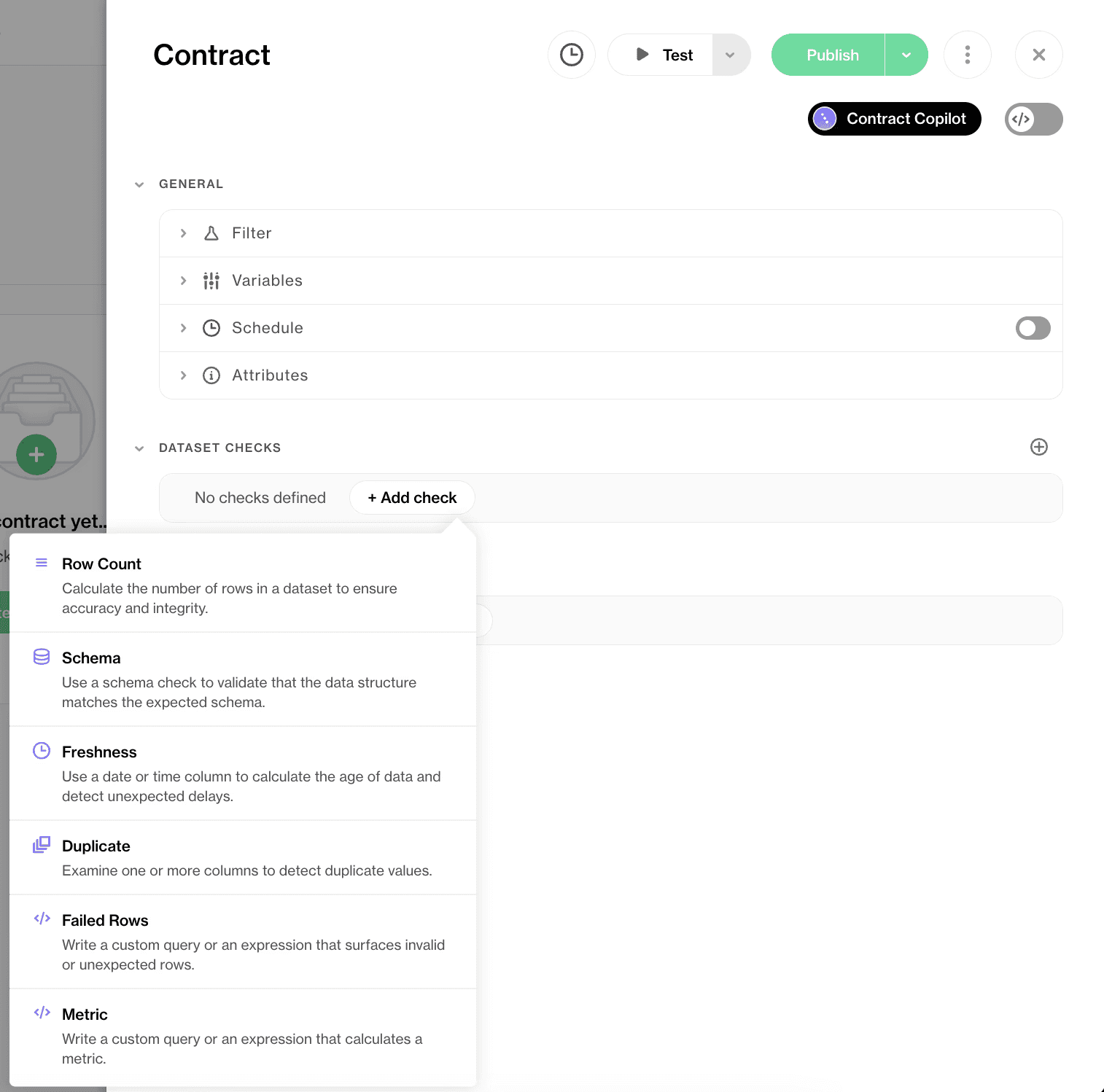
Instead of hand-writing checks dataset by dataset, to get quick, broad coverage, Contract Autopilot establishes an immediate baseline of the current state of your data, and drafts a fully populated data contract from the dataset's own profile. Autopilot works from metadata by default. If you ever want it to check actual sample rows, that's an explicit opt-in. See it in action below:
To edit and iterate on the contract, Contract Copilot lets you add rules in plain English, no SQL or syntax to learn. Copilot writes checks into the contract and shows you exactly what it wrote, so the person who knows the data stays in charge. See it below:
You can watch a full demo on how to implement Soda contracts in production in three ways, via CLI, Soda Cloud, or MCP: How to Implement Data Contracts in Production at Scale.
Observability: ML-Based Anomaly Detection
Contracts catch the problems you knew to specify. Observability catches the ones you didn't.
Soda Metric Monitors watch your datasets' behavior over time to flag anomalies that fixed rules would miss. By leveraging metadata such as row counts, schema evolution, and insert activity, you can get large-scale observability with minimal setup.
The ML-based dynamic thresholds instantly analyze historical metadata and metric trends with smart defaults but they can also be fine-tuned. Teams can improve detection by providing feedback and adjusting sensitivity, exclusion values and thresholds so that alerts remain focused and useful.
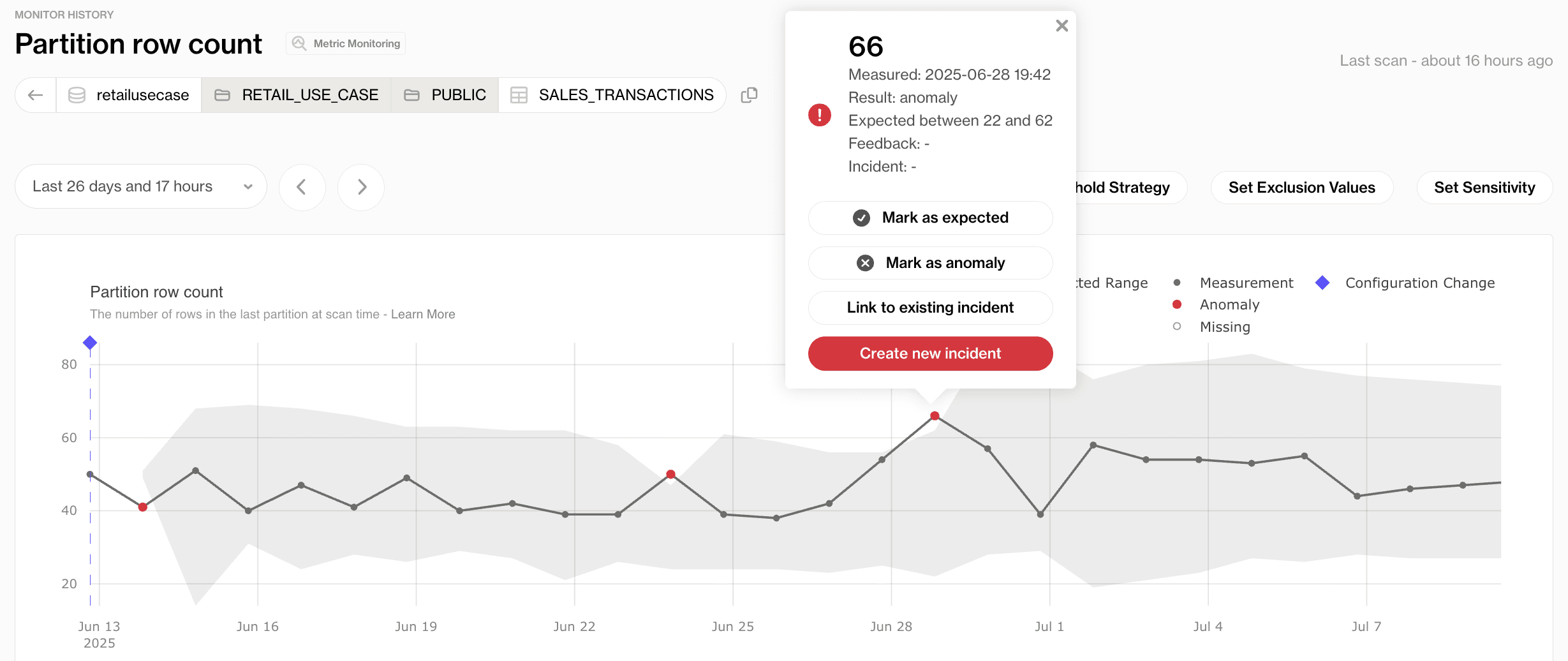
Soda’s proprietary anomaly detection algorithm is specifically designed for data quality monitoring and has demonstrated a 70% improvement in anomaly detection accuracy compared to Facebook Prophet.
For the hands-on tuning, setting threshold strategy, exclusion values, and sensitivity dataset by dataset, see a day in the life of a data steward.
Fixing: Agentic Cleansing
Detection only matters if something changes. Agentic data cleansing closes the loop, letting you trace an issue to its root cause with full context from your contracts, anomalies, and historical runs.
When checks from contracts or monitors fail, Soda Cleanse’s specialized AI agents analyze the failed records, identify the failure pattern, and generate targeted fix recommendations. They propose the specific record-level corrections, with the failing-row evidence kept in your own warehouse. Nothing is written back to the source until you say so.
See the Soda Cleanse Inbox below:
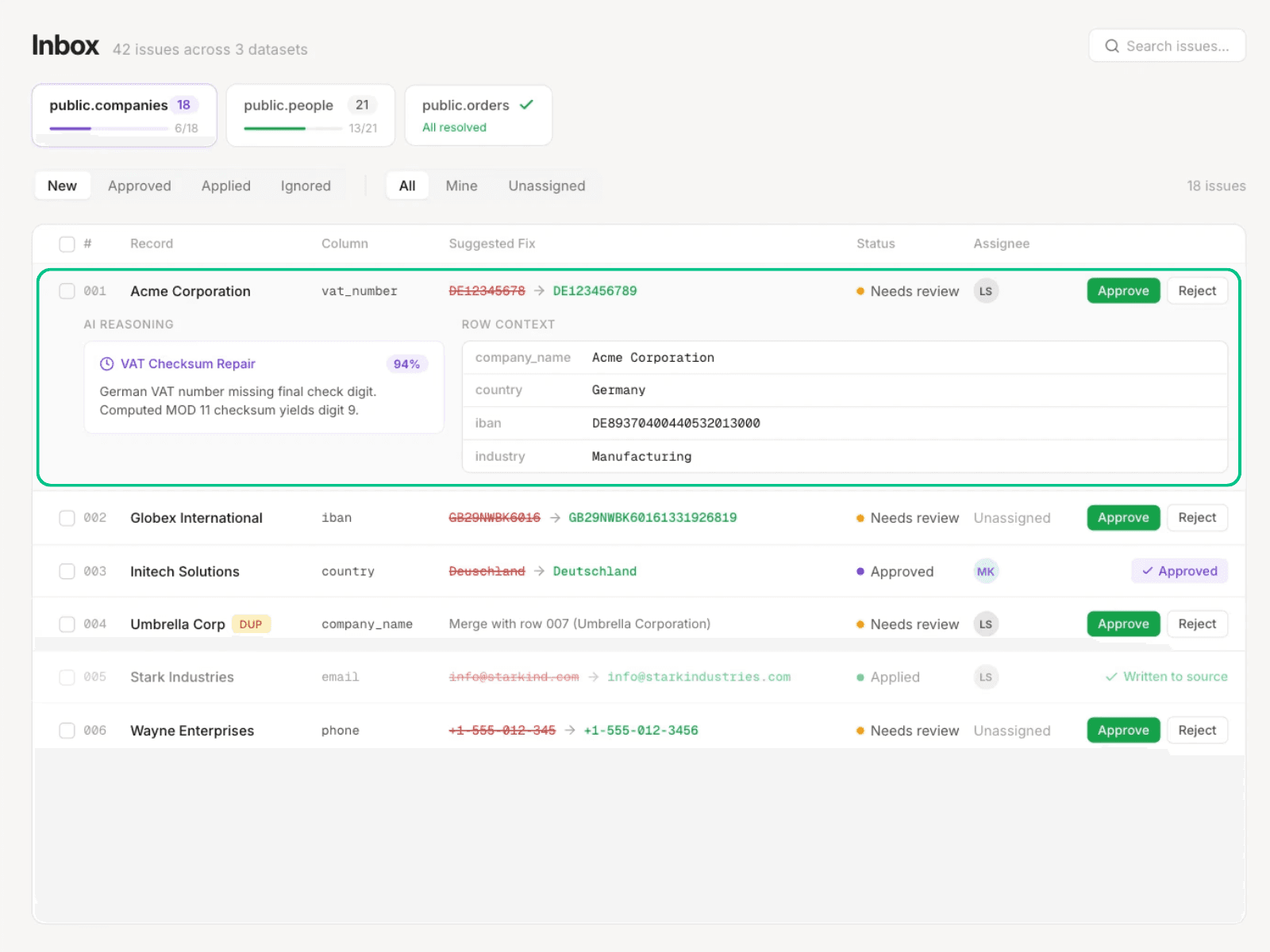
That scales because you approve patterns, not rows. Cleanse sorts the failures by type and confidence and allows you to bulk-approve the high-confidence corrections in a single pass, while the uncertain cases go to individual review.
Fixes can be routed to a staging table rather than straight to source until you trust the results, and every approve or reject trains the agents, so the queue that needs your eyes keeps shrinking.
You can watch a full product walkthrough here: Closing the Data Quality Loop with AI Agents.
The New Operational Reality: Human-in-the-Loop
Most teams don't have a governance gap on paper; they have a practice gap: the policy exists but rarely shows up where data actually gets created and used.
The change isn't a new tool to learn. It's a shorter path between a question about your domain and an answer you can act on. This is where governance stops being a document and starts shaping decisions.
The through-line is control. You still decide what "good" means and what gets enforced. Soda AI does the drafting, the reading, and the routing, then hands each decision back for a yes or no.
How far should you trust an agent?
Across every task, the split holds: the AI proposes and, once you approve, carries out the change, but it is never accountable.
What grows as it earns your trust isn't the agent's authority; it's how fast you review. Coverage goes up while the volume that needs your eyes goes down.
The objective is to be able to spend your judgment on the calls that matter, instead of re-approving the same safe one a hundred times.
And some actions never leave the human gate:
contract-breaking changes
metadata or contract changes on regulated or sensitive datasets
irreversible merges and deletions
anything with legal exposure
That, together with scoped permissions and a full audit trail, is what keeps the agent useful without ever handing it the wheel.
For a steward who has to defend every certified dataset in an audit, the combination of propose-then-approve, scoped permissions, and no raw data leaving your environment is what makes it safe to adopt where the data actually matters.
Wrap up
Stewardship has always been the connective tissue between strategy and execution that makes governance policy actually execute in the real world. Without stewards, definitions drift, metrics diverge across dashboards, lineage breaks, and trust erodes.
What's new is leverage. AI finally gives stewardship the room to scale, turning janitor work into actual governance work: read where your data stands, close the gaps with contracts, name the owners, and approve every change.
You keep the control you always had. What changes is the reach to prove it across your domain, in plain language, instead of one ticket at a time.
You don't need a program to begin. Pick one domain, name its business and technical owner, and run agents in propose-only mode: every draft comes to you for approval. Track how often their proposals hold up, and let that track record decide how much you lean on them, one dataset at a time.
Book a demo with our team if you have any other questions.
Frequently Asked Questions
The agentic AI era has fundamentally raised the stakes of data stewardship. When an AI agent relies on your domain to automate workflows or drive business decisions, a single unflagged anomaly doesn't just ruin a report; it can trigger cascading errors across automated workflows in seconds.
Suddenly, you are being asked to govern at a scale and velocity that manual cleanup can no longer match. But while the rise of AI creates unprecedented governance challenges, it also provides the exact leverage you need to survive it: the ability to hand off the repetitive "janitor work" to AI agents while elevating your own role to human-in-the-loop strategic governance.
Here is how modern data stewards use Soda AI to take the operational weight off your shoulders, without giving up ownership, accountability, or control over what the agents do.
The Double Shift: AI as Both Consumer and Co-Worker
As organizations deploy autonomous workflows, AI agents are consuming your data directly at machine speed, acting on whatever data you provide.
For instance, a single upstream schema change (like renaming customer_id to client_id) can instantly break the automated features feeding a real-time fraud detection or credit-scoring model.
At the same time, AI has become a co-worker: it can now do the stewardship work itself — drafting, profiling, matching, routing — at a volume no team could clear by hand.
That double shift changes what the steward's job is. While less of your day can be spent on manual, routine cleanup, far more depends on your strategic judgment being right.
The Trap: When Stewardship Turns Into Janitor Work
As data volume grows, so do the challenges of managing it effectively. Scarce specialized expertise, heavy manual workloads, and organizational or cultural resistance can drag down data governance maturity across most companies.
What we see is that too much of the stewardship work has turned into janitor work such as fixing a date format, filling a missing value, resolving the same address inconsistency for the fourth time this month, or chasing down why two dashboards disagree on the same KPI.
It's laborious, and it doesn't scale.
But cleaning up after the fact was never the point of data stewardship. The objective is to generate business value by operationalizing data standards and policies, and upholding data quality.
The Goal: AI-Augmented Stewardship
AI agents are only as effective as the data and instructions they're given. Human input remains essential for defining standard operating procedures, organizational context, and governance guardrails.
An agent doesn't know which of your datasets the business actually runs on, which definitions were argued over in committee, or which anomalies are deliberate. That context is yours, and supplying it is what separates governance from generic automation.
So the goal is augmentation, not automation: agents absorb the volume, you make the call on what gets enforced.
Scaling Control at Machine Speed with Soda
That division of labor only holds up with tooling built around human-in-the-loop workflows rather than black-box automation.
With Soda AI, the agents work from metadata by default (not your raw rows), and any failed-record detail stays in your own warehouse. You approve patterns by confidence, not one row at a time.
Here's how that works across four pillars:
Onboarding & Triage: Natural Language Domain Navigation
This is where a steward starts: working out what's actually in the domain and what state it's in.
Through the chat interface or the MCP connection, you can ask Soda about coverage, ownership, and data health in natural language. You can also have it update contracts, monitors, and dataset attributes — always scoped to the permissions you already have, always shown before it's applied.
In the walkthrough below, Soda AI surfaced a Postgres source with 52 datasets and reported how many checks each one had and how many were passing or failing. From that read, you flag the 13 that carry the business logic as the ones worth onboarding first.
Getting this picture by hand used to take days. Here it takes minutes:
For a deep-dive on the day-to-day triage-and-remediation loop, see a day in the life of a data steward.
Testing: Executable Data Contracts
Once you know which datasets matter, testing is where you write down what "good" means for them: explicit expectations the data has to meet on every scan. Here's what you can do in Soda:
Turn what consumers need into checks in a data contract: one machine-readable file that states what "good" looks like for a dataset and enforces it on every scan.
Instead of hand-writing checks dataset by dataset, to get quick, broad coverage, Contract Autopilot establishes an immediate baseline of the current state of your data, and drafts a fully populated data contract from the dataset's own profile. Autopilot works from metadata by default. If you ever want it to check actual sample rows, that's an explicit opt-in. See it in action below:
To edit and iterate on the contract, Contract Copilot lets you add rules in plain English, no SQL or syntax to learn. Copilot writes checks into the contract and shows you exactly what it wrote, so the person who knows the data stays in charge. See it below:
You can watch a full demo on how to implement Soda contracts in production in three ways, via CLI, Soda Cloud, or MCP: How to Implement Data Contracts in Production at Scale.
Observability: ML-Based Anomaly Detection
Contracts catch the problems you knew to specify. Observability catches the ones you didn't.
Soda Metric Monitors watch your datasets' behavior over time to flag anomalies that fixed rules would miss. By leveraging metadata such as row counts, schema evolution, and insert activity, you can get large-scale observability with minimal setup.
The ML-based dynamic thresholds instantly analyze historical metadata and metric trends with smart defaults but they can also be fine-tuned. Teams can improve detection by providing feedback and adjusting sensitivity, exclusion values and thresholds so that alerts remain focused and useful.
Soda’s proprietary anomaly detection algorithm is specifically designed for data quality monitoring and has demonstrated a 70% improvement in anomaly detection accuracy compared to Facebook Prophet.
For the hands-on tuning, setting threshold strategy, exclusion values, and sensitivity dataset by dataset, see a day in the life of a data steward.
Fixing: Agentic Cleansing
Detection only matters if something changes. Agentic data cleansing closes the loop, letting you trace an issue to its root cause with full context from your contracts, anomalies, and historical runs.
When checks from contracts or monitors fail, Soda Cleanse’s specialized AI agents analyze the failed records, identify the failure pattern, and generate targeted fix recommendations. They propose the specific record-level corrections, with the failing-row evidence kept in your own warehouse. Nothing is written back to the source until you say so.
See the Soda Cleanse Inbox below:
That scales because you approve patterns, not rows. Cleanse sorts the failures by type and confidence and allows you to bulk-approve the high-confidence corrections in a single pass, while the uncertain cases go to individual review.
Fixes can be routed to a staging table rather than straight to source until you trust the results, and every approve or reject trains the agents, so the queue that needs your eyes keeps shrinking.
You can watch a full product walkthrough here: Closing the Data Quality Loop with AI Agents.
The New Operational Reality: Human-in-the-Loop
Most teams don't have a governance gap on paper; they have a practice gap: the policy exists but rarely shows up where data actually gets created and used.
The change isn't a new tool to learn. It's a shorter path between a question about your domain and an answer you can act on. This is where governance stops being a document and starts shaping decisions.
The through-line is control. You still decide what "good" means and what gets enforced. Soda AI does the drafting, the reading, and the routing, then hands each decision back for a yes or no.
How far should you trust an agent?
Across every task, the split holds: the AI proposes and, once you approve, carries out the change, but it is never accountable.
What grows as it earns your trust isn't the agent's authority; it's how fast you review. Coverage goes up while the volume that needs your eyes goes down.
The objective is to be able to spend your judgment on the calls that matter, instead of re-approving the same safe one a hundred times.
And some actions never leave the human gate:
contract-breaking changes
metadata or contract changes on regulated or sensitive datasets
irreversible merges and deletions
anything with legal exposure
That, together with scoped permissions and a full audit trail, is what keeps the agent useful without ever handing it the wheel.
For a steward who has to defend every certified dataset in an audit, the combination of propose-then-approve, scoped permissions, and no raw data leaving your environment is what makes it safe to adopt where the data actually matters.
Wrap up
Stewardship has always been the connective tissue between strategy and execution that makes governance policy actually execute in the real world. Without stewards, definitions drift, metrics diverge across dashboards, lineage breaks, and trust erodes.
What's new is leverage. AI finally gives stewardship the room to scale, turning janitor work into actual governance work: read where your data stands, close the gaps with contracts, name the owners, and approve every change.
You keep the control you always had. What changes is the reach to prove it across your domain, in plain language, instead of one ticket at a time.
You don't need a program to begin. Pick one domain, name its business and technical owner, and run agents in propose-only mode: every draft comes to you for approval. Track how often their proposals hold up, and let that track record decide how much you lean on them, one dataset at a time.
Book a demo with our team if you have any other questions.
Frequently Asked Questions
Does AI replace data stewards?
No. It automates the manual parts, drafting contracts, reading coverage, and routing issues, but keeps you accountable for what gets enforced. Soda AI proposes actions and waits for approval, so you stay the decision-maker, not the middleman.
What's the difference between a data owner and a data steward?
The owner is accountable; the steward is responsible. The owner is usually a senior business person with the authority and budget to approve changes and sign off on risk. The steward is the domain expert closest to the data who defines the rules and certifies datasets day to day (DAMA DMBOK).
How fast can I get coverage across my domain?
Contract Autopilot drafts contracts from your own data, so coverage starts as a working draft rather than a multi-quarter project. Autopilot is currently available on request for Soda Cloud, so the practical first step is switching it on for the datasets with the widest gaps.
Does Soda AI read our raw data or PII?
It works from schema, metadata, and your contracts. Your raw data isn't sent to the model by default, and any row sampling is opt-in. Failed-record detail stays in your own environment through the Diagnostics Warehouse.
Trusted by the world’s leading enterprises
Real stories from companies using Soda to keep their data reliable, accurate, and ready for action.
At the end of the day, we don’t want to be in there managing the checks, updating the checks, adding the checks. We just want to go and observe what’s happening, and that’s what Soda is enabling right now.

Sid Srivastava
Director of Data Governance, Quality and MLOps
Investing in data quality is key for cross-functional teams to make accurate, complete decisions with fewer risks and greater returns, using initiatives such as product thinking, data governance, and self-service platforms.

Mario Konschake
Director of Product-Data Platform
Soda has integrated seamlessly into our technology stack and given us the confidence to find, analyze, implement, and resolve data issues through a simple self-serve capability.

Sutaraj Dutta
Data Engineering Manager
Our goal was to deliver high-quality datasets in near real-time, ensuring dashboards reflect live data as it flows in. But beyond solving technical challenges, we wanted to spark a cultural shift - empowering the entire organization to make decisions grounded in accurate, timely data.

Gu Xie
Head of Data Engineering
4,4 sur 5
Commencez à faire confiance à vos données. Aujourd'hui.
Trouvez, comprenez et corrigez tout problème de qualité des données en quelques secondes.
Du niveau de la table au niveau des enregistrements.
Adopté par
Product








Trusted by the world’s leading enterprises
Real stories from companies using Soda to keep their data reliable, accurate, and ready for action.
At the end of the day, we don’t want to be in there managing the checks, updating the checks, adding the checks. We just want to go and observe what’s happening, and that’s what Soda is enabling right now.
Sid Srivastava
Director of Data Governance, Quality and MLOps
Investing in data quality is key for cross-functional teams to make accurate, complete decisions with fewer risks and greater returns, using initiatives such as product thinking, data governance, and self-service platforms.
Mario Konschake
Director of Product-Data Platform
Soda has integrated seamlessly into our technology stack and given us the confidence to find, analyze, implement, and resolve data issues through a simple self-serve capability.
Sutaraj Dutta
Data Engineering Manager
Our goal was to deliver high-quality datasets in near real-time, ensuring dashboards reflect live data as it flows in. But beyond solving technical challenges, we wanted to spark a cultural shift - empowering the entire organization to make decisions grounded in accurate, timely data.
Gu Xie
Head of Data Engineering
4,4 sur 5
Commencez à faire confiance à vos données. Aujourd'hui.
Trouvez, comprenez et corrigez tout problème de qualité des données en quelques secondes.
Du niveau de la table au niveau des enregistrements.
Adopté par
Product
Solutions
Trusted by the world’s leading enterprises
Real stories from companies using Soda to keep their data reliable, accurate, and ready for action.
At the end of the day, we don’t want to be in there managing the checks, updating the checks, adding the checks. We just want to go and observe what’s happening, and that’s what Soda is enabling right now.
Sid Srivastava
Director of Data Governance, Quality and MLOps
Investing in data quality is key for cross-functional teams to make accurate, complete decisions with fewer risks and greater returns, using initiatives such as product thinking, data governance, and self-service platforms.
Mario Konschake
Director of Product-Data Platform
Soda has integrated seamlessly into our technology stack and given us the confidence to find, analyze, implement, and resolve data issues through a simple self-serve capability.
Sutaraj Dutta
Data Engineering Manager
Our goal was to deliver high-quality datasets in near real-time, ensuring dashboards reflect live data as it flows in. But beyond solving technical challenges, we wanted to spark a cultural shift - empowering the entire organization to make decisions grounded in accurate, timely data.
Gu Xie
Head of Data Engineering
4,4 sur 5
Commencez à faire confiance à vos données. Aujourd'hui.
Trouvez, comprenez et corrigez tout problème de qualité des données en quelques secondes.
Du niveau de la table au niveau des enregistrements.
Adopté par
Product
Solutions
Company